‘Many believe this is nothing to talk about’: KKK ‘costumes’ spotted in El Paso cause outrage
Lawmakers, community leaders, and historians react as footage of an unidentified group in El Paso wearing Ku Klux Klan regalia

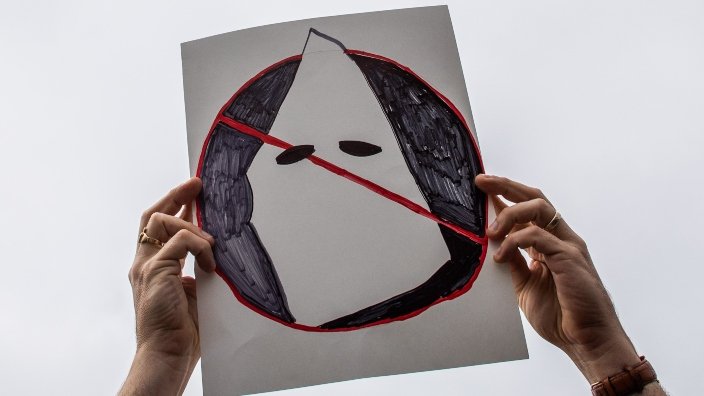

Lawmakers, community leaders, and historians react as footage of an unidentified group in El Paso wearing Ku Klux Klan regalia goes viral.
Deep, long Negro spiritual sigh.
Apparently, in 2026, we need to state plainly and make it clear that dressing up as members of the Ku Klux Klan is, well, about as acceptable as donning blackface.
On Monday, Oct. 26, the El Paso branch of the NAACP held a press conference condemning footage that began circulating over the weekend of a group dressed in KKK regalia in El Paso, Texas.
“Many believe this is nothing to even talk about,” El Paso NAACP President Carl B. Dwyer Jr. began during the press conference, per KFox14 News.
“Many believe that it’s just a joke. That it’s a party costume. That’s negative. Can’t be nothing more further from the truth,” he continued, with his voice full of emotion. “It hurts. It hurts fighting for freedom. Still to this day, in 2026, we have people that think it’s okay to don white sheets, white robes, and white hats that are emblematic of the most racist time and period of this country. It is not a joke, and it is not funny, and is not to be taken lightly.”
In the footage, roughly six unidentified individuals, believed to be teenagers or young men, can be seen walking around outdoors at night wearing pointed white hoods and matching robes bearing KKK insignia. There are also reports of them shouting racial slurs. They just had to be in full character, didn’t they? Who they are and what exactly they were doing remains unclear.
Before Monday’s press conference, Congresswoman Veronica Escobar also condemned the footage in a statement.
“The reports of teenagers wearing Ku Klux Klan regalia and allegedly shouting racial slurs in our community are deeply disturbing and unacceptable,” Escobar began, adding, “The KKK represents a shameful history of white supremacy, racial terror, and violence against Black Americans and other communities of color. Treating that history as a costume is not a joke.”
As lawmakers and community leaders continue responding to the incident, the footage is also raising larger questions and concerns about how such blatant displays of racism continue to find their way into everyday life, especially as efforts to squash DEI initiatives and restrict how American history is taught persist throughout the country and social media continues to give ignorance an increasingly public platform.
For Dr. Dwonna Goldstone, an associate professor of history and director of the African American Studies program at Texas State University, the images were both shocking and deeply saddening.
“I think the one that probably comes to mind for any person of color is fear,” Goldstone told theGrio over the phone on Monday, adding how that the imagery sends a message of intimidation and exclusion.
“You know, it’s the idea that you don’t belong here, and we’re going to intimidate you to get you out of this space where we’ve decided you don’t belong,” she continued. “To let Black and brown people know ‘This land is not yours. This is ours, and we need to remind you of where your place is in this order.’”
The professor was also left wondering how much the young people in the footage actually know about the history behind what they’re wearing, especially as efforts to limit what students learn about race and racism continue. However, she suspects they clearly know enough to recognize the Klan’s infamous uniform.
“They know the Klan, right? Like they know they know enough to get the costume,” she noted, before adding, “They know what they’re doing. It’s deliberate. I also wonder how much people know, though. You know, as we water down what we’re allowed to teach, I also just think there’s a whole generation of people who are not really learning what it has meant historically to be Black in this country, and what it means to be Black today. And I think as more and more books get pulled from the shelves, it makes it more difficult for these kids to actually know what it has meant, to know the history of the Klan, and know what its purpose was.”
The KKK first emerged following the Civil War in the mid 1860s, using violence and intimidation to terrorize newly freed Black Americans and undermine Reconstruction. The organization later experienced a resurgence in 1915, following “The Birth of a Nation,” with their white robes and pointed hoods becoming enduring symbols of white supremacy.
In Texas, the Klan’s influence was widespread during the 1920s. According to the Texas State Historical Association, membership reached as many as 150,000 by the end of 1922, with members gaining considerable political power while terrorizing Black communities and other marginalized groups. The organization even backed candidates in El Paso’s 1923 municipal elections, though they ultimately lost.
“Historically, what it has meant is white supremacy; whiteness is at the top. ‘Everyone else is below me. Know your place. Sit in the back of the bus. You don’t belong in this neighborhood,’” Goldstone explained. “I mean, really, it’s just a message: You do not belong here.”
However, as disturbing as the footage is, Goldstone wasn’t entirely surprised. While she’s aware these attitudes haven’t died out and even younger generations romanticizing or making fun of them isn’t wholly new, social media has made them increasingly visible. She’s also concerned about what younger generations are learning, or rather, what they aren’t learning, about America’s racial history.
“As long as we keep this kind of history out of the schools, we’re going to see more and more of this until we start telling a more balanced history of the United States,” she said. “I think people just aren’t going to know. They just don’t have the context for what it all means.”
Continuing to push for American history to be taught in a more balanced way, in a way that fully acknowledges the experiences of Black, Brown, and Indigenous communities rather than continuing to leave generations with an incomplete understanding of the country’s past, is one way the educator sees reversing course. Goldstone also noted that many individuals in America rarely engage meaningfully with others who are truly different from them—we’re talking about different ethnicities, socioeconomic status, beliefs and values, religion, and beyond—and that doing so can increase empathy and genuine understanding of the diverse world around us.
When it comes to the specific group in El Paso, she can’t help but wonder what was going through their minds in the footage and exactly what they found so funny.
“I would love to ask those kids, what were you thinking?” she said. “Do you think racism is funny?”
Share
What's Your Reaction?
 Like
0
 Dislike
0
 Love
0
 Funny
0
 Angry
0
 Sad
0
 Wow
0