Who is Abdul El-Sayed? Michigan’s Democratic Senate nominee makes his case to Black voters
After an upset primary win, the progressive Democrat is pitching shared economic interests, racial equity and investment in Black communities

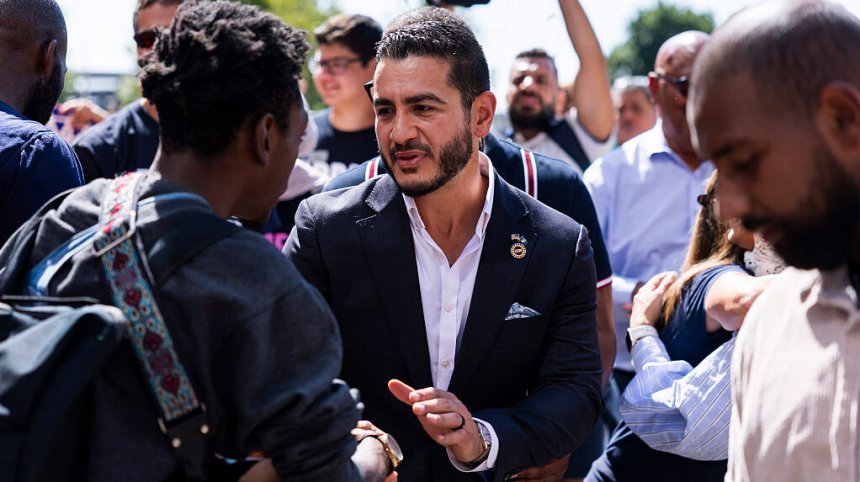

After an upset primary win, the progressive Democrat is pitching shared economic interests, racial equity and investment in Black communities ahead of November.
Progressive candidate Abdul El-Sayed caused an upset in Tuesday’s U.S. Senate Democratic primary in Michigan, defeating veteran U.S. Rep. Haley Stevens, who was backed by the party’s top leaders. Now, El-Sayed is staring down an expensive and contentious general election contest against the Republican nominee, U.S. Congressman Mike Rogers.
But to win on Nov. 3 and potentially help Democrats gain a majority in the U.S. Senate next year, El-Sayed will need to improve his support among Black voters. Based on election results, most Black Michiganders appeared to back Stevens. The congresswoman outperformed El-Sayed in several majority-Black counties, including Detroit’s Wayne County, Oakland County, and Macomb County.
So who exactly is Abdul El-Sayed, and what is his pitch to Black voters in Michigan?
Who is Abdul El-Sayed?
Abdul El-Sayed is a 41-year-old scientist born to Egyptian immigrants in Rochester Hills, Michigan, a Detroit suburb. Prior to his victory in Tuesday’s primary, the Democrat served as the director of the Department of Health, Human, and Veterans Services of Wayne County, Michigan, from 2023 to 2025. He was also a candidate in the 2018 Michigan gubernatorial election.
While he has often been associated with the Democratic Socialists of America, El-Sayed is not a Democratic socialist. He instead identifies as a progressive.
“I’m too much of a scientist to be an ideologue,” the epidemiologist told “The Clay Cane Show” on SiriusXM.
However, some of El-Sayed’s political positions have aligned with Democratic socialist candidates who have found success in races in New York, Pennsylvania, and Colorado. Among those positions is Israel’s military strikes in Gaza, which have killed more than 73,000 Palestinians. El-Sayed backed the 2024 uncommitted movement in Michigan against President Joe Biden’s then-re-election campaign; however, after Biden dropped out of the presidential race, El-Sayed ultimately supported the presidential campaign of former U.S. Vice President Kamala Harris.
El-Sayed compared the moral opposition to Israel to the anti-apartheid movement that captured Black Americans in the 1980s.
“They decided that they were going to pressure the system…they said, ‘Enough is enough.’ We are not going to allow our tax dollars, we’re not going to allow our government to backstop the systematic discrimination of a people because of the color of their skin,” the U.S. Senate candidate told Cane. “I think if you look at the Biden administration’s rule when it came to backstopping genocide in Gaza, there’s no question that standing with uncommitted to make the argument that that was not going to be acceptable was the right argument.”
He added, “And then when he dropped out of the race, and Vice President Harris became the nominee, I also think it was the right thing to back her.”
Abdul El-Sayed supports similar policies, backed by national progressives like U.S. Senator Bernie Sanders and U.S. Congresswoman Alexandria Ocasio-Cortez, such as getting corporate money out of politics, raising taxes on wealthy Americans, and using the resulting revenue to fund social services for the working class, including universal child care and education, and Medicare for all.
What is El-Sayed’s pitch to Black voters?

Abdul El-Sayed knows he has work to do to gain the support of more Black voters. Thankfully for him, his opponent, Rep. Stevens, quickly rallied behind him after conceding the hard-fought primary contest. But will it translate to her supporters casting their ballots for El-Sayed in November?
“My commitment to our Black communities didn’t start because I wanted to come and take a photo op. It started when I left my tenure-track job at an Ivy League school to come back to rebuild the health department in the city of Detroit, which is the largest majority-Black city in the country,” El-Sayed told political influencer George Lee, Jr., also known as The Conscious Lee.
El-Sayed has leaned into his Egyptian heritage, arguing that he has a dual consciousness rooted in his African and Muslim backgrounds. He told Clay Clane, “My Arab heritage is real, as is my African heritage. And what I’m hoping to do is to be able to heal divides by bringing folks together under one tent that is about trying to build out policy that benefits all of us.”
The Democrat told The Conscious Lee that much of his political awareness has been shaped by the contributions of Black abolitionists, civil rights and thought leaders, including Malcolm X, Dr. Martin Luther King Jr., James Baldwin, Frederick Douglass, and Sojourner Truth.
“My dad doesn’t get to move from Egypt, but for the incredible contributions of the civil rights movement in passing the Immigration Act of 1965,” he told Cane. “I learned what it meant to be a person of color reading about Black folks and the civil rights struggle, and I understand that my responsibility is about trying to address racial inequities.”
As an epidemiologist, El-Sayed argued that his professional work has been about addressing racial inequities in health, explaining, “Whether it’s the maternal infant mortality crisis, it’s protecting kids from asthma, taking on polluters, putting glasses on kids’ faces, eliminating medical debt.”
El-Sayed is also calling for greater investment in Black communities across Michigan, especially in the greater Detroit metro area. Acknowledging the “mistrust” among Black voters, he told Cane, “I think a lot of the mistrust among Black folk in Metro Detroit is well-founded, based on a kind of double standard that too often business owners, particularly in the Arab and, yes, Muslim communities have had when it comes to the way they do business in local communities.”
He continued, “You see money go in and then money leaves these communities rather than be reinvested in the community. It’s a conversation I’ve been having with the Arab and Muslim community for a very long time. We can’t sit here and talk about racism against Arabs and Muslims unless we’re willing to actually look inward and ask how is it that we’re engaging with the Black community in a way that is responsible?”
As he looks toward November’s general election, El-Sayed appears ready to make his pitch to Black voters that there are common threats to their economic prosperity in his Republican opponent, Mike Rogers, the Trump administration, the Republican Party, and the wealthy class.
“I hope that this campaign, as we take it forward, to take on Mike Rogers and all the corporatism that he represents, the kind of corruption, the Trump era policies that are about going after anybody who’s a person of color at all, we can come together around this and say that proximity, that shared fight, is something that can bring us together, help us to heal divides,” said El-Sayed.
He added, “But I also know that right now we owe a profound responsibility to Black communities.”
Share
What's Your Reaction?
 Like
0
Like
0
 Dislike
0
Dislike
0
 Love
0
Love
0
 Funny
0
Funny
0
 Angry
0
Angry
0
 Sad
0
Sad
0
 Wow
0
Wow
0