The Vote Is Our Voice. The Money Is the Microphone.
How Black voters can make history by investing in Black candidates like Keisha Lance Bottoms. Rick Jackson put more than

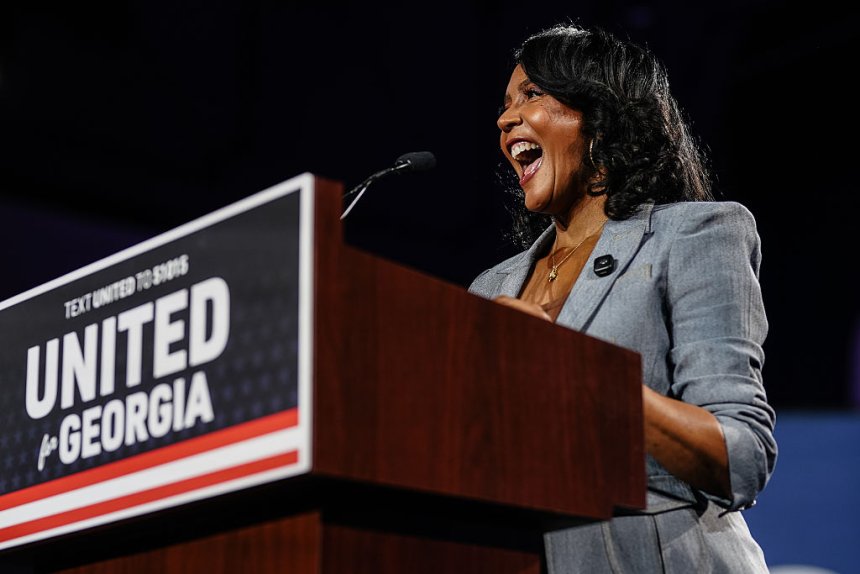

How Black voters can make history by investing in Black candidates like Keisha Lance Bottoms.
Rick Jackson put more than $111 million of his own money into his campaign for Georgia governor and had spent more than $108 million by early July. More than $83 million of that spending went to television and cable ads. That is the microphone, itemized. Bottoms spent about $2.6 million to win her party’s nomination, so he outspent her by more than forty to one. He has said, including in an ad, that he’ll spend whatever it takes to win, and the AJC reports analysts now expect him to spend roughly $200 million of his own fortune. That isn’t a scandal. It’s the system working exactly as designed.
In the most recent state campaign finance reports, which covered activity through July 31 and were filed in August, Jackson’s campaign accounts, including his leadership committee, had raised roughly $130 million, much of it from his own bank account. Bottoms had raised about $10 million across hers. The next round of filings is due this month, and those numbers will have moved. The Democratic Governors Association has pledged at least $10 million to help her, and the Republican Governors Association gave Jackson $10 million of its own. Bottoms told ABC News her opponent has put in over $100 million of his own money, and the race is still tied. The latest AJC poll, released October 20, has him at 46 and her at 45, within the margin of error.
Sit with that. In a state organizers call the cradle of the civil rights movement, a billionaire can try to purchase the governor’s office, and the law shrugs. Meanwhile the woman who could become the first Black woman elected governor in American history is asking ordinary people for whatever they can give. That should make you angry. It makes me angry. But it should not surprise us.
None of this is a discovery. Anybody who ever passed a collection plate for a cause already knows it. We love to talk about the vote, and we should, because the vote is our voice. But money is the microphone. It pays for the staff, the ads, the mailers, the rides to the polls, and the phone calls to the grandmother who hasn’t voted in years. Bottoms put it well: he has the money, but the people still have the power. I believe that. But power that isn’t organized stays potential, and in this country we organize it with dollars.
That is capitalism standing in the front yard of democracy. We teach kids that one person gets one vote, and then we run the campaign on one dollar, one megaphone. Attention is a market. Airtime is priced, and so are mailers and field organizers. The courts blessed this a long time ago. In Buckley v. Valeo in 1976, the Supreme Court struck down limits on candidates’ personal campaign spending, reasoning that the government couldn’t restrict it just to equalize candidates’ resources. In Davis v. FEC in 2008, the Court barred, by a 5 to 4 vote, a mechanism designed to let opponents of wealthy candidates raise contributions above the otherwise applicable limits. A self financed candidate can spend unlimited personal funds, and the Court wouldn’t even let his opponent’s donors give a little more to catch up. That is how the system was built.
Now put Black America inside that machine. According to the Federal Reserve’s 2022 Survey of Consumer Finances, the typical white family held about six times the wealth of the typical Black family, and donor networks are built from wealth. An analysis by Rutgers’ Center for American Women and Politics, which estimates donors’ race and gender from itemized contribution data, found that Black women accounted for about 1 percent of the money contributed to 2024 congressional candidates. And in 2020, OpenSecrets found that Black women running as Democratic challengers or for open seats in competitive races received significantly less money from large individual donors than any other group of candidates. Nobody’s talent explains that. The wealth gap and old donor habits do.
And still, Black women show up. They powered Bottoms to an outright primary win in May, the way they have powered this party and this country on credit nobody has ever fully repaid. If Bottoms wins in November, she becomes the first Black woman elected governor in American history, the first Black governor of Georgia, and the first Democrat to win that office since 1998. She told ABC the milestone is much more personal to her, because her family goes back at least five generations in Georgia and she descends from enslaved people on both sides. That is a long road to a front door, and we should not let her walk the last mile outspent.
I know what ordinary people can do with money. In 2022, a story about my debate coach and me went viral, and nearly 30,000 people gave to the Brooklyn Debate League, pushing the total past $1.3 million. Before that, our founder had been spending his own savings to keep it running. The idea was never the shortage. The shortage was always the money to carry it. I also spend my days in a hospital, where I’ve seen what happens to families when coverage and care are a coin flip. Her campaign says her plans include expanding Medicaid, protecting Georgia’s hospitals, guaranteeing prekindergarten and raising teacher pay. A governor’s decisions land in neonatal units, classrooms and kitchens, and they land hardest on people who never had the money to lobby for them.
That is why I’m asking you to stop thinking of a campaign donation as charity or moral support. Think of it as an investment with a return you can see: staff, door knocks, texts, ads and turnout. It isn’t symbolic, either. In figures it announced in February, the Bottoms campaign said it received more than 16,000 donations since July, with 93 percent of contributions under $100. A billionaire writes one check. We can write ten thousand.
Here is the uncomfortable part. In the final stretch, JB Pritzker put $1 million toward her bid, and Michael Bloomberg is steering at least $1 million of his $80 million late push for Democrats to her campaign, the AJC reported. I’m glad they did. But look at what it says. Even our rescue comes from billionaires, because we haven’t built a donor class of our own at scale. Every five dollars we give builds one. It’s ownership of the thing that decides our future, and it ends our waiting on somebody else’s generosity.
I’ll be honest about the limits, too. Money doesn’t guarantee a win. OpenSecrets’ director has noted that self funding can buy visibility but doesn’t necessarily buy votes. That’s the whole point. Money without people is noise, and people without money are whispering. We need both, and right now we’re short on one.
So here is what to do. If you live in Georgia and you’re registered, vote now. Early voting runs through October 30, today is the final Saturday, and Election Day is November 3 with polls open from 7 a.m. to 7 p.m. Check your location at the My Voter Page, because your early voting site may differ from your Election Day site. The Secretary of State’s office reported that more than a million Georgians had already voted in person by October 20, and the count has kept climbing, so the energy is real. If you live anywhere else, give five dollars at keishaforgovernor.com. Then ask someone you love to do the same. Bring the brothers, the cousins, the uncles. Black women carried this campaign to the general election, and the rest of us can meet them there.
I wasn’t supposed to be here. Somebody funded the door I walked through. This week, we get to be that somebody for a woman trying to walk through the biggest door in Georgia history.
About the Author:
Jonathan Conyers is the author of the acclaimed memoir I Wasn’t Supposed to Be Here. He is also a respiratory therapist, writer, and producer, as well as the owner and investor of several successful business ventures. Through his storytelling and work, Conyers continues to amplify underrepresented voices and create impact across industries.
Share
What's Your Reaction?
 Like
0
 Dislike
0
 Love
0
 Funny
0
 Angry
0
 Sad
0
 Wow
0