Forest Theater reopens in South Dallas, bringing a Black cultural landmark back to life
The Forest Theater reopened in South Dallas with performances by Tamela Mann, a surprise appearance by Erykah Badu, and a

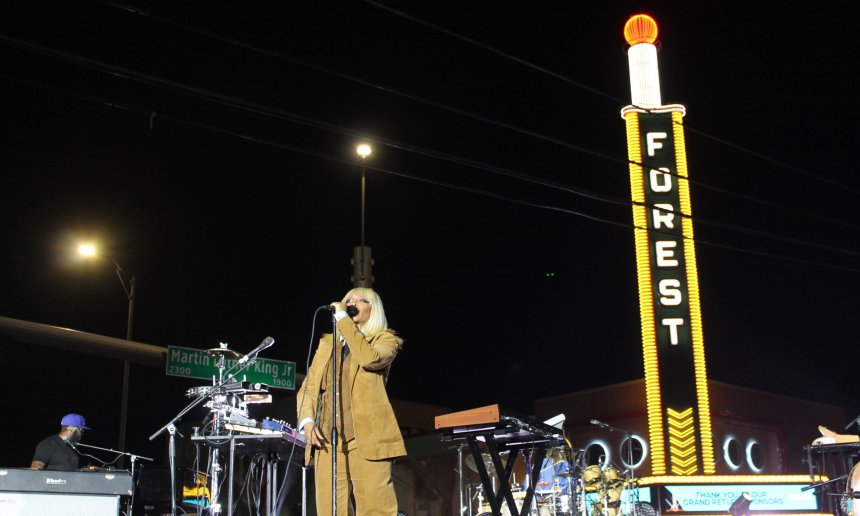

The Forest Theater reopened in South Dallas with performances by Tamela Mann, a surprise appearance by Erykah Badu, and a new vision for Black arts.
Under the glow of the Forest Theater’s newly illuminated tower, South Dallas reclaimed a piece of its cultural history Sunday night. After more than half a century without its iconic marquee lighting the way, the historic venue reopened its doors, marking a new chapter for a neighborhood that has spent generations fighting to preserve its place in Dallas.
The evening’s celebration, known as the Grand Return, culminated in the relighting of the theater’s tower and marquee for the first time in more than 50 years. Grammy-winning gospel singer and Dallas-Fort Worth native Tamela Mann performed. At the same time, Dallas music icon Erykah Badu made a surprise appearance on Martin Luther King Jr. Boulevard, the street where the theater has stood for more than 75 years.
For a venue long known as the “Apollo of the South,” the reopening was more than restoring a historic building. It offered a glimpse of what a community-centered arts institution could mean for South Dallas, where Black creativity has endured alongside decades of disinvestment.
Led by Forest Forward, a nonprofit dedicated to restoring the theater and revitalizing the surrounding neighborhood, the project has transformed the historic property into a multipurpose arts and education campus. The renovated complex includes a 1,000-person concert hall, a 200-seat black box theater, a creative education lab, recording and podcast studios, artist classrooms, and community spaces. A Forest Forward-owned Starbucks is also part of the development.
Throughout the building, sculptures, photographs and paintings by local Dallas artists reflect the creative community the theater is intended to serve. A bookshelf featuring a work by James Baldwin offers another reminder that the space’s cultural ambitions extend beyond music to the broader traditions of Black literature and artistic expression.
For local artists, the theater’s return represents an opportunity to build something that lasts beyond opening night.
Dallas rapper and singer Daraja Superstar described participating in the celebration as “a pioneering experience… to be part of history.” She hopes the theater will give young people in the community a place to create and develop their talents without financial barriers.
Recently back in Texas, Daraja, drawing inspiration from Lauryn Hill, Nicki Minaj, Beyoncé, and Badu, sees the theater as a potential bridge between the artists who helped shape Dallas’ musical identity and the young performers still finding their voices. Her dream collaborations include Dallas rapper Big Tuck, which she described as a potential “full circle moment,” and Beyoncé.
She also encouraged people to support the theater by creating authentic content about its work, rather than treating the reopening as simply another viral moment.
That distinction matters in a neighborhood whose cultural legacy has developed alongside persistent barriers to investment and opportunity.
The Forest Theater opened in 1949 as a whites-only venue. By 1956, it had begun serving Black audiences as the surrounding neighborhood changed. Its stage eventually welcomed Prince, Gladys Knight & the Pips, B.B. King, Ike & Tina Turner, and Wilson Pickett, making it an important destination for Black entertainment. The venue’s history reflects a broader transformation: a space that initially excluded Black patrons became a gathering place for generations of Black performers and audiences.
South Dallas’ story extends well beyond the theater. Following emancipation in 1865, Freedmen’s Towns formed throughout Dallas as formerly enslaved people established communities and built lives beyond slavery. In 1937, the city redlined South Dallas, restricting investment in an area already facing environmental challenges associated with the Trinity River floodplain.
Highway construction further reshaped the neighborhood. North Central Expressway opened in 1949, and subsequent projects divided communities and pushed Black residents farther south. That same year, racially motivated bombings targeted Black families moving into the area. South Dallas grew as a center of Black life even as its residents faced barriers to housing, resources, and economic opportunity.
The boulevard outside the theater carries its own civil rights history. Forest Avenue was renamed Martin Luther King Jr. Boulevard in 1981 following a campaign led by City Council member Elsie Faye Heggins. King had spoken at a Fair Park rally in 1963. Nearby Mount Olive Lutheran Church became a civil rights organizing hub, where residents opposed Fair Park land seizures during the 1960s. In 1976, King’s father unveiled a bronze statue of his son at the Martin Luther King Jr. Community Center.
Against that history, Badu’s surprise appearance on the boulevard carried a particular resonance. The Dallas icon had previously operated the venue as the Black Forest Theater, helping revive the space in the early 2000s. Her return connected that earlier chapter to a new effort to make the theater a lasting home for arts and culture.
For Big Tuck, the reopening also brings a personal connection to the neighborhood into focus. The Dallas rapper grew up around the corner from the theater, wondering about its rich history. He has performed there before with Badu and hopes the renovated venue will become a resource for young people.
He also envisions a multigenerational “whole Dallas show,” bringing artists from different eras together on one stage. His advice to emerging performers is simple: “stay original… bring your stories to life.”
The new recording and podcast studios, creative education lab and artist classrooms offer infrastructure for that kind of development. Whether those spaces translate into lasting opportunities for local young people will be an important measure of the project’s success.
Mann’s performance brought another dimension to the evening, connecting the theater’s revival to a story of faith and perseverance. She praised Forest Forward President and CEO Elizabeth Wattley’s vision as “mind-blowing.”
At Wattley’s request, Mann performed “God Provides,” a song that had helped Wattley through the yearslong fundraising process. The choice reflected the persistence required to restore a historic venue and bring its future into reach.
Mann also reflected on her own journey, from singing at age 12 with Mattie Moss Clark at a Dallas church to performing at the White House, Carnegie Hall and Radio City Music Hall. The only one of 14 siblings to graduate from high school, she spoke from the perspective of someone whose career has been shaped by determination and opportunity.
Her assessment of the theater’s return captured the significance of restoring the building for the community: it had been “put back together by our people… for all people.” She urged supporters to contribute their time as well as their money, emphasizing the role community participation will play in sustaining the institution.
South Dallas continues to face economic challenges, and restoring a landmark alone cannot undo decades of disinvestment. But the Forest Theater now has the potential to connect its celebrated musical past with a broader investment in arts education, creative work and community life.
For Daraja, that means making room for young people to create without financial barriers. For Big Tuck, it means giving emerging artists resources and a stage where their stories can be heard. For Mann, it means ensuring the community continues to show up.
The illuminated tower marks the return of a familiar landmark on Martin Luther King Jr. Boulevard. What happens inside the building in the years ahead will determine whether its revival becomes something more enduring: a cultural home where South Dallas residents can make art, tell their stories, and help shape the future of their own community.
Share
What's Your Reaction?
 Like
0
 Dislike
0
 Love
0
 Funny
0
 Angry
0
 Sad
0
 Wow
0