A 15-year-old’s sickle cell breakthrough honors the legacy of Black medical pioneers
Phillip Mullin’s historic gene therapy treatment underscores the legacy of Black doctors whose decades of research helped shape modern sickle

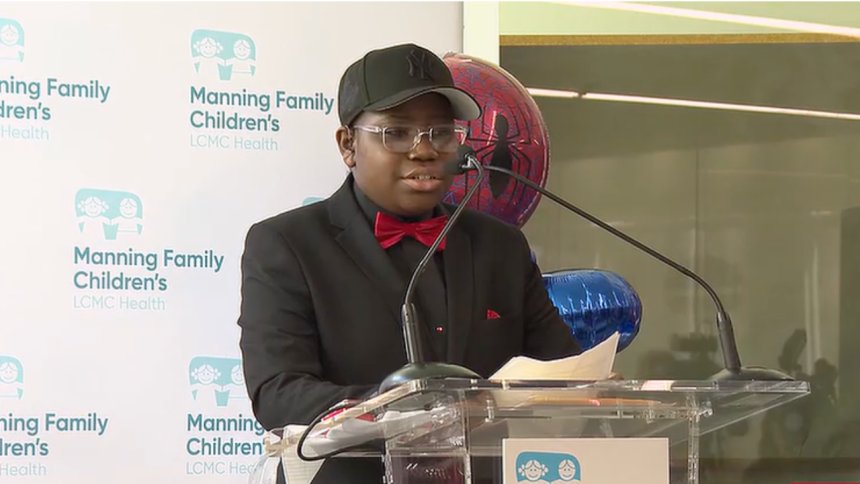

Phillip Mullin’s historic gene therapy treatment underscores the legacy of Black doctors whose decades of research helped shape modern sickle cell care.
On October 23, 15-year-old Phillip Mullin made history in Louisiana as the first pediatric patient to be cured of Sickle Cell Disease (SCD) through gene therapy. Mullin is reportedly the first child and second person in Louisiana to receive LYFGENIA, a one-time stem cell treatment designed for sickle cell patients 12 and older with a history of pain crises known as vaso-occlusive events (VOEs).
“Sacrifices are necessary,” the teen said in a ceremony, per Fox 8 Live. “You can’t gain anything without first giving something in return, although if you can endure that pain and walk away from it, you find that you now have a heart strong enough to overcome any obstacle.”
“I think I’ll be unpacking every fear, every negative emotion that I had, every time I thought my baby wasn’t going to be here with me. I will remember every sleepless night and every moment I wondered how much more his body could take, but I will also see the young man who made it through,” his mother, Shataka Figgins, added.
For years, Mullin was one of the approximately 100,000 people living with sickle cell disease in the United States. Sickle cell disease is a blood disorder that affects red blood cells’ ability to carry oxygen to other parts of the body because of their abnormal, sickle-like shape, which increases the risk of complications such as chronic pain, infections, joint problems, and more throughout the body. As previously reported by theGrio, sickle cell impacts Black people at higher rates. According to the CDC, more than 90% of people in the US with sickle cell are Black, and 1 in 13 Black children are born with the sickle cell trait; meanwhile, 1 in 365 are born with the disease, per the National Institutes of Health.
With dreams of becoming “a doctor that can relate to somebody… relate to a sickle cell patient and actually know what they’re going through,” Mullin’s healing and medical aspirations follow in the footsteps of a legacy of Black scientists and doctors whose work paved the way for the types of treatments helping the thousands of Black patients living with sickle cell disease.
Dr. William Warrick Cardozo

Dr. William Warrick Cardozo is one of the first doctors to conduct major research on sickle cell disease. His 1930s study, “Immunologic Studies in Sickle Cell Anemia,” proved that sickle cell anemia is an inherited condition that primarily affects people of African descent.
Dr. Roland B. Scott

Known as the “father of research into sickle cell disease,” Dr. Roland B. Scott was a groundbreaking pediatrician and researcher at Howard University. After noticing the high number of Black children going to emergency rooms due to sickle cell symptoms and complications, Dr. Scott turned his focus on understanding the blood disease. In 1948, he published a research paper exploring SCD in newborns, which later laid the groundwork for modern-day newborn sickle cell screenings. An advocate of the National Sickle Cell Control Act of 1972, which authorized targeted federal funding and programs to combat sickle cell disease, Dr. Scott also founded the Howard University Center for Sickle Cell Disease in 1971, one of the first centers in the nation devoted to the disease.
Dr. Charles F. Whitten

Similarly, Dr. Charles F. Whitten, a pediatrician and medical leader, founded the Sickle Cell Detection and Information Center, a comprehensive community program that developed educational tools for teaching children and families about sickle cell disease in 1971. He also co-founded the Sickle Cell Disease Association of America, Inc. (SCDAA) and was instrumental in creating the National Association for Sickle Cell Disease, now known as the Sickle Cell Disease Association of America, Inc.
Dr. Marilyn Hughes Gaston

Dr. Marilyn Hughes Gaston was among the first to become interested in the problems of children with sickle cell disease during her internship at Philadelphia General Hospital in 1964. After treating an infant patient experiencing swelling due to SCD, Dr. Gaston secured federal grants to study SCD in children and established protocols for routine screening for the disease. In 1976, Dr. Gaston joined the National Institutes of Health as a medical expert and later became a deputy branch chief of the Sickle Cell Disease Branch. In 1986, Dr. Gaston published the results of a groundbreaking national study demonstrating the effectiveness of long-term penicillin treatment for children with SCD in preventing septic infections. Her study showed that babies should be screened for SCD at birth, which led to Congressional legislation to encourage and fund SCD screening programs nationwide. Additionally, her research highlighted the life-saving impact of early treatment on sickle-cell patients.
Dr. Clarice Reid

Dr. Clarice Reid was the national coordinator of the national sickle-cell disease program and Chief of the Sickle Cell Disease Branch, and later became the director of the Division of Blood Diseases and Resources at the National Heart, Lung, and Blood Institute (NHLBI). Under her leadership, these organizations made numerous important advances in sickle cell disease research and hematology, which would prevent infections in young children and infants, explore new ways to prevent pain episodes in adults with SCD, and more.
Share
What's Your Reaction?
 Like
0
 Dislike
0
 Love
0
 Funny
0
 Angry
0
 Sad
0
 Wow
0