What happened when Black women received guaranteed income? New data offers answers
A Georgia program called In Her Hands gave women cash with no restrictions and researchers found improvements in savings, stability

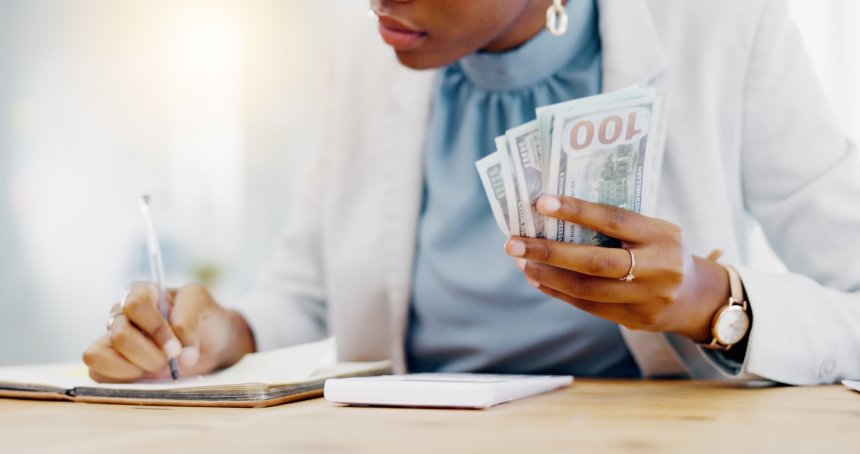

A Georgia program called In Her Hands gave women cash with no restrictions and researchers found improvements in savings, stability and financial security.
Whoever said “money can’t buy happiness” must not have been taking into account all the ways it can secure the kind of stability that does—especially in this economy.
In Georgia, beginning in 2022, a cohort of Black women received unrestricted cash for two years, and according to new data released in September, while the money didn’t erase every financial burden, it greatly improved the financial stability of many involved.
Launched by the Georgia Resilience and Opportunity Fund in partnership with GiveDirectly, the guaranteed income initiative In Her Hands initially selected 654 low-income women living in majority-Black communities in Atlanta’s Old Fourth Ward, College Park, and rural Southwest Georgia to receive $20,400 over two years to use however they saw fit. At a time when the cost of living has been stretching household budgets thin, a new study published Sept. 17 in the Journal of Economics, Race, and Policy found that those funds helped women build savings and rely less on some of the costly ways people make ends meet when money gets tight.
To measure exactly how the funds were making a difference, researchers spent two years tracking the women selected to receive them, as well as eligible applicants who were not selected. The first women began receiving payments in June 2022, with the remaining in August and October. Half of the women received $850 each month for two years, while the other half received $4,300 upfront, followed by $700 a month for the remaining 23 months.
According to the new report, by the end of the program, 25.5% of women who received the cash had an emergency fund, compared with just 11.5% of eligible applicants who did not receive the cash. Women who received the cash also had an average of $433.50 in savings, more than three times the $128.40 saved by women who did not receive the payments, and were less likely to overdraft their accounts. While 42.6% of those who received cash still reported overdrafting an account during the previous six months, 60.3% of those who did not receive the cash had done the same.
Women who received the money were also less likely to turn to other ways of getting cash when they were short. About 21% used a pawn shop during the previous six months, compared with 34% of women who did not get the money, and 14% sold plasma, compared with 27% of women who did not receive the payments.
However, the money did not significantly reduce the women’s existing debt. Instead, researchers found the women appeared to first use the money to get their immediate finances under control. During the first year, they became less likely to overdraft, use pawn shops, and sell plasma. By the second year, the difference began showing up more significantly in their savings. But the findings also make a compelling case for what can happen when that breathing room is given specifically to Black women.
Black women are already carrying a considerable share of the financial weight in their families. In 2023, 69% of Black mothers were either the sole or primary breadwinners for their families, compared with 40% of white mothers, according to an analysis of Census data by the Center for American Progress. More than half of Black mothers were unmarried breadwinners.
So when Black women have more money to work with, they aren’t necessarily the only ones who benefit. Earlier findings from In Her Hands found that participants were able to put more money toward their children’s education and provide more financial support to others. The women themselves have described using the cash for everything from household bills and transportation to their children’s clothes, their businesses, and, finally, a little joy.
“Our work demonstrates that direct, unconditional cash investments are the most effective way to address deep-seated economic insecurity, improve public health, and accelerate the closure of the racial wealth divide,” officials wrote in a release.
Aisha Amos knows firsthand just how far that money can travel. The Baltimore native had been living in Atlanta for more than 20 years and working as a master cosmetologist when health issues forced her to close her salon in 2021. She later reopened a suite and began taking gigs where she could while trying to rebuild her clientele. After learning about In Her Hands and initially encouraging a friend to apply, that same friend convinced Amos to submit an application of her own. Amos was selected as part of the program’s Westside expansion, which began serving more than 270 women in the summer of 2024.
“I was feeling worthless a little bit because I wasn’t able to contribute my portion to my family as I had been, and just trying to take a gig here and a gig there, just to kind of make something, pay something for the month,” Amos explained in a video.
“It was always a bill being paid for the month, but not the bills being paid for the month,” she continued. “So having that stress of worrying about like, is your car outside when you wake up in the morning? Can you continue with what you planned on for the day? That was kind of like the breaking point.”
Quaniya “Q” Ferguson, a 24-year-old Atlanta mother of two, is part of that Westside cohort too. Ferguson had been supporting herself since she was 19, working while raising her children and constantly figuring out which needs she could afford to meet. When applications for In Her Hands opened in 2024, she and a coworker applied just after midnight.
“I’ve been able to, you know, pay bills, make sure the children okay,” she explained in a video of her own.
“I have the extra money to go get them school clothes, school shoes, get them school supplies, get their hair cut, hair done,” she continued. “So it’s like I actually feel great knowing that I don’t have to piggyback.”
Ferguson said having the funds has meant she no longer has to choose as often between enjoying life and surviving. After catching up on expenses, the young mom got her first passport and took her own mother on a trip to Jamaica. She was also able to take her children to Disney World, while putting money toward her small hair and skincare business and plans to return to school for mortuary science.
“We having a ball,” she said. “It helped me a lot. Like not even just financially, just mentally, physically. It brought a lot of struggling situations at ease. It makes you feel more release of stress. I’m telling you, this the program. Like, listen to me. This the program.”
Those kinds of ripple effects are particularly worth noting when so much of the economic story of Black women is about how much they manage to do with less. On top of overwhelmingly being the breadwinners, Black women continue to face a racial wage gap, fewer opportunities to build wealth, and fewer buffers when an emergency hits.
In Her Hands offers a glimpse at what can happen when the equation changes, even just a little. Since launching with its first 654 women, the program has continued to expand. Backed by a $6.2 million grant from the Arthur M. Blank Family Foundation, the program expanded to Atlanta’s Westside in 2024, where women in English Avenue, Vine City, Bankhead, and Washington Park receive an average of $1,000 a month for three years. Today, In Her Hands is a $30 million initiative serving more than 920 women across urban, suburban, and rural Georgia.
And for women like Amos and Ferguson, the breathing room it creates has opened up something even bigger than what they can afford now.
As Ferguson put it, “It’s about showing my kids there’s more out there, and reminding myself I can get there.”
Share
What's Your Reaction?
 Like
0
Like
0
 Dislike
0
Dislike
0
 Love
0
Love
0
 Funny
0
Funny
0
 Angry
0
Angry
0
 Sad
0
Sad
0
 Wow
0
Wow
0