Prince George’s County, Md., has long been a haven for Black families. Does it deliver the schools they’re looking for?
The majority-Black Maryland suburb represents Black middle-class success, but families and experts say opportunity still comes with tradeoffs. Is there


The majority-Black Maryland suburb represents Black middle-class success, but families and experts say opportunity still comes with tradeoffs.
Is there a perfect place for Black families to raise and educate their children in America? The internet seems to think so.
On Sunday, Sept. 20, Pulitzer Prize-winning journalist Nikole Hannah-Jones published a deeply personal essay in The New York Times Magazine reflecting on whether she failed her daughter and her own values by choosing to send her to a predominantly Black, high-poverty public school in Brooklyn. The essay “In Fighting for Every Black Child, Did I Betray My Own?” has since sparked a broader conversation about a conundrum many Black parents know well when deciding where to live and educate their children.
“For Black parents, it’s often the case that they can’t get that package deal,” Angela Simms, an assistant professor of sociology and urban studies at Barnard College and author of “Fighting for a Foothold: How Government and Markets Undermine Black Middle-Class Suburbia,” told theGrio. “They’re often trading off access to material resources, or at least the potential for material resources, with social acceptance for their children.”
As the conversation continues well into the week, Prince George’s County, Maryland, has repeatedly come up as a potential quasi-third option of sorts. The majority-Black suburb outside of Washington, D.C., has been an enclave of Black middle- and upper-class life for generations, seemingly offering families a chance to raise their children surrounded by a Black community without sacrificing access to resources. To find out how that actually plays out in its public schools, theGrio spoke with experts who study Black middle-class communities and education, along with a mother who grew up and raised her own children in Prince George’s County.
“I think people may see it as that third option,” Omari Keeles, an assistant professor at Towson University whose research includes race, social class, and education, told theGrio. “But I think people who live in it would suggest that it is not exactly.”
Prince George’s is home to roughly 970,000 people, nearly 61% of whom are Black, according to the latest U.S. Census data. The median household income is $101,798, and more than a third of adults over 25 have at least a bachelor’s degree. Its concentration of Black middle-class residents has made the county a national example of what Black suburban prosperity can look like.

However, Simms, whose research and recent book focus on Prince George’s County and the ability of Black middle-class regions to provide quality public services, said the wealth visible in the county doesn’t tell the whole story.
“You can have the same household income, but because of historical processes that produce wealth inequality, Black households at every level of the income distribution have less wealth than white households,” she explained.
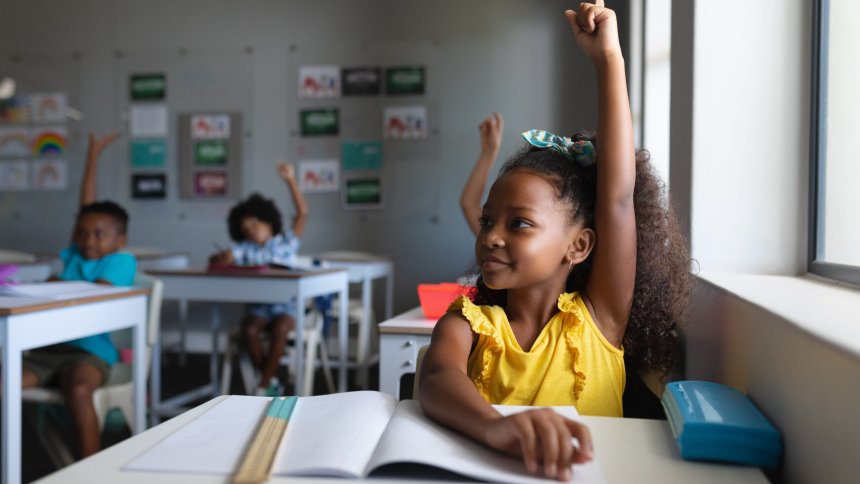
That distinction can be seen in the county’s public schools. Prince George’s County Public Schools is the second-largest school system in Maryland, enrolling 132,854 students during the 2024-25 school year. Roughly 51% of its students were Black, and 40% were Latino, while 60.4% qualified for free or reduced-price meals.
While SchoolDiggers, which ranks Maryland school districts using state test-score data, currently places PGCPS 22nd among the state’s 24 ranked districts for the 2025-26 school year, the school system has been making gains. Black students in PGCPS outperformed Black students statewide on 2025 state assessments by 4.3 percentage points in English language arts and 1.9 points in math. More than three-quarters of PGCPS schools earned at least three out of five stars on the latest Maryland School Report Card, while the graduation rate among Black students rose from 84.65% in 2024 to 86.63% in 2025.
“Prince George’s County does many things well,” Simms added. “There are at every level—high school, middle, and elementary—high-performing schools. But as we know, there’s more demand than there are seats.”
That demand is especially apparent in the county’s specialty schools and programs. PGCPS offers students options ranging from performing arts and language immersion to science, technology, career education, and health sciences, giving some families another choice beyond their neighborhood school or leaving the public system altogether.
“So to some degree, if you can get into those selective schools in Prince George’s County, yes, you have perhaps cracked the code,” Simms said. “But there are far fewer seats than there are children who need those seats.”
For families who can afford another option, not getting one of those seats can mean paying for private or parochial school on top of the taxes they already pay into the public system. Keeles said that added financial calculation, along with the stress of trying to determine which environment will serve a Black child best, can be understood as another form of the “Black tax.”

“The idea that you can’t be where your family is or where your community is and your child get a good education; it’s also a tax in terms of the emotional stress and concern that goes along with having a Black child—that you have to consider more things than a non-Black person or that a white person would have to consider,” Keeles noted.
Even in Maryland, where Prince George’s is not the only affluent county with a sizable Black population, the calculation does not necessarily disappear.
“If someone chooses Howard County, then their child may get what is quote unquote, I’m saying quote unquote, a stronger academic preparation,” Keeles continued. “Whereas if a person chooses Prince George’s County, they may get a stronger, you know, cultural preparation.”
Lakita Wilson, author of YA novel “Pretty Girl County,” knows that dynamic intimately from both sides. The writer and assistant professor of education at Prince George’s Community College grew up in Prince George’s County, attended its public schools, and later chose them for her own children.
As a child, Wilson attended a magnet program in Capitol Heights, where she remembers reading books above her grade level, working on long-term projects, and having teachers who encouraged her writing. Years later, her own children attended Thomas G. Pullen Creative and Performing Arts Academy, where they studied everything from dance and drama to visual arts and music within the public school system.
“It’s possible to pour into our public school system in a way that can rival some of these private schools,” Wilson said. “We just have to care about our community resources.”
Two of Wilson’s daughters later attended the Academy of Health Sciences at Prince George’s Community College, one of six PGCPS schools to earn five stars on the latest Maryland School Report Card. Students at the school can graduate with both their high school diploma and an associate degree.
Meanwhile, her son chose their neighborhood high school instead. Wilson said he was invested in sports but less engaged academically, and looking back, she wonders whether a specialty program more closely aligned with his interests could have given him a greater sense of purpose at school.
“I think that Prince George’s County Public Schools offers opportunities for students to experience purpose, a bigger purpose, along with their learning,” Wilson said. “And so private school isn’t always the answer.”
Still, having the means to make another choice remains one of the things that separates middle-class families from those without it. Simms said Black middle-class parents may be better positioned to move, supplement what schools are not providing, or pay tuition elsewhere, but those options do not eliminate the underlying problem.
“Even when you’re middle class, you don’t escape that,” she said. “You just have more tools to navigate it.”

Wilson has watched some of those families leave. She said friends who reached a certain income level pulled their children from the public system and sent them to private schools, taking with them students and parents who might otherwise have been invested in their neighborhood schools.
She saw a different response when fighting became an issue at her son’s school following the pandemic. Parents got involved, organized, and worked with the school to address it.
“When you see an issue in your school, instead of taking flight, you lean in, and you figure out how do we fix this thing that I’m complaining about?” Wilson said. “Our schools have value, and they have potential even when there are shortcomings. But the school is a part of the community, and if it’s a part of us, we shouldn’t just give tax dollars to it. We have to give ourselves to uplifting these schools.”
For Wilson, making something closer to that elusive third option available to more Black families ultimately requires enough families with resources to stay invested in the public schools around them, rather than leaving at the first sign of trouble.
“We have to have a steady influx of families who are saying we’re going to pour into our own communities,” Wilson said. “If we have more families invested in, ‘yes, we’re going to remain in our communities and not give up at the first crack in the infrastructure,’ then she wouldn’t have been alone. We have to stop taking flight.”
Share
What's Your Reaction?
 Like
0
Like
0
 Dislike
0
Dislike
0
 Love
0
Love
0
 Funny
0
Funny
0
 Angry
0
Angry
0
 Sad
0
Sad
0
 Wow
0
Wow
0