What does it mean to be ‘culturally Christian’ after leaving the church?
Ebony Jasmine Harris’ debate with Christian women raised bigger questions about faith, labels and how Black people inherit religious culture.


Ebony Jasmine Harris’ debate with Christian women raised bigger questions about faith, labels and how Black people inherit religious culture.
A “witch” sat down with 20 Christian women, and somehow nobody got rebuked.
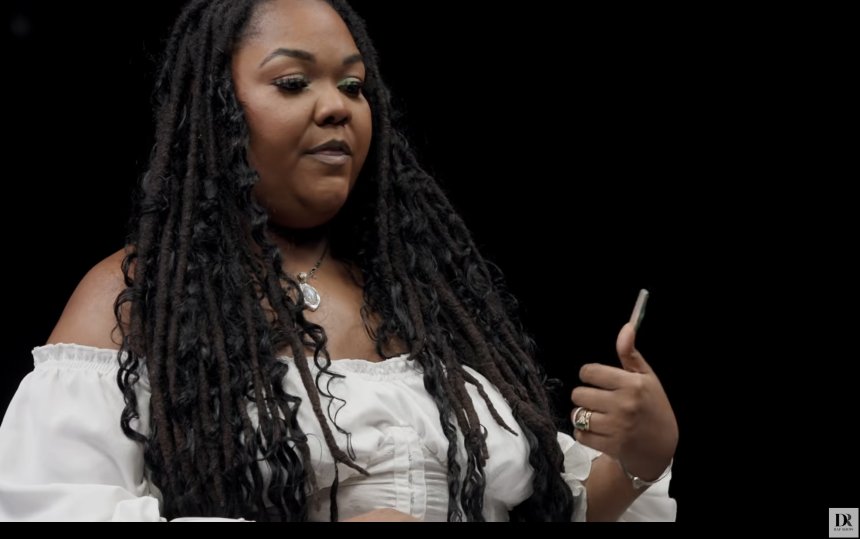
Ebony Jasmine Harris, a former Christian, spiritualist, and someone classified as a “new ager” in the religious and spirituality world, recently sat down with 20 Christian women, several of whom are Black for an episode of the YouTube debate series “The Dr. Daf Show,” where the two sides attempted to find some common ground on faith, spirituality, and practices many Christians consider downright “demonic.”
Across several prompts, including whether manifestation is simply “faith in action” or something Christians should fear, Harris, with the patience of Job, might we add, unpacked her beliefs and the journey that brought her here. A self-described witch, spiritualist, and coven leader who left the church roughly eight years ago, she was hardly unfamiliar with the faith she was being challenged on. The pastor’s daughter grew up in the Black church, studied the Bible closely, and said she spent years seeking God on her own before ultimately arriving at a spirituality that extends well beyond modern Christianity. Throughout the conversation, Harris repeatedly returned to an interesting description of herself, “culturally Christian,” something that resonates with many Black folks.
“I’m Black. So, I grew up in the church, so a lot of my rhetoric is Jesus,” she explained. “I mean culturally Christian as it pertains to the culture.”
When she or anyone else says that they are “culturally Christian,” they’re talking about the parts of the Black church that stick with you even when the beliefs and practices don’t. She’s a pastor’s kid after all, who grew up in church, knows the Bible backward and forwards, she demonstrated, and still says “amen” and “hallelujah.” She even still turns to scripture from time to time.
“I will use the scriptures to divine,” she said, adding, “And I know somebody’s going to go, ‘But you don’t believe in the Christian God.’ I do believe that messages can come in many different forms. My ancestors were Christian. So being culturally Christian, sometimes I will still use the Bible through Hoodoo also to have that message delivered.”
For many Black Americans, the concept of being “culturally Christian” probably isn’t that hard to understand. The Black church has shaped so much of our language, music, traditions, and culture for generations, including for people who no longer consider themselves Christian. Over the last decade, more and more young adults have been reevaluating their relationship with faith and often arriving at less rigid traditional understandings and moving toward a more open expression. Still, many attest to keeping gospel playlists in heavy rotation and turning to the tools passed down by their ancestors, including prayer, in times of need. There’s also something somewhat unifying across the diaspora around some of the traditions of the church that, whether you ever step foot in one or not, you develop—you’d be hard-pressed to find a Black person who doesn’t know what a church clap is, for instance.
Harris said her definition of God also evolved after she left the church, and that she considers Him to be the universe and its creator all at once. This was mystifying for several of the others, who challenged what she meant and how she could see a being as both the thing it creates and the creator.
“When I think about the God or God is the universe. I think about God being bigger than just this planet that we live on,” she said. “I just kind of make God larger I think than how it was presented to me in Christianity.”
“I chose this because I think oftentimes there is a big rift between Christians and spiritualists over terminology,” she said at the top of the discussion around God is the universe.
In fact, a lot of her terminology, including how she defined her faith, tripped them up. “Manifestation” was another major example. Some Christians heard the word and immediately associated it with a spiritual practice incompatible with their faith, while Harris challenged them to consider whether what she called manifestation was really so different from praying for something, believing it will happen, and then moving accordingly. Other words like “witch,” “divination,” “energy,” or even “spirituality” seemed to trigger a reaction before Harris had fully explained what she meant by them.
None of the Christian women were obligated to agree with Harris, accept her beliefs, or leave the room questioning their own faith. They came there as Christians and remained Christians. What might have made the conversation even more interesting, however, would have been a little more genuine curiosity about the person sitting across from them. Harris spent much of the discussion explaining her beliefs in Christian terms, engaging with their scripture and taking their questions seriously, even when those questions framed her spirituality as dangerous or demonic. That same generosity did not always seem to travel in both directions. Christianity remained the measuring stick against which her beliefs were judged rather than simply one faith tradition encountering another.
While not surprising, it was disappointing, given Christianity’s emphasis on love. There was an opportunity in that room to demonstrate what loving someone across a profound spiritual disagreement can actually look like without requiring conversion, agreement or even approval. Instead of approaching Harris primarily by asking whether her beliefs were wrong, evil, or compatible with Christianity, there could have been more interest in understanding why those beliefs matter to her in the first place. For a religion that teaches its followers to love their neighbors, curiosity itself might have been one of the more powerful expressions of that love.
Share
What's Your Reaction?
 Like
0
Like
0
 Dislike
0
Dislike
0
 Love
0
Love
0
 Funny
0
Funny
0
 Angry
0
Angry
0
 Sad
0
Sad
0
 Wow
0
Wow
0