Mississippi Department of Public Safety officials discover 1960s-era Klan items at headquarters in Jackson
The suitcase, containing a trove of 1960s Ku Klux Klan era paraphernalia, includes ledgers, meeting notes, propaganda and more. The

The suitcase, containing a trove of 1960s Ku Klux Klan era paraphernalia, includes ledgers, meeting notes, propaganda and more.
The Mississippi Department of Public Safety is preparing to move into its new headquarters. What was left in a closet in their soon-to-be-old building in Jackson shocked officials, according to Mississippi Today.
Tucked inside a small blue suitcase was a handbook for the White Knights of the Ku Klux Klan, along with a Klan robe, KKK recruiting materials, propaganda, meeting notes, ledgers and a list of members who had either paid their dues or did not. Not long after discovering the items, department officials gave the materials to the Mississippi Department of Archives and History.
It is unclear how long the suitcase had been in the closet or who placed it there.
“Mississippi Highway Patrol Troopers and Agents with the Mississippi Department of Public Safety have worked for decades with our federal law enforcement partners to shed light on the darkness in which groups like the Ku Klux Klan chose to operate,” Public Safety Commissioner Sean Tindell said in a release. “By preserving these artifacts and shedding light on such organizations, we help ensure that future generations are never led astray by such hate.”
The material is set to be processed to make it digitally accessible to the public, giving researchers “broader access to documentation that deepens our understanding of Ku Klux Klan activities in the 1960s,” incoming Department of Archives and History director Barry White said.
The entire process could take several months.
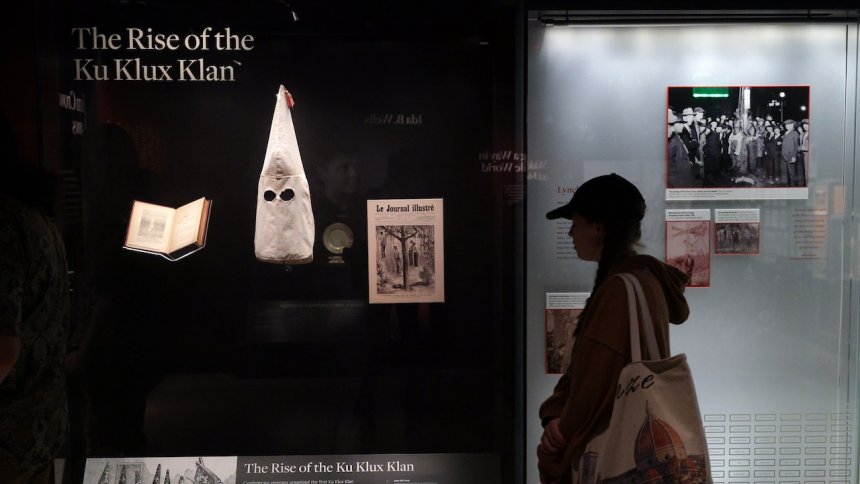
The Department of Archives already has in its possession a Klan robe and arrest photographs of Freedom Riders that are on display at the Mississippi Civil Rights Museum, but the new material highlights how membership for the White Knights reportedly grew to nearly 100,000 members and became such a political power in the state that politicians sought their support in elections.
The Knights were founded in 1962 by Samuel Bowers, following James Meredith’s desegregation of the University of Mississippi. The group would later carry out the murders of civil rights workers James Chaney, Andrew Goodman and Michael Schwerner in 1964 and the investigation into the killings led the state’s highway patrol to investigate how many of its members were Klansmen, marking the start of documentation of Klan activities in the state.
Ultimately, seven of the 18 men tried in the killings, including Bowers, were found guilty, but only served three to 10 years in prison. A man who went free during the original trial, Edgar Ray Killeen, went to prison in 2005 after a Mississippi jury convicted him of manslaughter for orchestrating the murders of the young civil rights activists.
The details noted within the Klan handbook outlined various rituals, organizational bylaws and order of operations, including a Voting Registration Committee to “study and watch the negro voting activity” and an Intelligence Committee. Despite being sworn to secrecy, the documents were filled with racist screeds and statements and also featured the names and dues of Klansmen.
The ledger was verified by the son of Byron De La “Delay” Beckwith. The elder Beckwith was the assassin of Mississippi NAACP leader Medgar Evers in 1963 and had joined the White Knights. Beckwith’s son, referred to as “Delay Jr.,” is one of the last surviving original Klansmen in the White Knights.
Share
What's Your Reaction?
 Like
0
Like
0
 Dislike
0
Dislike
0
 Love
0
Love
0
 Funny
0
Funny
0
 Angry
0
Angry
0
 Sad
0
Sad
0
 Wow
0
Wow
0