Black women have a 400-year history with Shakespeare. A new exhibit in D.C. finally tells their story
Curator Dr. Patricia Akhimie brings together 400 years of artifacts, exploring how Black women have engaged with Shakespeare on their

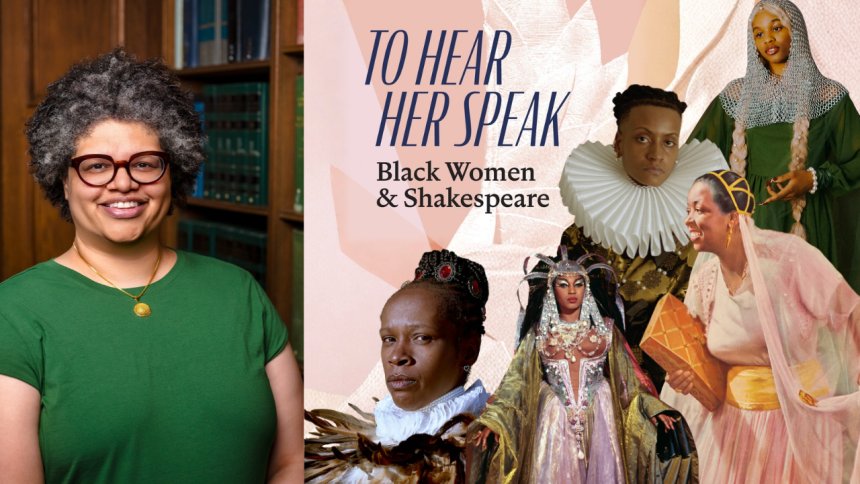

Curator Dr. Patricia Akhimie brings together 400 years of artifacts, exploring how Black women have engaged with Shakespeare on their own terms.
In the middle of the Folger Shakespeare Library’s newest exhibit, surrounded by 400 years of rare books, manuscripts, and a Shakespeare First Folio, there’s a sofa, intentionally placed for visitors to sit and take in centuries’ worth of artifacts that connect Black women and Shakespeare.
“To Hear Her Speak: Black Women and Shakespeare,” on view through May 2, 2027, in Washington, D.C., is the first comprehensive history of Black women’s engagement with the Bard and the Folger’s most ambitious temporary exhibition since its galleries reopened in 2024. Curator and director of the Folger Institute, Dr. Patricia Akhimie wants it to feel like an invitation, not a museum at arm’s length. In a conversation with the Grio, Akhimie admits that Shakespeare can sometimes feel distant to many people.
“But here at the Folger Shakespeare Library, that’s what we live and breathe all day,” she shared. “So I really hope that the exhibition is a place where there’s an entry point for anyone and everyone. I hope the exhibit really expands that, makes people feel like there’s room on the sofa for you.”
She knows what it’s like to find that seat. She found hers in middle school. Akhimie’s passion for understanding Shakespeare’s connection to Black women bloomed in childhood.
“I come from a mixed-race family,” Akhimie explains. “I had questions about the history of contact between early modern… European culture and African cultures.”
So during a National History Day, which she likens to a science fair but for history, Akhimie created a project exploring the first cross-cultural contacts and the art that emerged from that moment. It was her first time doing independent research, and as a self-described “precocious teen,” she unveiled a word of scholarship she hadn’t known existed.
“I came across scholarship about Black women in the early modern period,” she recalls. “Before that moment, I don’t think I really knew that there were scholars who were studying that. That there were books I could read. That there was a story to tell.”
And decades later, she’s one of the people telling it. Akhimie’s “To Hear Her Speak” exhibit centers Black women’s relationship with the 16th-century poet and playwright across 400 years. Describing it as “the most fun research project” she’s ever been involved in, the Folger Institute director says the challenge came in wanting to create a space that is responsible, welcoming, “rigorous in its scholarship, but also fun and not boring.”
“What are the objects, what are the stories, who are the individuals that we need to make sure are in this exhibition?” she recalled asking herself before calling in experts, ranging from junior scholars to the Library of Congress, to dig up archival materials and bring the story to life. But in addition to the Royal Shakespeare Company costumes by Melissa Simon-Hartman, Shakespeare’s First Folio, and a notebook that was owned by Phillis Wheatley, Akhimie hopes visitors remember the care and intention behind the exhibit.

“I’m really hoping that people will notice how much joy is in this exhibition,” she shared. “Something we have in common with Black women as artists and creators over 400 years is that they come to Shakespeare and find all the things they need — the stories that they want to dive into and the language that is most useful for expressing whatever it is that they want to express.”
Oftentimes, exhibitions about Black women in the 16th-19th centuries lead with pain, and Akhimie admits that there was plenty of it when exploring the archives. So, when building the exhibit, she says deciding what to include and what not to include was a “tough call” at times.
“I knew that there were objects that are important to the story of Black women’s experiences across these 400 years, but they are painful and maybe too harmful,” she explained. “Maybe they do more harm than good to bring them into a public gaze in the space of an exhibition that is meant to welcome people at every stage and every age. So there was a process of thinking hard about what objects can help to tell the story without reintroducing some of the trauma that is evidenced in them.”
Rather than pretending that material doesn’t exist, the exhibit acknowledges it and gives visitors a range of areas to explore, while giving those who want to dive deeper into the hard, racist history within this context the space to do so. The exhibit takes its name from Shakespeare’s Sonnet 130, which readers have long suggested may describe a Black woman. The speaker spends most of the poem listing what his mistress isn’t (“My mistress’ eyes are nothing like the sun”) before turning to something else entirely: “I love to hear her speak.”
For Akhimie, that turn is the whole point: “The poem cannot deliver that. It can’t deliver the voice of this Black woman or any Black woman,” she explained. “And in fact, all of the material from the 16th and 17th centuries in this exhibition, none of it is written in the voice of, or from the perspective of, a Black woman.”
So the exhibit takes up the poem’s challenge. If you want to hear her speak, Akhimie says, “here it is” pointing to the showcase of 400 years of Black women engaging with Shakespeare “in all kinds of media and to various ends.”
Beyond archival pieces, the gallery includes interactive elements like a table for writing and copying inspirational texts, a reading nook that doubles as a mini archive, and an audio guide narrated by actress Adjoa Andoh, known to many of us as Lady Danbury on “Bridgerton.”

“Whether you love Shakespeare and you’ve read every play, whether you’ve studied the 16th century or none of the above,” Akhimie says, “whatever age you are, whatever your personal background is, there’s a way in.”
Ultimately, Akhimie built the show with one young visitor in particular in mind: her 11-year-old daughter. She hopes kids like hers “catch the bug” and see that it’s “joyful and fulfilling to be a researcher, to want to learn more, to ask questions, and to fill in the gaps that are missing in our histories.” Whatever they grow up to do, she wants them to understand their part in what comes next. Many objects in the show were nearly lost. Others aren’t there at all, because no one saved them.
“When we think about what things to document and what things to save and what things to pass on to future generations,” she says, “we are also the ones who are choosing what stories we’ll be able to tell in the future.”
So she hopes visitors walk out asking themselves: “I wonder what I have in my possession that needs to be saved, especially if it documents marginalized voices of any kind.”
“I hope we can tell an even more robust story of Black women in Shakespeare 400 years from now,” she says.
Until then, the sofa’s waiting. Pull up a seat and hear her speak at the Folger Shakespeare Library in Washington, D.C.
Share
What's Your Reaction?
 Like
0
 Dislike
0
 Love
0
 Funny
0
 Angry
0
 Sad
0
 Wow
0