
Tomi Adeyemi isn’t the first author to reject a Hollywood adaptation…
As backlash mounts after Tomi Adeyemi said she was distancing herself from “Children of Blood and Bone,” we think of

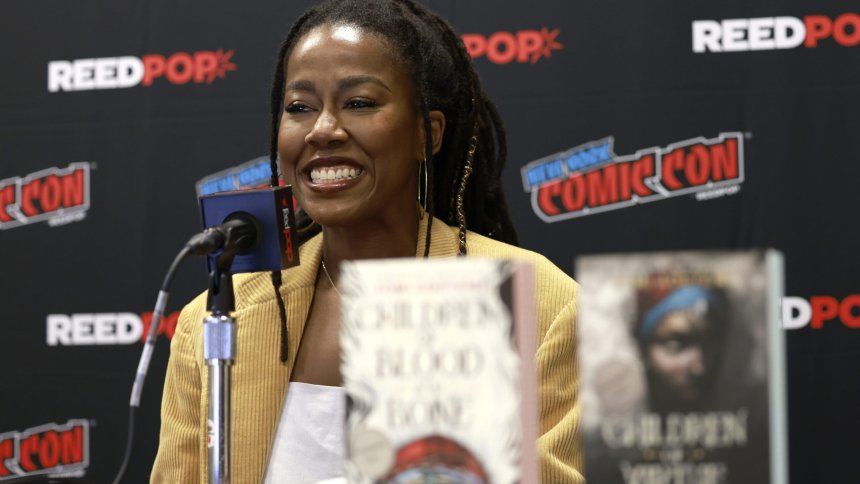

As backlash mounts after Tomi Adeyemi said she was distancing herself from “Children of Blood and Bone,” we think of others.
Since the author Tomi Adeyemi publicly expressed that she is distancing herself from the adaptation of her novel “Children of Blood and Bone,” slated to land in theaters in January 2027, directed by Gina Prince-Bythewood and starring Thuso Mbedu, Amandla Stenberg, Damson Idris, Viola Davis, Cynthia Erivo, Idris Elba, Regina King, and more, she has ignited nearly as much conversation as the highly anticipated upcoming film itself.
The public discourse around Adeyemi and “Children of Blood and Bone” intensified earlier this summer when Stenberg, responding to criticism over her casting as Princess Amari, said she had the author’s approval to take on the role. Adeyemi quickly jumped online and clarified that wasn’t the case and that, despite being credited as a co-writer and executive producer on the adaptation, the bestselling author explained she has distanced herself from the project and said she would neither watch the film nor discuss it any further.
In what she described as her final word on the matter in an emotional video shared to social media this week, Adeyemi hinted at a “traumatic” experience during production that she said those behind the scenes are well aware of. Calling it “the worst thing I have ever had to live through,” she revealed that at one point she left the set “hyperventilating and sobbing,” though she declined to elaborate further.
Some fans have applauded her honesty, while others have accused her of unfairly undermining a film audiences have yet to see. The discourse has quickly grown beyond the project itself, kicking off a debate over whether authors should publicly criticize adaptations of their work or let them stand on their own.
History, however, suggests there isn’t a simple answer. Long before Adeyemi, plenty of other authors have publicly wrestled with what happens after their stories leave the page and enter Hollywood. Black literary giants Alice Walker and Toni Morrison, in particular, found themselves navigating that same complicated space, though they arrived at very different conclusions.

After Steven Spielberg’s 1985 adaptation of Walker’s novel, “The Color Purple,” which was widely celebrated by critics and earned 11 Academy Award nominations, the Pulitzer Prize-winning author later spoke openly about one creative decision she believed fundamentally altered the story. She was very disappointed that the film largely softened the romantic relationship between Celie and Shug Avery, whose love she viewed as central to Celie’s healing and self-discovery. Spielberg has since acknowledged dialing back the characters’ physical intimacy in hopes of avoiding an R rating, a compromise Walker believed came at the expense of one of the novel’s emotional cornerstones.
In later years, Walker made clear that her disappointment wasn’t rooted in Spielberg alone but in the realities of Hollywood as it existed in 1985. She suggested the industry simply wasn’t prepared to faithfully bring every aspect of her novel to the screen, particularly its portrayal of Black women’s love. At the very same time, Walker also famously found herself under attack from another direction. There were some Black male critics and community organizations who accused “The Color Purple” of reinforcing racist stereotypes of Black men, igniting a fierce public debate and even calls to boycott the film.
The backlash became so overwhelming for the writer that she later said she withdrew from public life for a time to escape all the scrutiny. Decades later, “The Color Purple” has only continued to evolve through a Broadway musical and a 2023 movie musical.

Meanwhile, Morrison held a remarkably different view of adaptation. After Oprah Winfrey spent more than a decade convincing the Nobel laureate to allow her novel “Beloved” to be adapted and then bringing the Pulitzer Prize-winning novel to the screen herself, the 1998 film ultimately became one of the biggest commercial disappointments of the media mogul’s career. The film completely flopped at the box office and received mixed reviews. Morrison, however, never publicly condemned the film.
In fact, long before “Beloved” reached theaters, the late author often pushed back on the very idea that a novel needed to become a movie at all. Rather than judging films by how faithfully they recreated every scene, she argued that novels and movies were fundamentally different artistic languages, describing adaptation as “an ongoing battle between the images of language and the images of the image.” She even referred to “Beloved” as “a good movie,” while maintaining that a film could never replace the experience of reading the novel because the two mediums were trying to accomplish different things.
That perspective was also consistent with one of Morrison’s most enduring beliefs about authorship itself.
“I was always annoyed,” she famously told Time magazine at the time of students asking when “Beloved” would be adapted. “I told them that a novel is not what happens before the movie. Why can’t it just be a book?”
Share
What's Your Reaction?
 Like
0
Like
0
 Dislike
0
Dislike
0
 Love
0
Love
0
 Funny
0
Funny
0
 Angry
0
Angry
0
 Sad
0
Sad
0
 Wow
0
Wow
0



![Stream: Tank’s ‘Experience’ Album [featuring Kirk Franklin, Remy Ma, Fred Hammond, & More]](https://thatgrapejuice.net/wp-content/uploads/2026/08/Tank-Experience-Album-Cover-thatgrapejuice-2026.jpg)
![2026 MTV Video Music Awards: Red Carpet Arrivals [Photos]](https://thatgrapejuice.net/wp-content/uploads/2026/09/vmas-2026-red-carpet-tgj-scaled.jpg)