The Gas Is Too High: What Triple Digit Oil Prices Mean For You
Source: NurPhoto / Getty You’re going to be shocked hearing this, but it turns out that attacking a country with a pronounced influence on the flow of oil with no real plan actually has immediate, wide-scale consequences. Who knew? Gas prices have dramatically risen in recent weeks as a result of President Donald Trump’s decision [...]


You’re going to be shocked hearing this, but it turns out that attacking a country with a pronounced influence on the flow of oil with no real plan actually has immediate, wide-scale consequences. Who knew? Gas prices have dramatically risen in recent weeks as a result of President Donald Trump’s decision to strike Iran over dubious claims regarding its nuclear capabilities. Any hope that prices would drop in the near future appears to be shot as analysts at Goldman Sachs believe oil prices will remain in the triple digits for years.
CNN reports that West Texas Intermediate (WTI), the U.S. benchmark for oil prices, is up by 0.3% at $95.9. Brent crude, the global oil benchmark, rose 1.4% to $110.2 a barrel. The reason for the disparity is that Trump freed up some of the U.S.’s oil reserves and made efforts to increase oil production stateside. While these moves may provide some short-term relief, it’s unlikely to completely offset further price increases as the war continues.
“The persistence of several prior large supply shocks underscores the risk that oil prices may stay above $100 for longer in risk scenarios with lengthier disruptions and large persistent supply losses,” Goldman analysts wrote in a note Thursday.
One of the primary reasons oil prices have risen dramatically is that the Strait of Hormuz, the primary shipping route for the world’s oil supply, has been closed for the last 19 days. This has resulted in 20% of the world’s oil supply being choked off. Goldman Sachs predicts that if the Strait of Hormuz remains closed, oil prices will continue to rise and possibly exceed their all-time high of around $147 per barrel. That high was set in 2008, and we all remember how great the economy was then.
Israel, everyone’s favorite country, exacerbated the issue this week with strikes on Iran’s South Pars gas field. As a result, Iran launched retaliatory strikes on energy fields in Kuwait and Qatar, which has led to prices spiking even higher.
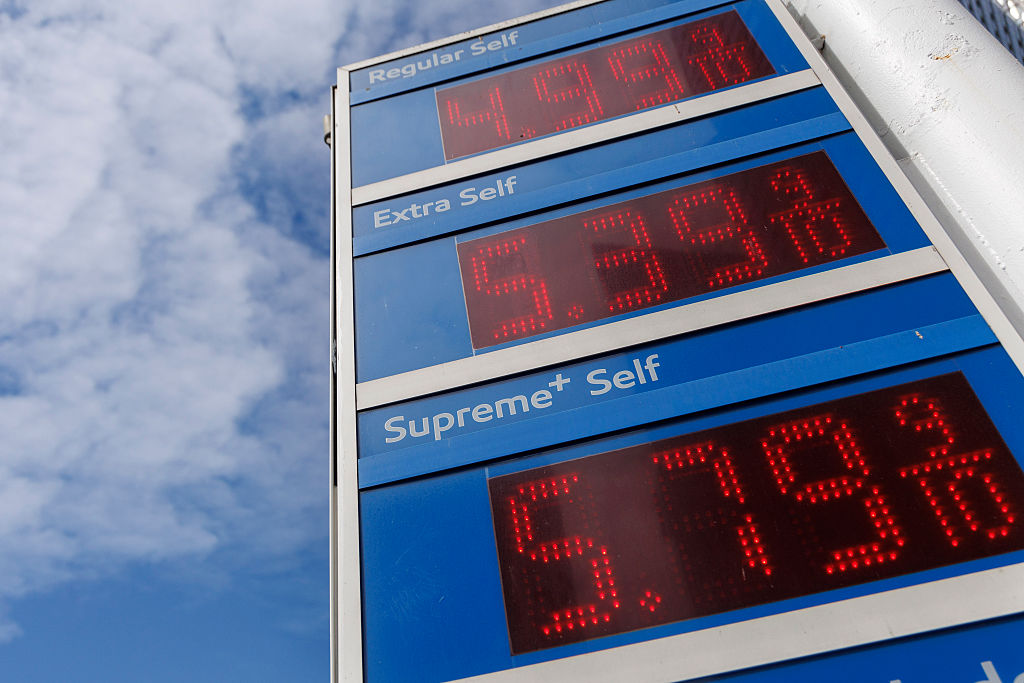
U.S. consumers have already been feeling the impact of the Iran war on oil prices at the gas pump. According to CBS News, gas prices are up nearly a dollar from before the war in Iran began. Nationwide, the average price for a gallon of gas is $3.88 as of Thursday. In my home state of Arizona, prices have spiked from $3.45 to $4.69 in only a matter of weeks.
Any uptick in gas prices affects consumer spending. The more people have to spend on gas, the less they’re able to engage in discretionary spending. There’s also the risk that the rising oil prices will have an inflationary impact on other essential goods.
From CBS News:
Economists say rising oil prices could also inject inflationary pressure into the U.S. economy as shipping costs rise.
“Even though the U.S. imports very little through [the Strait of Hormuz], it’s still causing some bottlenecks in the global supply chains that could also be inflationary,” Sweet said.
A recent analysis from Pantheon Macroeconomics found that if oil prices increase to $150 per barrel and stay at that level for three months, the Consumer Price Index could jump to an annual pace of 6%, up from 2.4% recorded in February.
Experts have warned consumers could start to see higher food prices, as the conflict drives up the price of diesel, the fuel used by trucks and barges that transport U.S. goods. Earlier this week, diesel surpassed $5 a gallon for the first time since 2022.
Should fuel and shipping costs continue to rise, we could see more companies trigger layoffs to offset these costs. “This is when you start getting concerned about that vicious cycle,” Samuel Tombs, a chief U.S. economist at Pantheon Macroeconomics, told CBS News. “Businesses start to lay off workers, and then that also hits consumption.”
Speaking for myself, I’m sitting my happy tail down for the foreseeable future. I’ve got a backlog of video games to beat, a stack of Blu-rays to watch, and plenty of shows to binge. Unless it’s a baddie asking me to do something, I ain’t burning gas if I don’t have to. I’m probably not alone in this line of thinking, which illustrates how gas prices are affecting consumer spending and harming the economy as a whole.
I wish I had some good news on the economic front, but all signs point to prices getting much worse before they get better.
SEE ALSO:
Iran War Already Increasing Gas Prices, Mortgage Rates
From Groceries To Cyberattacks: How The Iran War Is Affecting The US
First 6 Days Of War On Iran Cost US $11.3B, Pentagon Says
Share
What's Your Reaction?
 Like
0
Like
0
 Dislike
0
Dislike
0
 Love
0
Love
0
 Funny
0
Funny
0
 Angry
0
Angry
0
 Sad
0
Sad
0
 Wow
0
Wow
0