‘Our attention spans are so short’: Organizers fight to keep Nolan Wells’ case in the spotlight
Months after Nolan Wells’ death, local organizers and “One March, Fifty States” are demanding answers through nationwide marches. It has


Months after Nolan Wells’ death, local organizers and “One March, Fifty States” are demanding answers through nationwide marches.
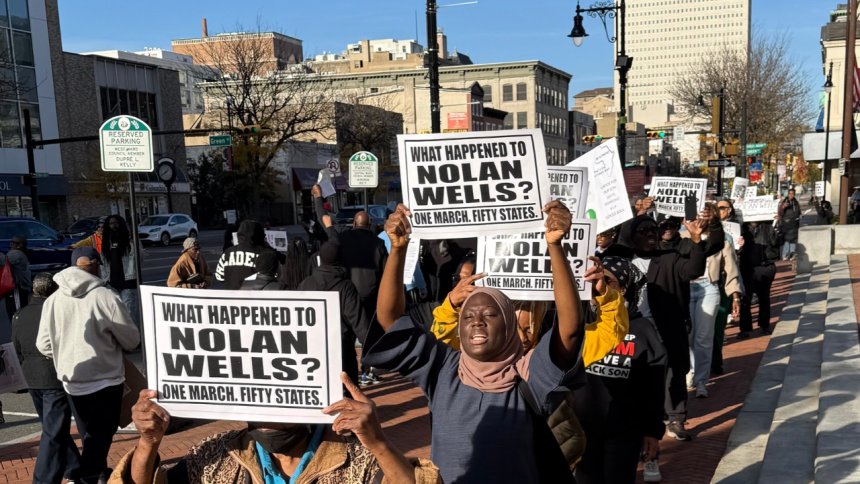
It has been 129 days since Nolan Wells’ body was found on Horn Island, Mississippi, and communities are still awaiting answers on the investigation into the teen’s mysterious passing. And recently, communities took their advocacy from social media to the streets. Organizers across the country collaborated with “One March, Fifty States” to organize Marches in Alabama, California, Connecticut, Delaware, Florida, Kansas, Illinois, Louisiana, Maryland, Montana, Nevada, New Jersey, Ohio, Oklahoma, Pennsylvania, Tennessee, Texas, Virginia, Washington, Washington, D.C., and Mississippi on November 1, 2026.
“History has shown us that some of the greatest changes in this country started with people taking to the streets and demanding justice,” Evelyn Green, the lead organizer of the demonstration in Newark, New Jersey, told theGrio. “One march won’t change everything, but it can spark a movement, inspire action, and remind people in power that we’re watching.”
She continued: “It brings awareness not to us, because we know what’s going on. It brings awareness to the powers that be, and it lets them know that, ‘hey, we see you, and we’re not going to forget about this.’”
A mother of four Black boys, a real estate agent, and a community organizer, Green’s decision to organize the Newark March stemmed from a sentiment many communities across the country have felt: “Enough is enough.” In Newark, roughly 60 to 70 people gathered for the November 1 march. Among them were Green’s three youngest sons, ages 10, 9, and 6, who chanted “Justice for Nolan Wells” alongside the crowd. Watching them, Green said, inspired her to start a youth-focused initiative of her own to foster the next generation of activists from elementary school and up.

“The conversation is painful,” Green said, reflecting on her experience explaining Wells’ death to her children. “I wasn’t just talking about Nolan Wells; it was about all the other things that have taken place and that are still taking place to this day. It’s a hard thing to do. It’s sad.”
Since news broke of Wells’ suspicious passing, communities across the country have paid close attention to the state’s investigation of his death, particularly as more and more conflicting details surfaced.
“From the beginning, it just didn’t seem right. Things were not adding up,” Lawrence Hamm, chairman of the People’s Organization for Progress told the Grio. “Why didn’t he have his cell phone with him? Why was his cell phone found in someone else’s home? He was found in the water off the coast of Horn Island. Why would he leave his cell phone, and why would he let his friends leave him if he didn’t have a way to get home?”
In September 2026, a Mississippi grand jury returned a “no true bill” decision, meaning they were not presented with enough evidence to pursue criminal charges in the death of Nolan Wells with probable cause. The decision sparked outrage among the teen’s family and communities across the country.
“What we were left with were many, many inconsistent stories,” Nolan’s mother, Christine Wonsley, said of the decision. “I cannot take that ruling, and I cannot move on with my life. We have been left with more questions and heartbreak than any answers.”
As Wells’ family and attorney continue to seek answers through legal channels, community organizers like Green and Hamm of the People’s Organization for Progress—a grassroots organization advocating for racial, social, and economic justice—are working to keep the teen’s case in the public eye because, as Green notes, “our attention span for this type of thing is so short.”
Over the years, Black communities have tragically grown accustomed to headlines about Black lives lost under suspicious circumstances or through violence. In an era when people are constantly bombarded with news and ever-changing trending topics, organizations like “One March, Fifty States” remind everyone that one question remains unanswered: “What happened to Nolan Wells?”
View this profile on InstagramONE MARCH. FIFTY STATES.™ (@onemarchfiftystates) • Instagram photos and videos
“This fight is bigger than Nolan Wells. It’s about justice, accountability, transparency, and the value of human life, especially Black ones. You don’t have to know Nolan Wells personally to care about what happened to him… Today it may be somebody else’s child, but tomorrow it could be yours,” Green noted. “We will not be silent anymore. We will not just let this pass like we did all the last ones.”
“The Nolan Wells case is such a tragic case, and is so emblematic of the issues that face young Black people. He was a young Black man, high school graduate, college student, star athlete, a bright future ahead of him, and all of a sudden that future was snatched away,” Hamm told theGrio. “We should not rest until we get some modicum of justice for the family of Nolan Wells: justice for the victim, and justice for the family.”
Share
What's Your Reaction?
 Like
0
 Dislike
0
 Love
0
 Funny
0
 Angry
0
 Sad
0
 Wow
0