‘Let’s not call him a man’: Nolan Wells’ mother reminds us why words matter when describing Black children & teens
Nolan Wells’ mother’s correction of the use of the word ‘man’ to describe her son reflects discourse on how Black

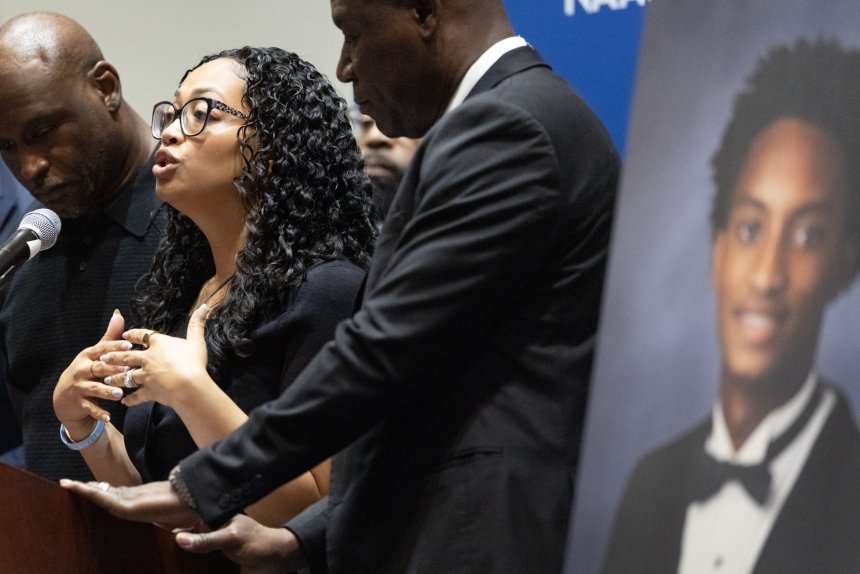

Nolan Wells’ mother’s correction of the use of the word ‘man’ to describe her son reflects discourse on how Black children are seen, described & remembered.
Words have meaning, and those meanings matter. It’s one of the first lessons we learn in grade school, yet as adults, it’s one we constantly need to relearn, especially when it comes to how we talk about Black children and Black lives.
NBC News reporter Yasmine Vossoughian got that reminder recently while interviewing Elmore and Christine Wells-Wonsley, the parents of Nolan Wells, when she referred to their late son as a “man.”
“Let’s not call him a man because [at] 18, you’re still a teenager. I know by law you’re an adult. Nolan was—he was a boy. He was a child. He was our child,” Christine told Vossoughian. “So, for everyone watching, please stop referring to him as a man because he was a teenager. He was 18 when he left this earth.”
Some might dismiss the correction as semantics, or as a grieving mother who will always see her child as her child. But Black communities understand why the distinction between “man” and “teenager” matters so much.
For decades, Black children have been subject to adultification bias, the tendency to treat children as adults. However, this tendency is particularly harmful as it strips children and teenagers of the assumed innocence and vulnerability that are typically associated with childhood.
Research shows that white youth are often not considered fully responsible for their actions until they reach their late 20s. In contrast, Black children are frequently viewed as adults by the age of 13, or even earlier. They are perceived as older, less innocent, and more threatening than their white peers of the same age.
“How we talk about our children matters, and Nolan Wells deserves to be remembered exactly as he was,” Attorney Ben Crump, who is representing the family, captioned an Instagram post.
“You gon learn today! They are always trying to adult our babies- they did that to Trayvon and Tamir,” actress Holly Robinson Pete noted in the comments.
Another user wrote: “She naturally clocked what the press has intentionally done for years. And it’s still a problem, every single time it happens. I’m glad that she called it out.”
Since news broke of Wells’ disappearance and passing, Black communities around the world have adopted the late teen as their own in a way that feels almost ancestral. They have grieved alongside the Wells-Wonsley family, covered them in prayer and virtual hugs, and continually brought Nolan’s name back to the forefront of their timelines as they waited for updates.
The case of the teenager whose Fourth of July boat day became a fatal mystery shook Black communities deeply. So much so, just as it is in the cases of Daniel Erving, 18, and Tyler Smith, 18, Nolan Wells became everyone’s child, because, for so many of us, the truth is painfully simple: it could have been any one of our children, brothers, cousins, uncles, friends, co-workers, or classmates.
That shared sense of understanding helps explain the extraordinary level of care Black communities and Black journalists have shown in the way they speak about Nolan, mourn his passing, and continue to hold his name close.
View on Threads
“We as Black Americans have always had to rely on ourselves when it came to telling the truth about our stories, to telling our stories with dignity, to telling our stories with humanity, to telling our stories with love, with respect,” journalist, author, and former Good Morning America anchor Janai Norman previously told theGrio. “We’ve always had to rely on ourselves. 2026 is no different.”
And despite her grief at the end of the NBC interview, Christine made clear what that responsibility looks like now.
“We have to stand up for Nolan because we are his voice now, because Nolan is not here. And please remember, the only victim in this situation is Nolan,” she emphasized. “Before all of this, before the hashtag, Nolan is our child, and he will always be our child.”
Share
What's Your Reaction?
 Like
0
Like
0
 Dislike
0
Dislike
0
 Love
0
Love
0
 Funny
0
Funny
0
 Angry
0
Angry
0
 Sad
0
Sad
0
 Wow
0
Wow
0