Law signed by Trump for Holocaust survivors proves reparations is possible, just not for Black Americans, say advocates
“The question that we have is not whether the U.S. can and does provide restitution, it’s who gets it and

“The question that we have is not whether the U.S. can and does provide restitution, it’s who gets it and who is able to make the claim.”
A bill signed into law expanding legal pathways for Holocaust survivors to retrieve stolen artifacts and property is bringing the reparations fight for African Americans back into the forefront, as advocates point to the bill as further evidence that the United States is capable of remedying harms done to a racial or ethnic group.
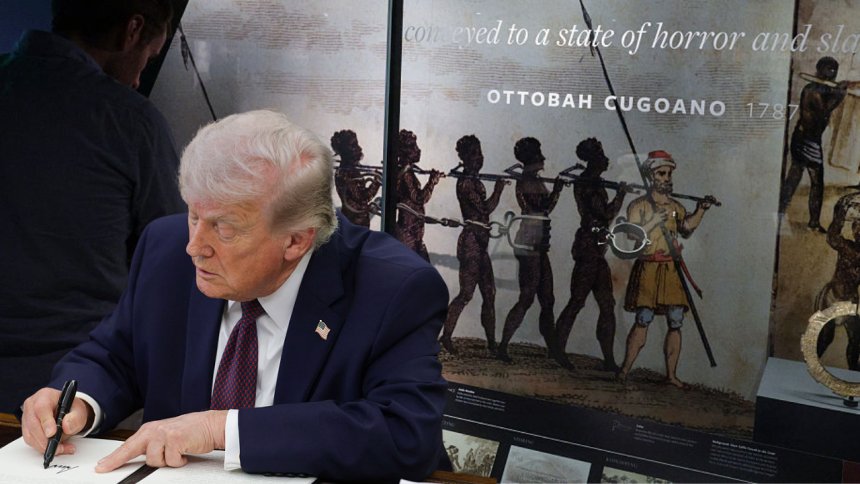
On Monday, President Donald Trump signed the Holocaust Expropriated Art Recovery (HEAR) Act of 2025, a bill passed by Congress that updates a law that establishes a process for Holocaust victims and their heirs to recover artwork and cultural property stolen by Nazis between 1933 and 1945. The law was initially signed by President Barack Obama in 2016.
The updated bipartisan law, signed by Trump, permanently extends and expands judicial authority, expands federal court jurisdiction, and strips away legal defenses used by museums and institutions to dismiss claims.
Racial justice advocates say that while they welcome the law establishing redress for Jewish victims, the law illuminates obvious hypocrisy and contradictions as it relates to reparations for the descendants of enslaved Africans.
“The question that we have is not whether the U.S. can and does provide restitution, it’s who gets it and who is able to make the claim, and what barriers are there to making the claim,” said Dreisen Heath, a reparations researcher and founder of the Why We Can’t Wait Reparations Network.
Heath, who has advised on reparative justice legislation on Capitol Hill, told theGrio that the HEAR Act strips away the types of “legal barriers” that Black communities continue to face in achieving justice for both historical crimes, since their enslavement in 1619, and present-day crimes. She explained, “Historical crimes as it relates to lynching and forced displacement and racial terror, all the way to police violence with qualified immunity; all of these different features that are protected by the legal system.”
She continued, “It just continues to show what’s possible and what’s feasible.”
Throughout decades of advocacy, both within and outside of the federal government, generations of racial justice advocates have pushed for various forms of reparations for Black Americans, from an official apology on behalf of the United States to H.R. 40, first introduced in the U.S. House of Representatives in 1989, to establish a commission to study the impact of chattel slavery and recommend economic and social remedies to redress its generational harms. 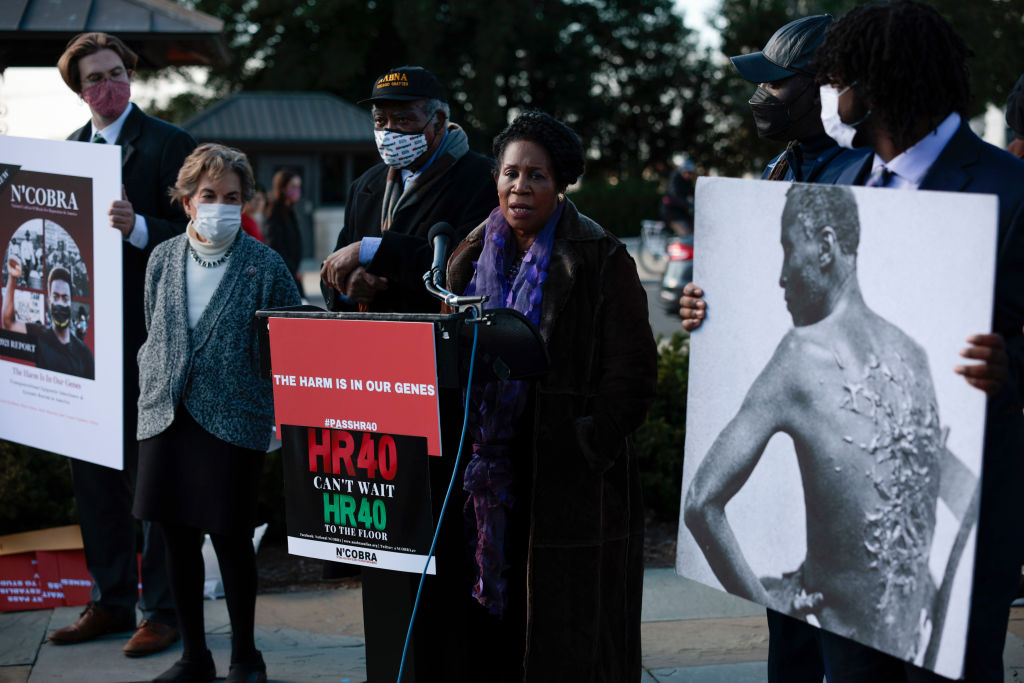
“Whenever it’s about African Americans and slavery, people make reparations like it’s a dirty word or never going to happen,” said Dr. Marcus Anthony Hunter, a professor of African-American studies at UCLA who has worked on reparations legislation and advised members of Congress.
Dr. Hunter, who is also the author of “Radical Reparations: Healing the Soul of a Nation,” tells theGrio that the signing of the HEAR Act shows that “reparative justice policies can be enacted swiftly” but also reveals a “recognition hierarchy.” He explained, “Not so much that perhaps deservingness isn’t there; it’s just that in the hierarchy of harm and historical harms, the Holocaust seems to remain at the top, and American slavery remains somewhere at the bottom.”
The signing of the HEAR Act also comes just weeks after the U.S. government voted alongside Israel and Argentina as the only nations in the world to reject a United Nations resolution declaring the Transatlantic Slave Trade the “gravest crime against humanity.” In defending its “no” vote, U.S. Ambassador Dan Negrea said voting yes would create a “hierarchy” of crimes against humanity. Advocates say U.S. actions like the HEAR Act and reparations issued to Japanese Americans incarcerated during World War II, while repeatedly turning a blind eye to reparations for African Americans, are a blatant contradiction.
“It is revealing,” said Dr. Hunter. “There’s a different access point that certain groups have to our government…there are folks receiving legislation, receiving repair, receiving forms of restitution through the same mechanisms that are not working in favor of the same request coming from African Americans around chattel slavery.”
Another frontier in the battle for reparations was highlighted on Wednesday at the UN Permanent Forum on People of African Descent in Geneva, Switzerland. Ironically, the international body’s agenda, like the HEAR Act, focused on the return of cultural artifacts.
During the meeting, Rev. Mark Thompson, an activist and member of the United Nations Economic and Social Council, highlighted a report that found that 90-95% of Africa’s cultural heritage is held outside the continent. 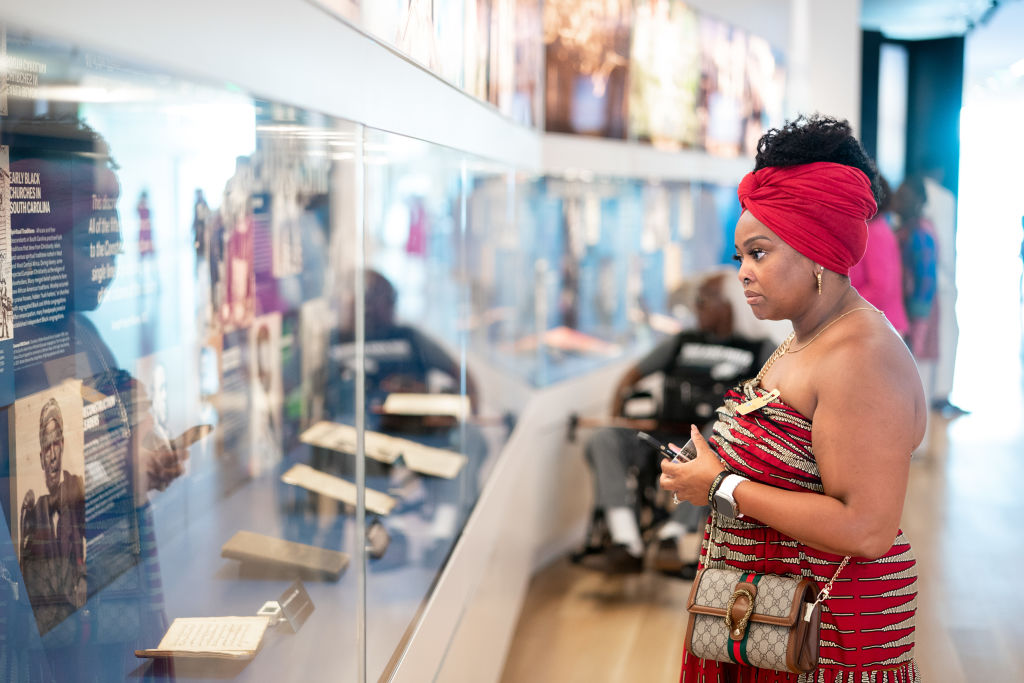
“That includes an estimated 70,000 artifacts in Paris, 73,000 in London, 180,000 artifacts in Belgium, and an estimated 500,000 artifacts in Germany. When looking at the diaspora as a whole, including the Americas and Europe, the concentration of these artifacts remains overwhelmingly in the hands of major Western national institutions, rather than the descendant communities themselves,” explained Thompson.
He continued, “The piracy of African diasporic cultural artifacts touches the injury areas of physical and mental injury, emotional suffering, economic loss, substantial impairment of fundamental rights, loss of peoplehood and nationhood, and education.”
Thompson added, “We were the first civilization. We deserve to have our artifacts returned.”
Heath, of the Why We Can’t Wait Reparations Network, tells theGrio that other examples of lost artifacts and belongings can be found in places like Tulsa, Oklahoma, where Black residents were murdered, and their communities were burned in a race massacre in 1921.
“Their community wasn’t just run down by the coordinated effort of the city, state, and county to expel Black folks. Their homes were also looted. Their family Bibles, their business ledgers, their photographs, jewelry that’s passed down from formerly enslaved grandparents…those are material evidence of Black humanity and Black progress,” explained Heath. “Just even from these hyperlocal cases, we can see through state-sanctioned violence, what has been taken, let alone what artifacts did not come over the oceans.”
The racial justice advocate emphasized that, in addition to mechanisms through the federal government, there are “communal practices” that can be undertaken to reclaim possessions belonging to Black victims of racial violence. She shared as an example of a reparations network of Japanese Americans surveying eBay and auction sites for items belonging to family members that are being sold without their knowledge.
“Imagine picking up a newspaper ad or signing online, thinking you’re going to buy a new hot pair of Nikes, and you come across this deeply meaningful and emotional piece of family history,” she tells theGrio.
And while there are cultural institutions like the Smithsonian dedicated to identifying and preserving Black artifacts, Heath points to the Trump administration’s efforts to police and overhaul it.
“Those cultural institutions are under attack as well. So it’s all this cycle of preservation that we have to stay committed to,” she said.
Share
What's Your Reaction?
 Like
0
Like
0
 Dislike
0
Dislike
0
 Love
0
Love
0
 Funny
0
Funny
0
 Angry
0
Angry
0
 Sad
0
Sad
0
 Wow
0
Wow
0