If AI destroys the books, who preserves Black history?
Reports of AI companies buying and destroying books to train AI models have sparked discussions about history preservation. These days,

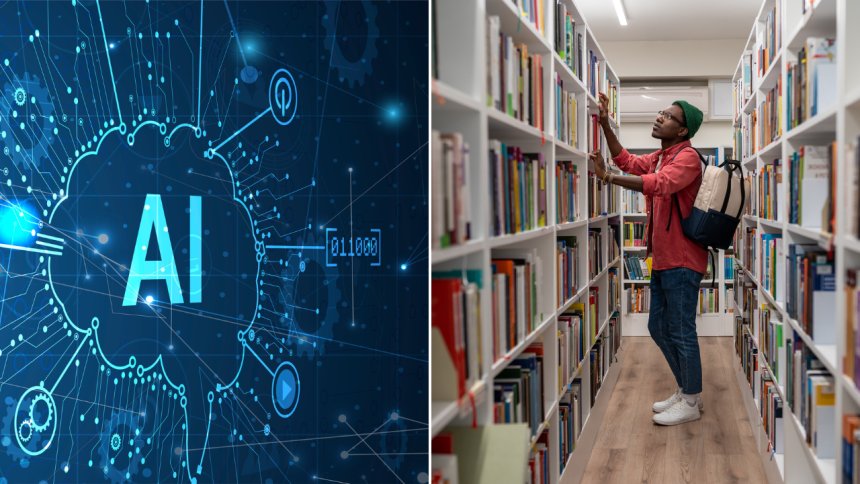

Reports of AI companies buying and destroying books to train AI models have sparked discussions about history preservation.
These days, it can feel like AI is everywhere. But while some corners of the internet are leaning into the power and convenience of artificial intelligence, others are clutching tighter to analog media and the systems that sustain it. So when reports surfaced that AI companies were buying physical books, cutting off their spines, scanning them, and then destroying them to train their AI systems, many social media users, book lovers, and academics like Shae Omonijo were outraged.
View on Threads
View on Threads
For Omonijo, a Harvard PhD candidate, intellectual historian and founder of Critical Thinking Labs, the news was particularly frustrating. Having handled and dealt with a number of undigitized rare books, texts and archives in her studies, she notes how “heartbreaking” it is to see videos of these machines destroying the bindings of a book.View on Threads
“That breaks a historian's heart as well. That breaks the archivist's heart as well because we know how much time and care it takes to work with these materials to handle them properly,” she shared with theGrio.
However, from a cultural perspective, the idea of these companies destroying rare physical copies of books is particularly alarming. Literature, whether fiction or nonfiction, has often been a space for authors to comment on elements of society and reflect on historical events and eras. It plays a key role in understanding history, especially the experiences of marginalized communities. For Black communities, books have served as a tool to understand the impacts of slavery beyond the limited recounting often seen in textbooks and class lessons.
So, while there are no reports of which titles have been destroyed to train chatbots, Omonijo reflected on how the preservation of Black history even came to be.
“When you're thinking about a lot of Black history that we have today, that I reference, the archives I go to are because of people I would call guerrilla archivists. It's people who said, 'I'm not going to wait on an institution or a body of funders to tell me that this work is important and valuable,' right? So much of what we have is individuals donating personal papers, personal mementos, personal things to make sure that history lives on,” she explained.
This mentality, she says is the secret to surviving this super technology-focused era in the U.S.
“I'm actually an optimist. I'm also a historian, so I just know how much people taking matters into their own hands matters. Whether it's obtaining freedom and liberation, documenting our histories, creating a form of joy as resistance, whatever it may be, there's always a level of human agency. And that's what we need more of in the age of AI: a reiteration and rearticulation of human agency that nobody can take away from us.”
“Nothing can quench the human desire to want to know more because once again, I truly believe in that innate human desire to seek knowledge and wisdom is not going away,” she added.
And in addition to independent entities like Black Market Vintage, Schomburg Center for Research in Black Culture and the Association for the Study of African American Life and History (ASALH), she says the first step in doing that is by building your own library and archive of physical books, knowledge, and history. From diaries to old notes, to recipes, to photos, Omonijo says even the most trivial things can hold a breathless amount of wealth in the future.
“And I'm not even talking about millions,” she shared. “I'm talking about there's a certain level of wealth you have that comes from knowledge, that comes from understanding, that comes from knowing where you come from, and the histories that came before you, and the ideologies and ideas and wisdom that came before you.”
“I think it's important to own your books because, while digital copies are convenient, they can be taken away for one reason or another. So I always say own physical copies. Always make sure you're building your archive, and also most importantly, look at the people in our community that hold our histories. Individuals can take it upon themselves to preserve their culture and their history”
Beyond these analog items, the Critical Thinking Labs founder encourages Black communities to remember, honor, and celebrate the “embodied knowledge” we all carry.
“You carry physically in your body forms of knowledge, whether it's your memories, whether it's physically in your body, whether it's you know markings or things on your body, you carry that knowledge, and I don't want us to downplay or negate or to diminish it just because it doesn't look like other forms of intelligence or other forms of knowledge,” she concluded.
So ultimately, while administrations attempt to edit our history and AI companies quietly feed our books to the machines, the power to preserve our culture remains, as it always has, in our own hands. Because at the end of the day, we don't just keep Black history and Black culture. We are Black history.
Share
What's Your Reaction?
 Like
0
Like
0
 Dislike
0
Dislike
0
 Love
0
Love
0
 Funny
0
Funny
0
 Angry
0
Angry
0
 Sad
0
Sad
0
 Wow
0
Wow
0