How retiring ESPN executive David Roberts built a career on results and respect
As a kid growing up in Detroit in the 1950s and ‘60s, David Roberts loved baseball. He lived a few miles from the Detroit Tigers’ home stadium. But young Dave was a Cleveland Indians fan – because his grandfather told him the Tigers, due to racist ownership, had been one of the last Major League [...]


As a kid growing up in Detroit in the 1950s and ‘60s, David Roberts loved baseball.
He lived a few miles from the Detroit Tigers’ home stadium. But young Dave was a Cleveland Indians fan – because his grandfather told him the Tigers, due to racist ownership, had been one of the last Major League Baseball teams to sign a Black player. Cleveland, meanwhile, had integrated the American League in 1947 with Larry Doby, a few months after Jackie Robinson’s debut. In 1948, Cleveland signed the Negro Leagues legend Satchel Paige, who at age 42 helped pitch the team into the World Series — where Doby batted .318 with a Game 4 home run, and Cleveland won the championship.
Cleveland understood the importance of diversity. Now, as that concept faces attacks in 2026, Roberts is retiring from ESPN, leaving a legacy of earning high ratings, cultivating talent, and proving the connection between diversity and success.
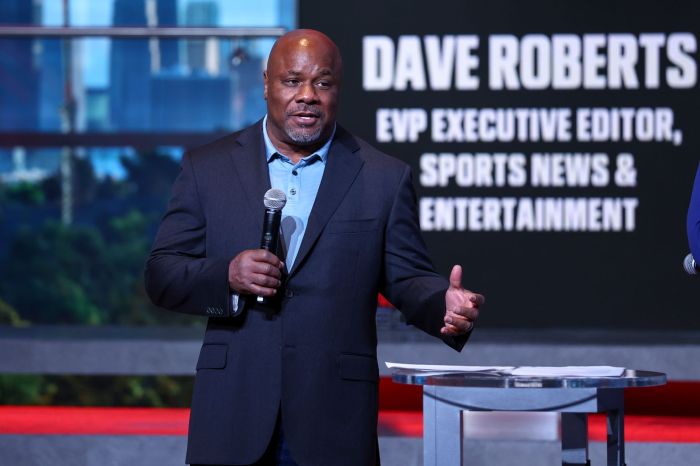
In August, after 22 years with the company, Roberts will step down from his role as ESPN executive vice president and executive editor of sports news and entertainment. During his tenure, he helped elevate ESPN personalities such as Mike Greenberg, Andraya Carter, Chiney Ogwumike, Rich Eisen, Malika Andrews and Stephen A. Smith. His purview includes all news and editorial coverage, audio and podcasts, and studio shows including SportsCenter, First Take, Get Up, Pardon the Interruption, NBA Today and NFL Live.
Roberts joined ESPN after 25 years in local television, where he broke barriers as the first Black news director in two states. He departs as ESPN linear television continues to see consistent ratings growth despite the industry-wide transition to the internet and the network’s ongoing dominance in digital media.
“Overseeing the magnitude of that content has been gratifying,” Roberts said in an interview. “It underscored the importance of having persons of color in the decision-making roles who determine who’s in front of that camera and who’s also behind the scenes, so that the diverse perspectives have the impact in reaching the diverse audience that any network should strive to serve.”
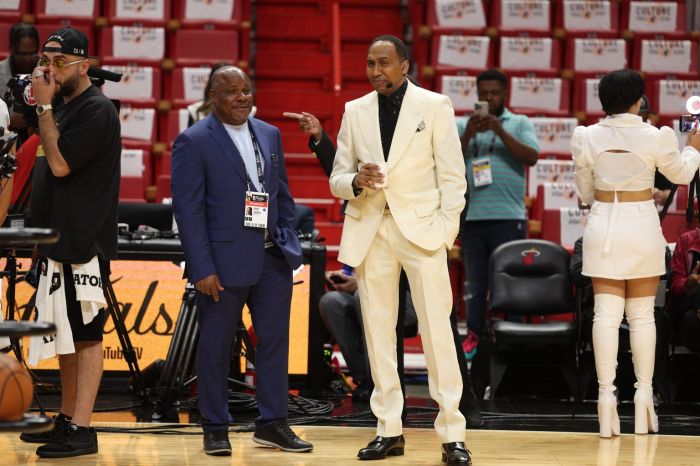
Allen Kee / ESPN Images
For Roberts, it comes down to one thing.
“It might sound simple,” Roberts told me, “but it does come back to, ‘Do they respect you? Do you have the respect? Have you earned the respect? Is that respect consistent?’ That’s what I attribute success to.”
How does a Black executive get respect in an industry with very few Black people in positions of authority? I spoke to Roberts several times for this story, and interviewed nine people who have worked with him. Everyone described him as having exceptional judgment about what the audience wants and needs, demanding excellence at all times, and being unafraid to speak uncomfortable truths.
Results are all that matter. Results get respect.
“Dave’s defining characteristics as a leader are his candor and ambition,” said Kwaku Gyasi, a producer on First Take. “He will always tell it like it is, no matter what. As a leader, he understands that those types of uncomfortable conversations are needed to ensure that everybody on the team is aware that the goal is to always improve and never settle.”
Smith, who credits Roberts with bringing him back to ESPN after an exile from 2009-11, was effusive in his praise.
“He’s incredibly demanding. He’s all about winning. The numbers, the ratings, the reviews — he pays rapt attention to that, and he’s unapologetic about it,” Smith said. “You could do 99 things right, and if that 100th thing is wrong, you’re going to hear about it. That’s how he rolled. He was that from day one. But that’s what made him a great boss.”
“David has been a transformational leader at ESPN because he helped shape the way we tell stories, he developed talent, and he created opportunities for us to expand our audience and reach new fans,” said Burke Magnus, president of content at ESPN. “He came up through local news and always brought a newsroom mentality to ESPN, stressing the importance of accuracy, preparation and enterprise reporting. Within our walls, David has also been a mentor to many, offering invaluable feedback and advice to our next generation of journalists, storytellers and leaders.”
While Roberts is known for his work elevating some of ESPN’s biggest stars, he also quietly pushed for improved journalism standards and greater inclusion behind the scenes, serving on the company’s standards-guiding editorial board for a time and as executive champion of Pulse, a Black employee resource group.
Said senior studio operator and Pulse co-chair Shadeed Sharpe: “He was in a position to make a lot of calls that will have a lasting impact on this company, and I don’t think you can perform in that role — and better yet, excel in the role the way that he did — without having the respect of those around him … whether they were reporting to him or if he was reporting to someone.”
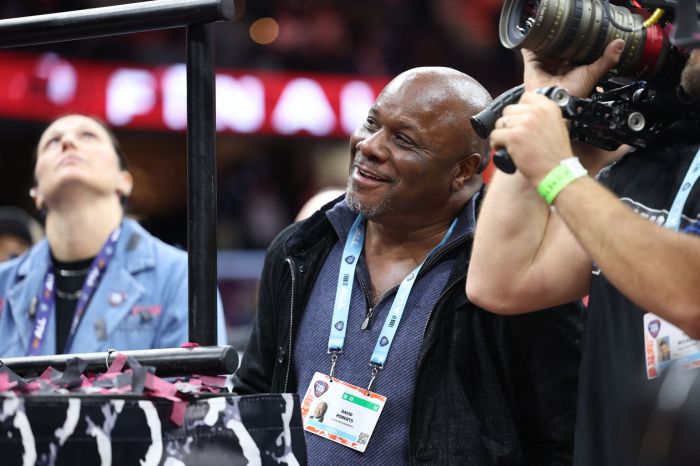
Allen Kee / ESPN Images
Roberts grew up in southwest Detroit. His mother was a hospital nurse, and his father owned nightclubs. While attending Southwestern High School, Roberts started working at the National Bank of Detroit as a processing clerk. The job helped pay his way through Wayne State University, where he majored in mass communications and broadcast journalism.
After a while, Roberts noticed the Black employees at the bank were concentrated on the eighth and ninth floors, and confined to the lowest-paying jobs. In the summer of 1978, Roberts and two other employees filed a class action lawsuit against the bank, which eventually paid them a settlement. The lawsuit also became the subject of Roberts’ college thesis.
“I didn’t like how the lawsuit was covered,” Roberts said. “It wasn’t covered enough. It was covered on the surface, and I didn’t like how I was portrayed. So that was one of the driving forces of saying, “OK, I definitely want to be in the news business.”
Roberts graduated and began his career in 1978 on camera as a reporter for Detroit’s legendary Black-owned TV station, WGPR. In 1980, he became a reporter for WFMY in Greensboro, North Carolina, where a dinner with civil rights leader Cleveland Sellers changed his life.
Over fried fish and spaghetti, Sellers advised Roberts to get off camera and move into management — because the people behind the camera make the decisions.
In 1982, Roberts returned to Detroit as an assignment editor at WJBK.
“I was like 26 years old. I was able to come in there and push the reporters, decide what we were covering on a day-to-day basis or sit in the meetings and say, ‘We need to do this, this, and this.’ Detroit at that time was a top 10 market. It’s where I grew up, and so it was a big opportunity to make an impact on what people saw in their evening news.”
This is when Roberts met Isiah Thomas, whom the Pistons drafted in 1981.
“When I got into the NBA, the people covering the league were 98 or 99 percent white males, and their perspective was what carried the day,” Thomas told me. “You look at Stephen A. Smith and Mike Wilbon and all them, they weren’t always at the Finals. David Aldridge wasn’t always at the Finals. We fought, and Dave fought here from Detroit, to have those voices be heard. He was able to highlight and spotlight some of those diverse opinions coming into the media. Dave was very instrumental behind the scenes during that period of time, and still today.”
Roberts moved up to executive producer positions at KFSN in Fresno, California, and WGHP in High Point, North Carolina. His next stop was assistant news director at WDTN in Dayton, Ohio. In 1987, the position above him became available.
“David Roberts walks in my door and says, ‘I want to be the news director,’” recalled Phil Stolz, who was general manager of the station at the time and later became a senior vice president at Hearst Television. “I gave him the job because he was very impressive from the get-go. Just an intense guy, but wanted everybody to do their jobs right. He was a very smart guy. You could tell right away he knew what he was doing. And our ratings started to grow.”
The promotion, in 1987, made Roberts the first Black news director in Ohio. One of his strongest memories is a conversation with Paul Warfield, the Hall of Fame wide receiver Roberts hired as an analyst at WDTN. When Warfield played for the Cleveland Browns in the 1960s, one of his teammates was cornerback Ben Davis.
“I asked Warfield why did the Cleveland Brown fans boo their cornerback, Ben Davis. He was really good,” Roberts recalled. “Every Sunday, you’d hear them introduce this guy, and he would get booed consistently.”
Warfield smiled and explained that the boos weren’t really about Davis himself, but Davis’s sister: political activist Angela Davis, whose involvement with the Communist Party and Black Panther Party made her a controversial figure in the 1960s.
When Stolz left Dayton for Baltimore’s WBAL, he brought Roberts as news director. In 1996, Roberts became the first Black news director in Georgia when he took the job at WXIA in Atlanta.
“David set the tone of, ‘We’re going to do our jobs, and we’re going to do it right,’” Stolz said. “We’re going to cover the news and not fool around with all this superfluous stuff that didn’t get us any ratings. He was in command of that newsroom, and people knew. He was a leader.”
After four years at WXIA, Roberts moved to WUSA in Washington, D.C., as news director.
“I couldn’t get the ratings up, so they fired me,” Roberts said. “I could have been a news director somewhere else, but I said, ‘Enough of this moving around. I’m going to do something a little different.’ That’s how I ended up at ESPN.”
Melina Pizano / ESPN Images
In 2004, when Roberts moved to Bristol, Connecticut, to start working at the Worldwide Leader, management was overwhelmingly white and male. But ESPN knew that to appeal to the widest possible audience, it needed the widest possible range of perspectives on its staff — especially since so many athletes and viewers are Black.
During a time of huge transformation in the TV industry, Roberts helped steer ESPN into a new era. He helped decide what people saw on SportsCenter and other shows — from the subjects that were chosen to the direction of stories to the faces delivering the news on screen.
“As the audience is changing, the needs of the audience changes,” Roberts said. “There was a need for a sense of immediacy, which made it easy to say that, ‘Look, our focus is going to be covering the news, covering breaking news.’ And the other factor in that evolution is trying to identify talent that breaks through, whether it’s Christine Williamson or Amina Smith or Mike Greenberg on Get Up. Someone of the caliber of Stephen A. Smith is a breakthrough talent, whether you like him or not. You have to have talent that is memorable, that resonates and will cut through the clutter, because there are so many choices out there. You have to constantly be nimble and ready to change as the industry changes and the audience habits change.”
Through it all, Roberts operated as he had during the previous 25 years of his career — speaking the truth, no matter how unpopular it might have been.
“Dave and I have had some tough conversations,” said ESPN producer Demetrius Harris, who helped launch WNBA Countdown and has worked on several top shows. “Literally, Dave has looked me in my eye and said, ‘You know, I’m hearing some folks say they don’t think you’re good enough right now. Why am I hearing this?’ Dave has told me things my manager wouldn’t even tell me.”
Roberts’ role in getting Smith back in the ESPN family may be his most valuable contribution to the network.
In 2011, Roberts was a vice president and senior coordinating producer overseeing radio and the ESPNews channel. Smith was on the outside of the network looking in after being unceremoniously let go in 2009. ESPN made him a lowball offer to return on radio only — no television.
“Dave Roberts said to me, ‘I know that the offer is not fair. I know it’s not ideal, but I believe in you,’” Smith told me. “’I believe you’re gonna kick ass. Please take this offer and do what you do. Everything will take care of itself.’”
Would Smith have ended up the face of ESPN anyway, without Roberts’ vision? It’s hard to say, but there’s no denying that Roberts foresaw him as one of the biggest stars in sports media history.
“No way I would be where I am today without him,” Smith said. “I’m incredibly grateful for what he’s done for me and my career.”
The narrative twists, though, with Smith’s recent forays into politics, which have alienated a significant portion of the Black community. It’s ironic that Roberts, who is so committed to Black opportunity, elevated a man who landed on the “Mount Rushmore of racism” at comedian Kevin Hart’s recent roast.
“I love him. And I always will,” Smith told me. “Our perspectives, our priorities can change. I understand that, but my gratitude knows no limits. My love for him doesn’t either. We can have a difference in opinion about perceived politics or roles. But Dave is a brother who looked out for a little brother and helped get me to where I am.”
Some of the biggest things Roberts and Smith did together, in terms of impact, are the First Take HBCU tours. Starting in 2019, they did live shows at historically Black colleges and universities, while also bringing students into the production process.
“Dave’s commitment to HBCUs and to making space for Black storytellers, both in front of the camera and behind the scenes, has been the best part of my career journey,” said Gyasi, the First Take producer. “Students reflect on how much they appreciate the time and effort we spend at their school, the opportunities we provide them to learn and take part in the production process, and how much we inspire them.”
When I asked Roberts for some of his favorite moments at ESPN, one of them was being at Dodger Stadium in 2022 for the 75th anniversary of Jackie Robinson breaking baseball’s color barrier. The other was from the HBCU tour.
“A student at Howard had interviewed Stephen A. when she was 6 years old, and that person got to come on the air during that HBCU show and ask him a question again as a junior,” Roberts said. “That’s what this business should always strive for – you find those memorable moments. That’s key to making sure that you break through the clutter.”
In 2021, Roberts was named senior vice president overseeing NBA production and studio shows. In 2024, he ascended to his current position as one of ESPN’s top executives. Also that year, he was inducted into the National Association of Black Journalists Hall of Fame. In 2024, he was named to the National Television Academy of Arts and Sciences honor society as part of the inaugural Sports Emmys class.
“He’s kind of like the Godfather,” Isiah Thomas said. “You had to get his blessing, but he was never overt with his power. He is one of the few people in the media I’ve run across — and I say few people — that had extreme power and chose to use their power for goodness and uplifting, as opposed to using their power to hurt and destroy.”
Roberts prepares to depart ESPN with ratings on the upswing.
“What’s happened over the last year has been very gratifying,” he said, “because I believe it’s the result of staying nimble, having the right talent in front of the camera and behind the scenes, and just knowing the audience.”
The decade before Roberts was born in Detroit, the Tigers won the 1945 World Series, when baseball was still all white.
Two years later, when integration arrived, the Tigers’ resistance sent them plunging to the bottom of the standings. Detroit did not win another title until 1968, with key contributions from Black players Willie Horton, Earl Wilson and Gates Brown.
Not only did Cleveland win the 1948 World Series with two of the first Black players in baseball — it led the majors in attendance.
“This is a critical point in our industry right now,” Roberts said. “My hope is that as the industry moves forward, we will not lose the necessary courage to stand up against the weaponization of the term ‘diversity, equity, and inclusion.’”
In the past six years, since the murder of George Floyd in Minnesota, America has whiplashed from reckoning with the systemic remnants of centuries of racism to an all-out government attack on diversity. Through it all, Roberts doesn’t flinch.
“The bottom line, and I’ve always said this, is that diversity is simply good for business,” Roberts said. “Anyone who doesn’t understand that should not be in leadership positions.”
Just ask those bygone Detroit Tigers — you can’t win without talent.
The post How retiring ESPN executive David Roberts built a career on results and respect appeared first on Andscape.
Share
What's Your Reaction?
 Like
0
Like
0
 Dislike
0
Dislike
0
 Love
0
Love
0
 Funny
0
Funny
0
 Angry
0
Angry
0
 Sad
0
Sad
0
 Wow
0
Wow
0