What the independent autopsy revealed about Nolan Wells’ death: 7 key findings
Experts found several issues in the independent autopsy of Nolan Wells, including a missing throat and discoloration on the back

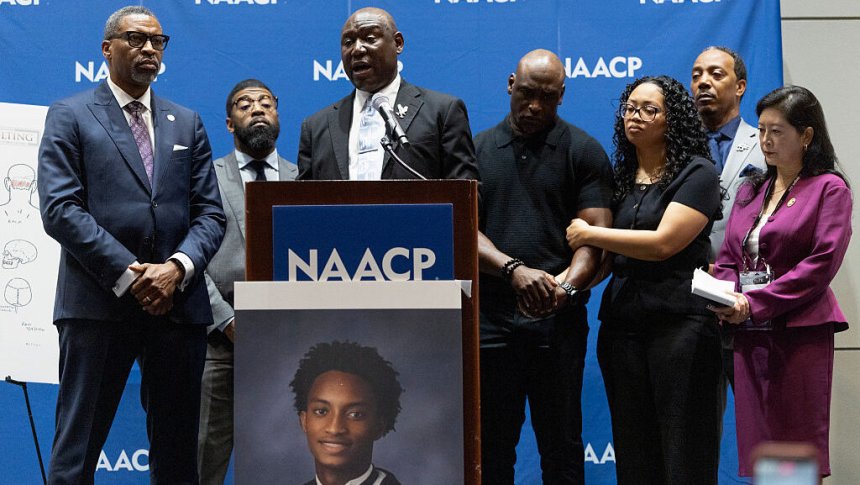

Experts found several issues in the independent autopsy of Nolan Wells, including a missing throat and discoloration on the back of his head.
This morning, attorney Ben Crump and the NAACP held a press conference to share the findings of the independent autopsy performed on 18-year-old Nolan Xavier Wells, who was found dead on July 6th after a July 4th outing to Horn Island, Mississippi. The autopsy, which Colin Kappenick helped pay for, was conducted by forensic pathologist Dr. Roger A. Mitchell, who received Wells’ body on July 10th and issued his preliminary report on July 19th. Here’s what the report found, and what questions remain unanswered.
Cause and manner of death ruled “undetermined pending investigation”
Dr. Mitchell did not reach a conclusion on how Wells died. Both the cause and manner of death were classified as undetermined, and he explicitly reserved the right to revise his opinion as more evidence, such as toxicology reports and records from the first autopsy, becomes available.
Red discoloration was found in the back of Nolan’s head

During a posterior head and neck dissection, Dr. Mitchell found a 12-by-8-inch focal area of red discoloration in the deep soft tissue overlaying the occipital bone (back of the skull). He reported that the cause of this finding was “unclear,” noting that there were no lacerations of the overlaying skin, nor fractures of the underlying skull.
Missing anterior internal neck structures
When Wells’ body was sent for the second autopsy, Dr. Mitchell says his throat (the trachea, laryngeal cartilage, thyroid horn, and hyoid bone) was not received with the body. Having experience as a chief medical examiner, Mitchell assumed that original Mississippi pathologist retained them; a common practice when there is concern about neck fractures or compression. Due to these missing elements in his examination, the pathologist stated that he could not rule out any neck injuries as a contributor or cause of death.
Limitations linked to decomposition
The body showed marked decomposition by the second autopsy (July 10), which can obscure bruising and abrasions. Because the organs had already been removed and dissected in the first autopsy, Mitchell could not directly examine the airway and lungs for water or the stomach for gastric contents, areas that would be key when examining for any signs of drowning.
“What he’s saying is that because the body was so decomposed that you couldn’t tell if there were bruises or abrasions on the body when he received it on the 10th of July,” Crump explained.
No signs of blunt force trauma
Following extensive dissection of the facial, posterior head/neck, ribs, pelvis, back, buttocks, arms, and legs, Dr. Mitchell ruled out fractures or deep tissue fractures.
He could not rule out foul play
Though local officials initially reported “no signs of foul play” in Wells’ case, the independent autopsy pathologist says he cannot rule out foul play as he could not rule out that intervening, non-accidental factors contributed to or caused Wells’ death.
“In cases where a death has occurred in or around a body of water with suspicion of drowning, it is important to confirm how that person entered the water. This information is especially important for those deaths of persons who can swim, as in the case of Nolan Wells. At the time of this report, this forensic pathologist does not know the condition of Nolan Wells,” Crump said, noting that details about whether or not the teen was forced into the water remain unknown. “He said the condition of Nolan Wells before he entered the water would be of utmost importance to being able to determine a cause and manner of death.”
7 questions remain unanswered
Ultimately, Mitchell outlined seven outstanding questions in his report:
- What were the circumstances that led to Nolan Xavier Wells entering the water?
- What was the body position when it was found?
- Was there water in Nolan’s airways?
- Is there any evidence of injuries to the anterior neck structure?
- Is there any evidence of any intracranial hemorrhaging?
- What was the composition of the stomach contents?
- What are the toxicology report findings?
Though the independent autopsy did not determine a cause of death, its findings offer more insights into what may have happened to Wells. As the fight for answers continues, Crump stated that his team is hopeful that Mississippi officials will share the observations and findings from the initial autopsy with Dr. Mitchell.
“This is only another part of the puzzle, and even though it tells us significant information, we still have more questions than we have answers at this time,” Crump concluded.
Share
What's Your Reaction?
 Like
0
Like
0
 Dislike
0
Dislike
0
 Love
0
Love
0
 Funny
0
Funny
0
 Angry
0
Angry
0
 Sad
0
Sad
0
 Wow
0
Wow
0