Trump’s China trade negotiations carry economic stakes for Black families and businesses
From baby products to beauty supplies and soybeans, Black communities have felt the effects of tariffs and changing trade policies.


From baby products to beauty supplies and soybeans, Black communities have felt the effects of tariffs and changing trade policies.
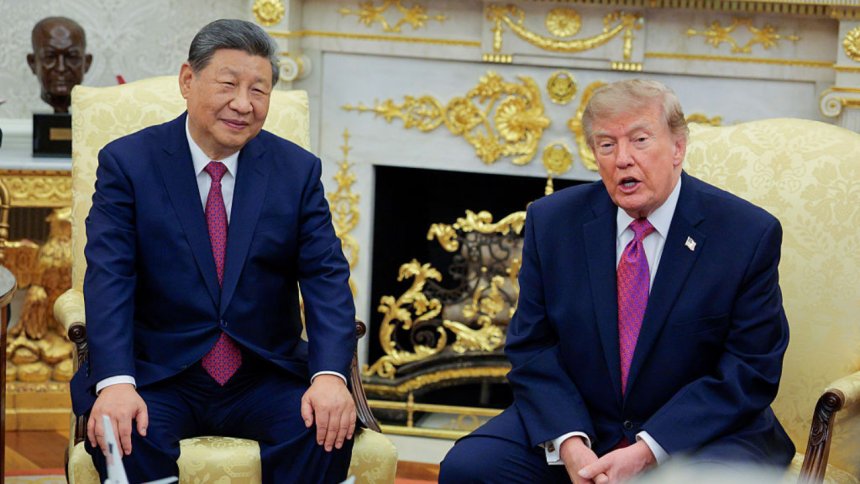
President Donald Trump rolled out the red carpet for Chinese President Xi Jinping at the White House, where the two leaders held a high-stakes trade meeting that will prove critical for American pocketbooks.
The stakes are even higher for Black Americans as they navigate higher costs as a result of a more than a year-long trade war between the two adversarial countries.
“It’s increased the cost of everything all across the board, and it’s been a driver of inflation,” says Gbenga Ajilore, chief economist at Center on Budget and Policy Priorities. He tells theGrio, “If we can see any progress towards lowering tariffs and ending a trade war with China, I think that means more for the pocketbooks of Black Americans.”
Ahead of the China state visit, U.S. Congresswoman Ayanna Pressley, a member of the U.S. House Committee on Financial Services, renewed calls for a tariff exemption for essential baby products, including car seats and strollers that have been hurting Black families.
“Donald Trump’s reckless and chaotic tariff policy is continuing to wreak havoc on our economy, and families with young children are no exception,” Pressley said in a statement. “We don’t need any more lip service from this Administration—we need action.”
Ajilore says the biggest impact of the U.S.-China trade war has been on Black businesses, such as beauty salons that sell hair products and source their goods overseas. Businesses were paying up to 145% more for products from China, prompting them to shift their sourcing to other Southeast Asian countries like Vietnam and Malaysia. However, Trump also raised tariffs on those countries.
“Black businesses were not able to escape tariffs,” he said. “If we’re able to get a deal with China and lower tariffs on anything, that’s actually going to help out businesses.” 
John Boyd, founder and president of the National Association of Black Farmers, tells theGrio that farmers have been especially hurt by Trump’s trade war with China. Despite the Asian superpower’s previous commitment to purchase $17 billion worth of U.S. agricultural products, China has purchased only $3.9 billion.
Boyd says that in addition to China pulling back on purchasing U.S. farming products, the Trump administration has prioritized the purchasing of foreign beef from Argentina and bailing out the South American country with $20 billion, even as it captures the soybean market that U.S. farmers say they have been shut out of due to Trump’s tariffs on China.
“President Trump is giving up more and more leverage and more and more ground on negotiations because he’s giving everything away, and we’re really not getting anything concrete in return,” said Boyd.
The Black farmers advocate tells theGrio that during the Obama administration, he saw soybean prices from China reach more than $17 per bushel. Under Trump, he said he has set a floor of $7 per bushel and a ceiling of $10 per bushel.
“I’m not even at break-even. I need to be somewhere between $15 and 16 a bushel to make any real money,” said Boyd.
Boyd criticized President Trump for his extravagant welcome to President Xi. He scoffed at the Chinese for stealing seed technology from U.S. farmers and for failing to honor their trade commitments.
“It’s the wrong position to take for America to roll out the carpet for China when they really haven’t put anything in place,” said Boyd. “How is he negotiating when we’re giving up U.S. ground and we can’t own anything in China? It’s mind-boggling to me.”
He added, “It doesn’t look good on the world stage.”
Share
What's Your Reaction?
 Like
0
Like
0
 Dislike
0
Dislike
0
 Love
0
Love
0
 Funny
0
Funny
0
 Angry
0
Angry
0
 Sad
0
Sad
0
 Wow
0
Wow
0