Trump administration to temporarily display controversial Caesar Rodney statue in D.C. for 250th anniversary
The move echoes former President Donald Trump’s longstanding support for the statue. The Trump administration plans to temporarily display a

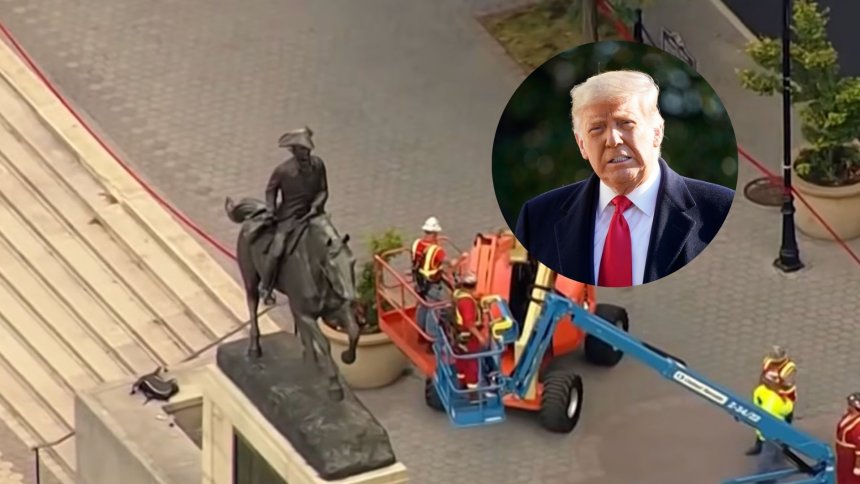
The move echoes former President Donald Trump’s longstanding support for the statue.
The Trump administration plans to temporarily display a statue of Caesar Rodney, a Delaware signer of the Declaration of Independence and slave owner, in Washington, D.C., ahead of the nation’s 250th anniversary celebrations, according to multiple reports.
Rodney, remembered for his pivotal vote in favor of independence from Great Britain on July 2, 1776, rode to Independence Hall while suffering from cancer. After the vote, the 13 colonies formally declared independence on July 4. Rodney later inherited as many as 200 enslaved people from his father, a fact that fueled debate over the statue’s presence in public spaces.
The statue, depicting Rodney on horseback, had been removed from its location in Wilmington, Delaware, in June 2020 as residents and officials grappled with the legacy of his slave ownership in the wake of the police killing of George Floyd. It has since been in a New Jersey storage facility. The National Park Service (NPS) will relocate the statue to Freedom Plaza in Washington, D.C., on a temporary basis, according to a memo reported by The New York Times.
“As the nation approaches the 250th anniversary of American independence, the Department is working with partners to highlight individuals associated with the founding era,” Interior Department spokesperson Charlotte Taylor told the Times.
The move echoes former President Donald Trump’s longstanding support for the statue. During his first term, he criticized its removal, arguing that Rodney’s legacy was “at risk of being erased forever.” Trump’s October 2020 proclamation stated, “If Caesar Rodney cannot be defended, then there is no principle by which the other signers of the Declaration can be shielded from similar eradication.” He later included Rodney in the proposed “National Garden of American Heroes,” a plan aimed at commemorating key historical figures.
The temporary display of Rodney’s statue in D.C. follows a broader push during the Trump administration to restore federal monuments that had been removed or defaced, including the Confederate Brig. Gen. Albert Pike statue in Judiciary Square, which returned in 2025 after its 2020 removal following nationwide protests sparked by George Floyd’s murder.
The statue’s return has reignited discussions over how the nation should remember complex historical figures who contributed to independence while participating in slavery. The display in Freedom Plaza is expected to be part of educational and historical programming during the semiquincentennial events, highlighting Rodney’s role in American history while acknowledging the more troubling aspects of his legacy.
Share
What's Your Reaction?
 Like
0
Like
0
 Dislike
0
Dislike
0
 Love
0
Love
0
 Funny
0
Funny
0
 Angry
0
Angry
0
 Sad
0
Sad
0
 Wow
0
Wow
0