The Trump Administration Wants White Men To Be Oppressed So Badly
Source: Al Drago / Getty Welp, it appears that the Trump administration’s Equal Employment Opportunity Commission is still scouring the U.S. in search of white men who are pretending to be victims of systemic racial discrimination, so that the administration can get in on the action of turning white fragility into legal precedent. On Tuesday, [...]


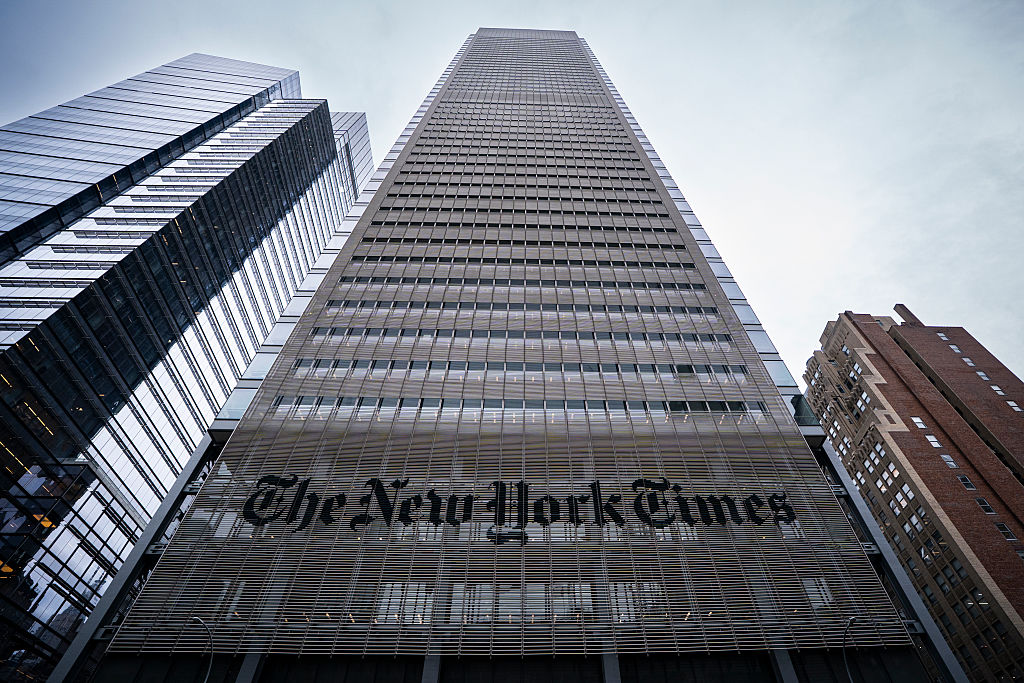
Welp, it appears that the Trump administration’s Equal Employment Opportunity Commission is still scouring the U.S. in search of white men who are pretending to be victims of systemic racial discrimination, so that the administration can get in on the action of turning white fragility into legal precedent. On Tuesday, the same EEOC that has spent the last year or so soliciting white men to come forward with their imaginary reverse-Jim Crow fan-fic (or Klan-fic?), investigating major corporations over vague anti-white discrimination claims made by no one in particular, trying to join anti-white discrimination lawsuits that had nothing to do with the federal government, and suing corporations for anti-male discrimination because they scheduled women’s retreats, sued the New York Times because some white man claimed reverse racism got him denied a promotion.
The lawsuit, filed in U.S. District Court for the Southern District of New York, says The Times’s “stated race and sex-based representation goals influenced the decision not to advance” the man’s candidacy for a deputy real estate editor role in 2025.
“The New York Times categorically rejects the politically motivated allegations brought by the Trump administration’s E.E.O.C.,” said Danielle Rhoades Ha, a spokeswoman for The Times. “Our employment practices are merit-based and focused on recruiting and promoting the best talent in the world. We will defend ourselves vigorously.”
The lawsuit followed a rapid escalation of an investigation that began last year when an employee filed a complaint with the E.E.O.C. in New York. The lawsuit indicates that the employee, who is not named, had worked at the paper as an editor since 2014 and applied for the deputy editor job in 2025.
The complaint quotes from Times diversity and inclusion reports in recent years, including a 2021 “Call to Action” that set a goal of increasing the number of Black and Latino employees.
The reports “detailed N.Y.T.’s express efforts to make employment decisions on the basis of race and sex to achieve its desired demographic goals,” the complaint says. “A decrease in the percentage of White male employees (whether new hires, existing employees or those in leadership, as appropriate) was a necessary consequence for the N.Y.T. to achieve these results.”
So, as usual, the administration is taking legal action based on white conservatives’ belief that any effort to diversify a traditionally white male-dominated field equals discrimination against white men, and that the diversity efforts can only be achieved by seeking out Black people, people of color, and women who are less qualified than their white male counterparts. It’s an absurd narrative that insists we live in a post-racial America, and therefore, any attempt to correct systemic racism must constitute anti-white discrimination, which is totally real despite us living in a post-racial America. It’s circular logic that serves no other purpose than the preservation of white supremacy.
The EEOC complaint even noted that the final pool of candidates for the job the poor, disenfranchised white man wanted consisted of “a white woman, a Black man, an Asian female, and a multiracial female” before asserting without cited evidence that the white man was more qualified than the person who ultimately got the job.
A spokesperson for the Times, of course, denied these allegations.
More from the Times:
The person at The Times said the job listing specifically sought somebody with experience in service journalism, which the person who got the job had, in addition to experience as a supervisor.
The E.E.O.C.’s investigation has deviated from its standard practice, said Ms. Rhoades Ha, the Times spokeswoman. “The allegation centers on a single personnel decision for one of over 100 deputy positions across the newsroom, yet the E.E.O.C.’s filing makes sweeping claims that ignore the facts to fit a predetermined narrative,” she said. “Neither race nor gender played a role in this decision — we hired the most qualified candidate, and she is an excellent editor.”
EEOC Chair Andrea Lucas, the same chair who put out a video ad, soliciting white men and only white men to come forward with their discrimination claims, tried to sell the lawsuit as an effort to “root out discrimination anywhere,” despite its expressed agenda to drop discrimination cases on behalf of Black and brown plaintiffs in favor of anti-white discrimination, which it justified by citing President Donald Trump’s executive order eliminating the use of “disparate impact liability” in federal civil rights cases.
“There is no such thing as ‘reverse discrimination’; all race or sex discrimination is equally unlawful, according to long-established civil rights principles. The E.E.O.C. is prepared to root out discrimination anywhere it may rear its head,” Lucas said in a statement.
Let’s go back to the “disparate impact” thing, because I wrote about that before when the EEOC launched an investigation into Nike over anti-white discrimination claims that, again, weren’t made by anyone in particular, but appeared to be based on the mere fact that Nike admittedly engaged in diversity efforts.
Here’s what I wrote:
Another interesting tidbit in the EEOC’s press release is that it claims Nike’s DEI initiatives may have created a “pattern or practice of disparate treatment against white employees.” This is especially interesting due to the government’s use of the word “disparate.”
Last year, Trump signed an executive order that required federal agencies, including the U.S. Department of Housing and Urban Development (HUD) and the Consumer Financial Protection Bureau (CFPB), to stop using “disparate impact” data to identify discriminatory policies and practices that disproportionately harm certain groups, namely Black people and other people of color. The president also signed a similar order discouraging school administrators from using “disparate impact” data to address racial disparities in disciplinary actions taken against students, labeling it a DEI practice.
But please, tell us more about how the EEOC is trying to stamp out racial discrimination against anyone, not just what it perceives as discrimination against white people, and specifically, white men.
SEE ALSO:
EEOC: Coca-Cola Women’s Retreat Discriminated Against Male Employees
Trump’s EEOC Investigates Nike Over Vague Anti-White Discrimination Claims
Share
What's Your Reaction?
 Like
0
Like
0
 Dislike
0
Dislike
0
 Love
0
Love
0
 Funny
0
Funny
0
 Angry
0
Angry
0
 Sad
0
Sad
0
 Wow
0
Wow
0