Texas Universities Going All In On Censorship And Anti-DEI Policies
Source: Austin American-Statesman/Hearst Newspapers / Getty Recent moves from the University of Texas Board of Regents highlight how Texas universities and colleges are doubling down on racist censorship. The UT Board of Regents decided Black History Month was the perfect time to enact a new censorship policy. Passed with little notice, the policy aims to [...]


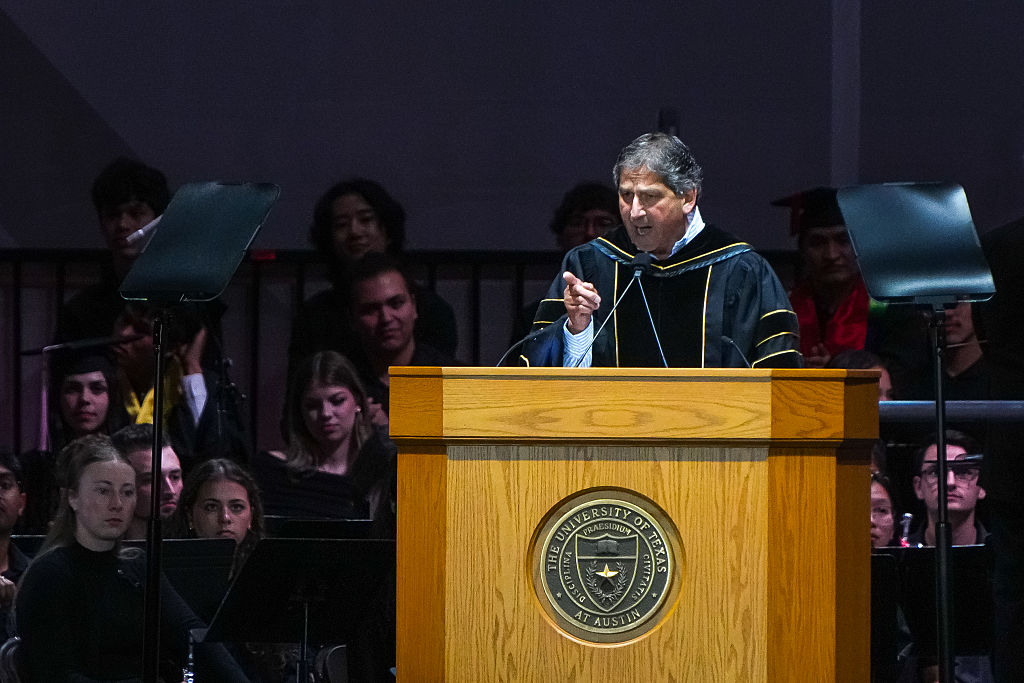
Recent moves from the University of Texas Board of Regents highlight how Texas universities and colleges are doubling down on racist censorship. The UT Board of Regents decided Black History Month was the perfect time to enact a new censorship policy.
Passed with little notice, the policy aims to eradicate the teaching of allegedly unnecessarily controversial subjects. As reported by The Texas Tribune, the policy requires professors not only to provide their syllabi for review but also to stick to the proposed plan.
Deviations and improvisation will not be tolerated. The policy also fails to define “controversial.”
Responding to the UT Board of Regents’ new decision, Association of American University Professors Texas Conference president Brian Evans told Houston Public Radio the move could cause confusion and leave students without answers.
“A faculty member is not going to be able to talk about current events without risking being fired,” he told Houston Public Media. “What kind of education is this?”
Educators will be forced to either comply and disregard their students’ natural curiosity or engage and face punishment.
Last week, the UT Board of Regents consolidated ethnic and gender studies programs, including African American studies, into a single program. The decision impacts hundreds of students and staff with uncertainty about the path forward. It could impact people’s ability to graduate, secure future employment, and access research funding and course offerings.
Previous public comments before the UT Board of Regents raised serious concerns about the transparency and logic behind the changes. There were also valid questions raised about the motivations of Executive Vice President and Provost William Inboden.
As noted by the Instagram Account A Voice from the South and in public comments, Inboden wrote an op-ed blaming higher education’s decline on the late Rev. Jesse Jackson, Chinese students, and “The 1619 Project.”
A clever group known only as Dr. Professor graded the op-ed, offering scathing feedback and highlighting its many shortcomings.
But the whytes are not holding back on their disdain for us. They are saying it clearly and boldly with their whole chest, and destructive policies are flowing freely.
UT Austin is not alone in adopting measures of censorship and erasure
Not to be left out, the University of Houston also joined the race to the bottom in adopting similar censorship policies that could raise serious issues in the classroom.
“The people who claim kids are being indoctrinated in school are the same people who only want one narrative taught about gender, race, U.S. history, evolution, etc,” said Colton Llenos, a UH graduate, in a statement. “They also have not spent that much time in a classroom. To them, simple exposure to other forms of thinking counts as indoctrination. To even entertain a thought that goes against the pre-established narrative is to work against America, and that is why communication has broken down.”
The University of Houston has been regarded as one of the most racially and ethnically diverse research institutions in the country. It’s something the school once proudly claimed in its 2022-2023 Graduate Catalog.
Nearly 13% of its student body identified as Black. Another 20.8% are Asian American, and 33.9% were Hispanic. Students identifying as multiracial comprised another 3%.
The schools follow a policy similar to that adopted by Texas A&M, which made news last month after a Black professor at the College Station campus, Leonard Bright, was told to remove references to certain works of Plato.
AAUP at Texas A&M-College Station condemned the decision, calling it censorship of “foundational philosophical texts within his expertise in an undergraduate core course because it addresses race and gender theories.” Bright also serves as president of the school’s AAUP chapter.
“Beyond the legal implications, the moral stakes are profound,” read a statement.”Silencing 2,500-year-old ideas from one of the world’s most influential thinkers betrays the mission of higher education and denies students the opportunity to engage critically with the foundations of Western thought.”
Yes, an institution of higher learning told a philosophy professor not to teach a dead white philosopher because it challenges students to consider other viewpoints on race, gender, etc.
“At a public university, this action raises serious legal concerns, including viewpoint discrimination and violations of constitutionally protected academic freedom,” the statement continued.
Both Texas A&M and the University of Texas dissolved their faculty senates late last summer in response to the passage of Texas Senate Bill 37. Eliminating faculty senates, a critical guardrail for institutional decision-making, is another example of the growing abuse of power and extremist control taking root in the states.
Diversity is a strength, no matter what Texas Republicans and their friends around the country would have people believe.
Attacks on the liberal arts aim to disrupt progress
Texas is not alone. In a move The Gazette reported was “compelled by the Legislature and Board of Regents,” the University of Iowa also announced the end of the African American Studies program. The Gender, Women’s, and Sexuality Studies program also faced closure.
Last May, students at Kennesaw State University protested the decision to cut Black studies. Professors and the broader Metro-Atlanta community also spoke out against the decision.
Even HBCUs have been impacted by this trend.
Florida A&M recently decided to consolidate several degree programs, including African American Studies. As reported by the Tallahassee Democrat, there has been little transparency or community input ahead of the decision.
The move follows a controversy earlier this month when a law student at FAMU was told she couldn’t use the word Black in a Black History Month flyer. Officials later claimed it was an error.
Political appointees are making decisions that impact the trajectory of people’s careers, education, and the future of our society without any consideration for those affected. Just totally normal for people who claim to care about what’s fair.
Similar concerns have been reported by students, professors, and alums at other impacted schools. Changing majors mid-course can throw students off and put them at a disadvantage compared to those at other institutions. The same is true for professors and researchers attached to institutions that defund certain work.
Interdisciplinary studies and liberal arts play an important role in fostering critical thinking, adaptability, and empathy. All three threaten the status quo and are critical to establishing and maintaining meaningful progress.
The tyranny of the majority, who are increasingly becoming a minority, remains fierce. They desperately cling to a pathological need for power, domination, and control over all aspects of civic, economic, and political life.
There are obvious issues with anti-equity policies, such as education funding, student resources, research, and tracking harmful disciplinary policies. But these attacks also threaten pipelines for professionals entering a variety of disciplines, from education and medicine to urban planning and public policy.
These programs have given us the language and research to combat bad housing policy and gentrification, Black maternal health disparities, wage and pay inequity, and voting rights discrimination, among other things. It’s also about making sure people are prepared to navigate the broader society and handle their business.
And to some extent, the federal courts agree.
A federal judge in New Hampshire ruled in favor of education equity, “permanently” ending the Trump administration’s 2025 anti-DEI policies in education. Many advocates, educators, and students warned institutions about rushing to comply with an obviously unconstitutional directive from the administration.
“While Trump and McMahon want to ban diversity, equity, and inclusion, educators know these values are at the core of our nation,” said Becky Pringle, president at the National Education Association, in a statement. “The Trump administration’s unlawful Dear Colleague Letter and certification requirement have now been vacated and abandoned, underscoring how badly Trump and McMahon overreached in their attempt to interfere with curriculum and instruction. Educators, parents, and community leaders will continue to organize, mobilize, and take action to protect our students and their futures.”
SEE ALSO:
Jesse Jackson’s Campaigns Offer Blueprint For Defeating US Extremism
Trump To Sign Anti-Critical Race Theory Executive Order, Seek Reinstatement Of His ‘1776 Commission’
Share
What's Your Reaction?
 Like
0
Like
0
 Dislike
0
Dislike
0
 Love
0
Love
0
 Funny
0
Funny
0
 Angry
0
Angry
0
 Sad
0
Sad
0
 Wow
0
Wow
0








![Drake Lights Up Houston With Surprise Appearance During Karol G Show [Watch]](https://thatgrapejuice.net/wp-content/uploads/2026/09/drake-karol-g-tgj.png)