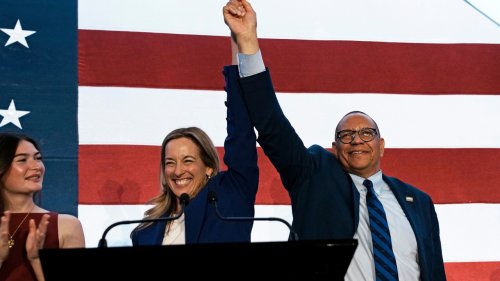
Fred Perpall’s historic USGA presidency coming to a close
For Fred Perpall, it’s fitting that his last championship as president of the United States Golf Association (USGA) would have him greeting the winner of last month’s Latin America Amateur Championship in Peru. As the first Black man to hold one of the most important leadership positions in golf, seeing Perpall at the Lima Golf [...]


For Fred Perpall, it’s fitting that his last championship as president of the United States Golf Association (USGA) would have him greeting the winner of last month’s Latin America Amateur Championship in Peru.
As the first Black man to hold one of the most important leadership positions in golf, seeing Perpall at the Lima Golf Club acknowledging the winner, Mateo Pulcini, represented much of what the outgoing USGA president stood for: increasing diversity.
“It’s a championship we do in this region of the world to try to inspire more golfers from alternative backgrounds,” Perpall said in an early morning phone call from Lima. “I hope my presence has been a good example that, whatever your background is, if you work hard there’s room in the game for you.”
The importance of Perpall’s presence at a tournament in South America where the winning golfer from an “alternative” background earned the life-altering opportunity to play in this year’s Masters, U.S. Open and British Open tournaments?
“Sometimes you have to see it to be it,” Perpall said.
Perpall, 51, has been seen the past three years by true golf fans. He is the tall, youthful-looking Black man who presented trophies to the past three U.S. Open Championship winners: J.J. Spaun (2025), Bryson DeChambeau (2024) and Wyndham Clark (2023).
Leading the USGA hasn’t been Perpall’s only job. He’s also the CEO of The Beck Group architecture and construction business.
“It keeps me busy,” said Perpall, whose leadership role with the USGA concludes at the end of the month. “I hope people remember that I put my heart and soul into this job with the USGA because of what it meant to me.”
Perpall’s leadership of the USGA coincided with an era that saw an increase in the number of golfers of color and female golfers, as well as a growth in the number of Black golf influencers, Black celebrities and Black-owned brands.
“We don’t have a relationship specifically with the USGA because they have an official apparel,” said Earl Cooper, co-founder of Eastside Golf. “But Fred, in spite of that, has worn our brand in spaces that we might not have access to. He has, with us, been very gracious with his time and perspective, and that’s been huge and inspiring for me.”
As Perpall enters his final days of his USGA presidency (the new president will assume office at the end of the month), he spoke with Andscape about the past three years leading the organization.
This interview has been edited for length and clarity.

Charles LeClaire-Imagn Images
As USGA president, what are some of the accomplishments you are most proud of?
I’m really proud that we started a lot of programs to help regular kids play golf … through our investments in the U.S. national development team. We think if you can play elite golf it doesn’t matter the color of your skin or who your parents were. We’ll have almost 1,000 kids participate, and we give grants to 50 kids based on financial need — $10,000 a year. We’ve created a lot more pathways for kids to play elite golf, and I think that will change the face of American golf.
We also started a pathways program to give kids leadership opportunities. This summer, we’ll have 50 interns paid for by the USGA placed throughout the world. And these kids will come primarily from underserved backgrounds — mainly Black and brown kids. This is our fifth year doing this.
Finally, we’ve done some tough things to help the game. Standing firm on what we believe is a golf ball that goes too far threatens the sustainability of golf.
About that golf ball rollback (starts in 2028 for professionals, and 2030 for amateurs). A lot of weekend warriors have had a lot to say about that.
This problem is primarily a problem for the elite golfers — the trampoline effect on the golf ball just takes it too far for the highest swing speeds. We shouldn’t have to build bigger golf courses to accommodate a few hundred elite golfers.
So I would say to my weekend warrior friends, you cannot swing it hard enough. And the good news is we’ve gone through a series of testing now and the average golfer is not affected by the changes.
You spoke earlier about pathways to golf for Black and brown players. What do you think about the APGA (Advocates Professional Golf Association) and the work that group has done since its 2010 launch?
I’m so excited about what the APGA is doing. I’m excited about all of these alternative pathways that create more opportunities for golfers of color.
Nothing in this country — not our churches, not our schools, not our businesses — gives you the opportunity to spend time with people who are not like you the way golf does. With golf, everything that is different about you fades away. That’s what makes golf so special.
You’ve often said golf changed your life. How so?
My mother worked as a cook at Lyford Cay Club, which is a very prestigious golf club in the Bahamas. When I was 15, 16 years old I met a bunch of the members there. That group at Lyford Cay Club had determined that all the goodness they were experiencing in the game of golf and coming down to the Bahamas in the winters, they wanted to share some of that with the kids in the community.
So they established a scholarship to help many kids go to college, and I was one of those kids. They didn’t just help me go to college. I got internships, I got invited to events. They didn’t just invite me to the party, they also danced with me.
When I was rising up in the USGA, they offered me an honorary membership. And I said I don’t want to be an honorary member, I want to be an actual member. Would you just sponsor me for membership? And so I’m very proud that I’m the first scholarship recipient to become a full member of the club.
So that’s why I say before I was a golfer, golf had already changed my life.
Is it true that you became a golfer as an adult?
Yes, you could say I’ve had a meteoric rise in golf. I became the CEO of my company in 2013, and early in 2014 I joined a golf club. I was mainly using the bar and the dining room, but I noticed the real magic — the real fun — was out there on the golf course. So I got interested.
I had an advantage — I started playing golf as a CEO and had the resources to join a good club, hire good instructors. My wife says I play golf eight days a week. I’ve probably played 25 years of golf in the last 12 years.
I went on to build a golf course myself with others. You could say I’ve thrown my life into the game of golf. And it’s certainly given me a lot back.
During your time as USGA president there was a steady increase of Black influencers and Black golf groups. How does it make you feel when you see that growing diversity?
I love it. I run a very large company in my real life and people say to me ‘You’re such a buttoned-up guy and golf is a buttoned-up game. What do you say about the guy with the sleeve tattoos and the hat turned backwards?’ I believe we need to meet people where they are. It’s not our game to tell people what they need to look like, how they need to dress. We need to fling the gates of golf open. I’ve tried to do that and embrace everyone. These [influencers] are doing cool things to encourage new people in, and we need to meet them where they’re at.
What’s been the biggest challenge being the CEO of your own company while also being president of the USGA?
The USGA probably takes about 20% of my business time and 80% of my personal time. There’s no doubt you’ve got to get your day job done, and Beck has thrived over the last three years while I’ve been USGA president.
What I do in golf is helpful for what I do in business. What I had to do was give up a lot of my personal time — those vacations and golf trips with the buddies. All my free time has basically been USGA time.
I will say that as much as I’ve given golf, the USGA has given me back a lot more.
I’m sure there are people who want the opportunity to play with the USGA president. Who are some of the big names that you’ve played with?
What’s interesting about golf is it puts you with different types of people. I’ve played with both President Trump and President Obama. One of my favorite golfing buddies is Michael Strahan. And I play a lot of golf with Larry Fitzgerald. These guys have become some of my best friends in the game.
John David Mercer-USA TODAY Sports

Whether I’m playing with the president or with a Hall of Fame wide receiver, an NFL sack leader or a senator, I enjoy it.
Anybody who you haven’t played with, but you would like to?
I’ve played with most of the folks that I’ve wanted to play with. Steph [Curry] has become a good friend, and I played two rounds with Bryson DeChambeau last week. So I can’t really put a finger on that.
Michael Jordan?
I’ve played at his club. In one fun round with Larry Fitzgerald and Michael Vick, there was a lot of trash talking, especially when Michael Jordan rolled up on us. But I’ve never played 18 with him.
When do you have your best times on the golf course?
I play in dream foursomes all the time. My best days on the golf course, really, [are when] I just put my dad in the cart next to me and zip around, and just spend time with him. My dad is not a golfer, but he’s turning 86, and if I could have an ideal way to spend a little time on the course, it’s usually with him.
What do you want people to most remember about your time as USGA president?
I hope people will remember that I just didn’t put my mind into it; I put my heart and my soul into it because of what it meant to me. I tried to lead in a way where I really focused on other people. I hope that all came through.
The post Fred Perpall’s historic USGA presidency coming to a close appeared first on Andscape.
Share
What's Your Reaction?
 Like
0
Like
0
 Dislike
0
Dislike
0
 Love
0
Love
0
 Funny
0
Funny
0
 Angry
0
Angry
0
 Sad
0
Sad
0
 Wow
0
Wow
0

![The WNBA’s Uneven Whistle Continues To Put Black Women In Danger [Op-Ed]](https://i1.wp.com/newsone.com/wp-content/uploads/sites/22/2026/08/17863865807191.jpg?w=1024&strip=all&quality=80&ssl=1#)




![Movie Trailer: ‘Clarissa’ [Starring Sophie Okonedo, Ayo Edebiri & David Oyelowo]](https://thatgrapejuice.net/wp-content/uploads/2026/10/clarissa-trailer-tgj-scaled.png)