‘Set-Jetting’ to Morocco: Exploring the sites, sounds and scenes of Marrakesh with Expedia
From the bustling souks of Marrakesh to the cinematic coastline of Essaouira, Morocco offers a journey where film, culture, design


From the bustling souks of Marrakesh to the cinematic coastline of Essaouira, Morocco offers a journey where film, culture, design and discovery intersect.
I’ve traveled around the world for journalism, but until recently, I had never visited the African continent. That changed when I arrived in Marrakesh, Morocco, for an editorial assignment with Expedia. I had dreamed of visiting for years, and from the moment I stepped into the city, I knew the experience would be special.
My first evening began at a beautiful riad, with a traditional Moroccan dinner of pastilla, beef tagine, mint tea, and pastries, followed by a captivating performance. I even spotted a shooting star. But beyond the architecture, vibrant colors, and warm hospitality, I hadn’t expected to feel something so profound so quickly. Morocco felt like a homecoming, and the locals greeted me as if I’d returned home.
As a journalist with a deep appreciation for film, fashion, interior design, and cultural storytelling, I was eager to explore Morocco through set-jetting, the travel trend inspired by movies and television shows that introduce destinations to audiences around the world.
That connection between screen and destination is central to Expedia Group’s “Unpack ’27: The Trends in Travel,” unveiled October 14. Drawing on first-party data, a survey of 26,000 travelers and social listening, the annual report from Expedia, Hotels.com and Vrbo identifies seven trends expected to shape travel in 2027, including set-jetting and experiences centered on personal interests.
Expedia is spotlighting Morocco as a destination for travelers inspired by film and television. According to Expedia, searches for travel to Morocco this autumn increased 110% year over year.
“Travelers are being more intentional in choosing their next adventure, seeking experiences that are more personal and purposeful to them,” said Ariane Gorin, CEO of Expedia Group. My journey reinforced that while a production might spark the desire to visit, a destination’s culture, cuisine, architecture, and people are what make the experience memorable.
Jardin Majorelle and La Mamounia: Where Art, Fashion and Film Meet
Two Marrakesh landmarks particularly resonated with me: Jardin Majorelle and La Mamounia. Both reveal the city’s creative legacy and connect art, fashion, architecture, and film.
French painter Jacques Majorelle began creating Jardin Majorelle in 1923. Today, the botanical sanctuary is known for its lush greenery and signature cobalt hue, Majorelle Blue. In 1980, Yves Saint Laurent and his partner, Pierre Bergé, purchased and restored the garden, helping preserve it from development. 

As someone who has always been drawn to blue, I was especially taken with the garden’s signature color. I associate blue with restoration, depth, and healing, and it felt personal and visually striking.
La Mamounia offered another perspective on Marrakesh’s relationship with fashion and film. The storied hotel is known for its gardens, distinctive design and hospitality, as well as its cinematic associations with productions including Sex and the City 2 and Inventing Anna. We couldn’t leave without enjoying the hotel’s pastries and tea, which reminded us of its appearance in Inventing Anna. For me, these landmarks offered more than famous backdrops. They revealed how creative legacies become intertwined with a destination’s identity.
Getting Lost and Finding Myself in the Marrakesh Medina Souks
If Jardin Majorelle offered tranquility, the Marrakesh medina souks provided a more immersive introduction to the city. Wandering through Souk Semmarine, Souk El Attarine, and the streets around Rue Mouassine, I encountered handcrafted pottery, jewelry, textiles, spices, and locally made beauty products.
Amid the markets’ vibrant energy, I reflected on a milestone: I was finally in Morocco, a country I had dreamed of visiting for years.
As a journalist, I’ve spent much of my career chasing stories, building my brand, and creating opportunities that once felt out of reach. Standing in the souks, I reflected on how much I had accomplished in a few short years, from expanding my career in Los Angeles to traveling internationally for journalism. What had once been a distant dream was now part of my lived experience.
I felt grateful for the places my ambition had taken me and the life I was building. The moment reminded me to acknowledge what I’ve achieved while remaining open to the next chapter. 


Of course, there was plenty to discover. I found a beautiful gemstone necklace, but shopping was only part of the experience. The souks encouraged me to slow down and appreciate the craftsmanship and traditions that give the markets their character.
One of my favorite stops was Marrakech Herboisterie, where I explored products inspired by Morocco’s plant-based remedies and beauty rituals. I was intrigued by the locally made offerings, including argan oil and other products I brought home for my personal care routine. The visit offered a glimpse into Morocco’s longstanding relationship with natural ingredients and wellness practices.
The culinary traditions were equally compelling. While exploring the markets, we shopped for spices that we later used in a cooking class at our riad, The Mellah Hotel. With our hosts’ guidance, we prepared chicken tagine with vegetables. Connecting the ingredients we discovered in the souks with the meal we made ourselves transformed the experience from simply sampling Moroccan cuisine into participating in a culinary tradition. 

The souks also brought me closer to the Marrakesh featured in “Sex and the City 2.” Although the film’s story takes place in Abu Dhabi, much of it was shot in Morocco. Its market scenes include the memorable sequence in which Carrie Bradshaw loses her passport while shopping and reconnects with Aidan.
Walking through the markets gave me a new appreciation for how a location becomes part of a film’s identity. Yet the souks are more than cinematic scenery; they remain vibrant centers of commerce, craftsmanship, and cultural tradition. For me, they also became the backdrop for a personal milestone and an opportunity to recognize how far I’d come.
From Marrakesh to Essaouira: Exploring Morocco’s Cinematic Coast
Our journey continued to Essaouira, a coastal city that contrasts with Marrakesh’s bustling medina. Known for its historic fortifications and Atlantic coastline, Essaouira appeared as the fictional city of Astapor in “Game of Thrones,” providing the backdrop for scenes featuring Daenerys Targaryen.
Exploring the medina and the areas around Skala de la Ville and Skala du Port let me appreciate the city’s architecture and ocean views beyond their connection to television.
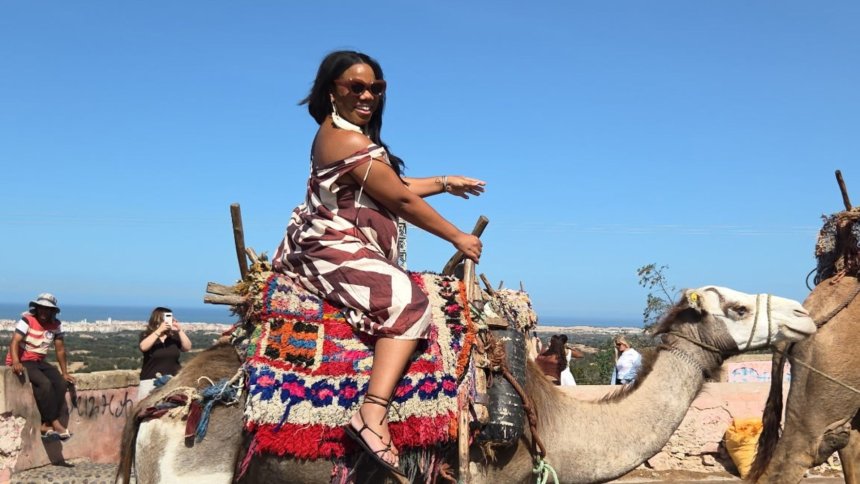
One memorable experience was riding a camel before heading into Essaouira. It reminded me that a journey inspired by cinematic discovery can create entirely new memories, ones that have nothing to do with recreating a scene.
That’s ultimately what makes set-jetting appealing: The screen might inspire the itinerary, but the destination provides the experience.
A Dinner Under the Desert Sky
Our Moroccan journey also included an evening at White Camel, a desert camp in the Agafay Desert near Marrakesh. The expansive landscape offered a dramatic change of scenery, far removed from the medina’s energy. As the evening unfolded, the desert became the setting for another memorable dining experience.
Experiencing Morocco through such different environments was especially rewarding. The souks offered color and movement, Essaouira revealed the country’s coastal character, and Agafay offered openness and quiet. Each setting showed me another dimension of the destination.
Why Set-Jetting Is About More Than the Screen
Travel inspired by film and television offers a compelling starting point for discovering somewhere new. Whether drawn by the glamour of “Sex and the City 2,” the intrigue of “Inventing Anna” or the fictional worlds of “Game of Thrones,” travelers can turn familiar stories into opportunities for exploration.
Yet the most meaningful experiences often emerge beyond the initial attraction. They happen through conversations, local cuisine, unexpected discoveries, and encounters that deepen our understanding of a place.
In Morocco, I found myself thinking less about visiting filming locations and more about the stories that existed long before a production arrived. Jardin Majorelle was more than a beautiful garden. Essaouira was more than the setting for a fictional city, and the Agafay Desert was more than a cinematic backdrop.
Each place offered its own history, traditions, and character. My first trip to Africa also left me reflecting on that unexpected feeling of homecoming. I arrived with years of anticipation and a journalist’s curiosity. I left with a deeper appreciation for how travel can connect us to cultural traditions, creative legacies, and parts of ourselves we might not expect to encounter.
Morocco allowed me to experience familiar stories in an entirely new way. More importantly, it reminded me that the best journeys don’t end when the camera stops rolling. They begin when we look beyond the screen and allow a place to tell its own story.
Share
What's Your Reaction?
 Like
0
Like
0
 Dislike
0
Dislike
0
 Love
0
Love
0
 Funny
0
Funny
0
 Angry
0
Angry
0
 Sad
0
Sad
0
 Wow
0
Wow
0