Of Course They Found A Ku Klux Klan Hood Inside A Mississippi Police Office
Source: Mississippi Department of Public Safety / MDPS So, the Mississippi Department of Public Safety says it stumbled across a Ku Klux Klan robe, handbook, membership lists, and propaganda while cleaning out a closet for a move. The items were packed inside a small blue suitcase that had been tucked away and forgotten, as if [...]


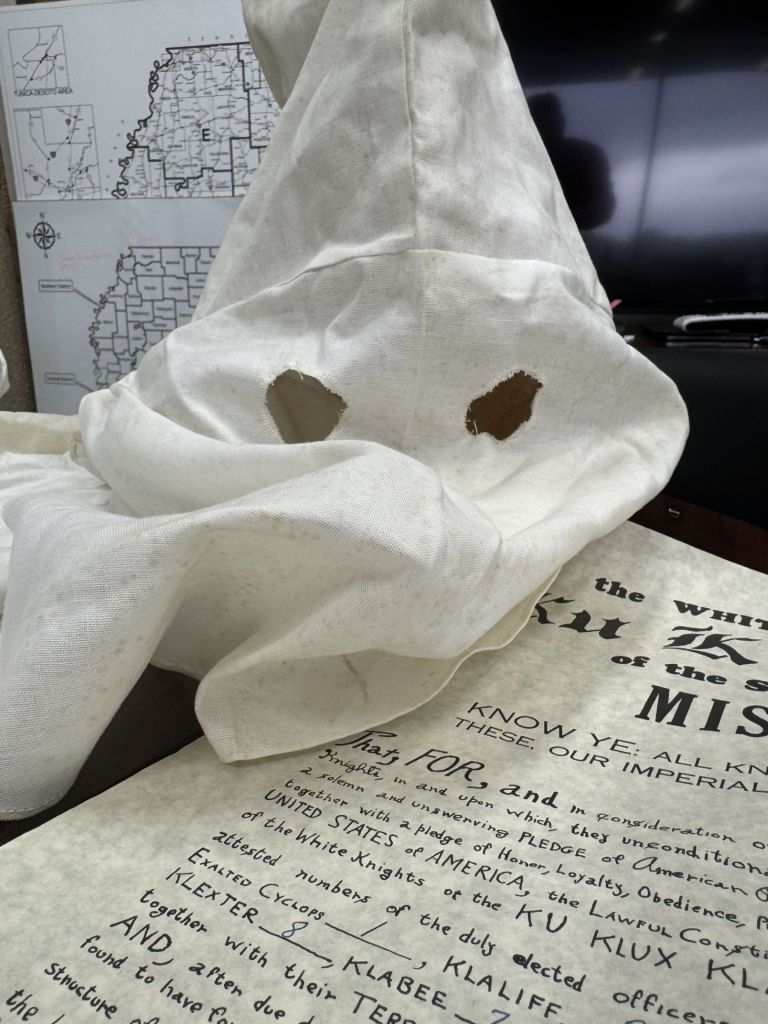
So, the Mississippi Department of Public Safety says it stumbled across a Ku Klux Klan robe, handbook, membership lists, and propaganda while cleaning out a closet for a move. The items were packed inside a small blue suitcase that had been tucked away and forgotten, as if it were some dusty relic from a bygone era. That’s the story being told.
It’s being dressed up as an accident, softened into an artifact, and framed as a harmless “window into history” as if this were something distant, contained, and safely behind us. Officials emphasize the importance of “preserving materials” and “shedding light on the past,” while news reports have reduced it to a “violent chapter” in Mississippi history.
But this is Mississippi, y’all. The state that didn’t just flirt with white supremacy, it codified it, enforced it, and perfected it. The state that was the last in the entire country to remove the Confederate emblem from its official flag. The state that dragged its feet on civil rights and built a reputation so steeped in racial violence that it became shorthand for it. And we’re supposed to believe that the machinery of that history just got packed away and forgotten in a closet?
Please.
In Mississippi, racism isn’t just some dusty artifact you stumble across during a move. It’s a throughline, a system, and a legacy that has never been fully dismantled. It just got repackaged and made polite enough for public statements. And if that sounds like an overstatement, just take a closer look at what was actually inside that secret KKK cache.
There wasn’t just a KKK hood. There were charters, records of surveillance, files on Freedom Riders, and documentation of a white supremacist organization that operated at scale, with tens of thousands of members and deep political influence. There were ledgers tracking membership, internal memos outlining strategy, propaganda, and intelligence-style records monitoring civil rights activity.
Taken together, these weren’t just artifacts of hate. They were administrative records of a white supremacist terror system. And they validate what Black communities have long known and lived. During Jim Crow, law enforcement did not simply fail to protect them from white supremacist violence. It documented them, tracked them, and, in many cases, treated their pursuit of freedom as a threat to be contained.
The presence of files labeling Freedom Riders as “agitators,” alongside meticulous Klan records, exposes the logic of the state in that era. It shows a system that surveilled those fighting for justice while preserving, cataloguing, or at least coexisting with those committed to terror.
Historians have documented what Black communities in Mississippi and beyond have always known: there were officers who were Klansmen and departments where the overlap wasn’t whispered about, it was understood. In some places, the same men enforcing the law were the same men organizing terror, tracking civil rights workers, and carrying out violence under the cover of darkness.
The Ku Klux Klan was never just some rogue band of night riders operating outside the law. In many places, it moved with the law, alongside it, inside it, and too often as it, with men wearing a badge by day and a hood by night and no real line between the two. The Klan thrived because it had the protection of white communities, the silence of courts, and the cooperation, or outright participation, of local law enforcement. Sheriffs didn’t just “fail to act.” They handed people over to lynch mobs. Police didn’t just “arrive too late.” They stood there and watched. Sometimes, they joined in.
In Mississippi, this was documented in the historical record. For example, in 1964, Neshoba County Deputy Sheriff Cecil Price, who was both an officer of the law and a Klansman, arrested civil rights workers James Chaney, Andrew Goodman, and Michael Schwerner, held them in jail, and then released them into a coordinated Klan ambush where they were murdered. That was the system operating in sync with white supremacist terror.
After the 1964 murders, Mississippi’s governor fired two state highway patrol officers for being Klansmen. This was proof that the overlap wasn’t hidden. It was known, acknowledged, and reached deep into the ranks of the state itself.
And this wasn’t limited to a single case or department. Violent Klan factions like the Silver Dollar Group, active in Mississippi, counted law enforcement officers and sheriff’s deputies among their members, even as they carried out bombings, kidnappings, and murders. At the same time, state agencies like the Mississippi Sovereignty Commission worked alongside local authorities to surveil civil rights activists, share intelligence, and undermine their efforts, treating those fighting for freedom as the real threat.
Even when officers weren’t formally in the Klan, they operated within a system that aligned with it. During Freedom Summer, civil rights workers moved through a landscape where local police routinely refused protection, shared information, or simply stepped aside as violence unfolded. And when that violence came through lynchings, beatings, and terror attacks, it almost never resulted in accountability, not because perpetrators were unknown, but because law enforcement and prosecutors chose not to act.
Because from the very beginning, policing in this country was born in slave patrols with armed groups tasked with chasing down Black people, surveilling their movement, and enforcing a racial order through fear. After slavery, that same logic of control shifted shape. During Reconstruction and Jim Crow, the Klan used lynchings, beatings, and night raids to enforce racial hierarchy and crush Black political life, but it did so in a landscape where law enforcement opened doors, shared information, and, at times, stood shoulder to shoulder with the mob.
So no, the boundary between law enforcement and white supremacist violence has never been clean. It has been porous, overlapping, and at times indistinguishable. And once you see that clearly, the idea that all of this can be reduced to a “violent chapter” tucked away in a suitcase starts to fall apart.
And that’s why the language surrounding this discovery feels so carefully managed. Because calling this a “historical cache” suggests distance. It suggests that whatever relationship once existed between law enforcement and white supremacist violence has been severed, resolved, and archived. And if this were truly just about the past, it would be easier to contain. But it isn’t.
In 2024, six Mississippi law enforcement officers were convicted of torturing two Black men. The officers broke into a home without a warrant, beat, tasered, and sexually assaulted them, all while using racial slurs, and then planted evidence and attempted to cover it up.
The Rankin County case itself wasn’t a one-off. Those six officers, who called themselves the “Goon Squad,” didn’t just commit a single act of violence. Investigators and reporting uncovered that they operated inside a culture of routine abuse, with multiple prior violent encounters involving Black men, including shootings and deaths tied to the same deputies.
Federal prosecutors didn’t treat it as misconduct. They charged it as a conspiracy under color of law, with 16 felony counts, including civil rights violations and obstruction of justice. And even after the convictions, the story didn’t end. The Department of Justice opened a broader civil rights investigation into the Rankin County Sheriff’s Office because of concerns that this kind of behavior was not limited to those six men. Officials explicitly said they had received reports suggesting this conduct was “far too common.”
The Rankin County case makes something impossible to ignore. What happened to Michael Jenkins and Eddie Parker wasn’t an aberration. It was a contemporary expression of a pattern that has been documented for generations, one that stretches backward through Mississippi’s history and refuses to stay there. What we are looking at is not a series of disconnected incidents, but a long, unbroken thread that connects slave patrols to lynch mobs to Jim Crow policing to modern-day brutality. A system that has repeatedly demonstrated its capacity to absorb, normalize, and sometimes conceal racial violence.
So no, finding a secret KKK cache in a police office is not shocking. What’s shocking is how quickly institutions move to frame it as benign. As accidental. As history. Because the real story isn’t that these materials existed. It’s that they were stored, forgotten, and only surfaced by chance, not through accountability or through investigation, but through a routine office move.
The record is already there. Decades of scholarship document the overlap between law enforcement and white supremacist terror. The testimonies are already there, from people who watched officers stand by, or join in, as violence unfolded. And the silence remains, in institutions that struggle to confront that history honestly.
What remains is the performance, reflexive surprise, and the insistence on treating each discovery like an anomaly, even though the evidence has been in plain sight for generations. So no, the question isn’t: How did a Klan hood end up in a police office?
The question is: Why do we keep acting like it doesn’t belong there?
SEE ALSO:
Klan Robe And Materials Found In Mississippi Law Enforcement Office Closet
‘White Genocide’ Story Falling Apart As ‘Refugees’ Return To South Africa
Share
What's Your Reaction?
 Like
0
Like
0
 Dislike
0
Dislike
0
 Love
0
Love
0
 Funny
0
Funny
0
 Angry
0
Angry
0
 Sad
0
Sad
0
 Wow
0
Wow
0