More than a title: Why Black people celebrated the Knicks’ championship win
The New York Knicks won their first NBA championship in more than 50 years, but this victory is bigger than

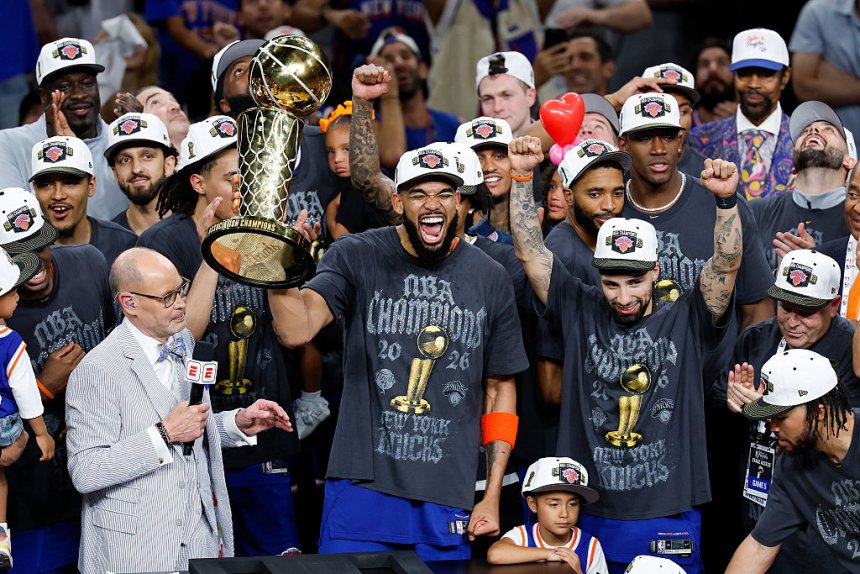
The New York Knicks won their first NBA championship in more than 50 years, but this victory is bigger than basketball. Generations of Black New Yorkers who helped shape the team’s identity are finally getting their moment.
The Knicks secured the franchise’s first NBA championship since 1973 on Saturday night, defeating the San Antonio Spurs 94-90 in Game 5 of the NBA Finals to clinch the series 4-1.
As the confetti came down and fans flooded the streets from Harlem to the Bronx, the energy across the city made one thing incredibly clear: this celebration was never just about a basketball game.
For anyone who grew up during the golden era of the NBA and hip-hop, this title is a deeply personal cultural milestone. It is the moment a franchise that has spent decades at the exact intersection of Black sports, style, and music finally reclaimed its spot at the top.
Remarkably, the Knicks’ cultural footprint has always been bigger than their record. Even during the worst losing seasons, the team remained a staple in hip-hop lyrics, fashion, and barbershop debates, while Madison Square Garden stood tall as the ultimate stage for the culture.
The team that raised a generation
While the championship belongs to today’s stars, including Finals MVP Jalen Brunson, the emotions surrounding the victory stretch far beyond the current roster. For many fans, Saturday’s win connected generations of Knicks basketball.
If you ask Black fans of a certain age about the Knicks, they will usually tell you about the heartbreak long before they mention any trophies. They’ll talk about the gritty, bruising 1990s squads led by Patrick Ewing, John Starks, and Charles Oakley.
Those teams never won a ring, but they became legendary because they perfectly mirrored the spirit of New York City itself. They played with a raw, unapologetic attitude. They were flawed, resilient, and impossible to ignore.
For countless Black families, Knicks games were absolutely appointment television, woven into the fabric of daily life alongside Sunday dinners and sitcoms. Entire generations grew up believing that, sooner or later, the team would finally break through. Finally.
The soundtrack of Black America
Part of what makes this championship hit so deep is timing. The Knicks’ rise in the ’90s happened as basketball and entertainment became global phenomena.
Remember the iconic NBA on NBC era? Michael Jordan was becoming larger-than-life, hip-hop was exploding into the mainstream, and sneakers were turning into cultural currency. Right in the center of that universe were the Knicks.
Madison Square Garden became the premier gathering place for artists, athletes, and tastemakers. Sitting courtside wasn’t just about watching a game; it was a fashion show, a high-level networking event, and a snapshot of Black celebrity culture. The Knicks weren’t merely a basketball team—they were a vibe.
Hip-hop’s hometown team
No franchise in sports history has been more intertwined with hip-hop than the Knicks. From the golden age of rap to today’s generation of artists, New York musicians have always treated the team as a direct extension of the streets.
Win or lose, the team’s iconic blue-and-orange colorway remained a fashion statement, and the fitted caps stayed in heavy rotation. While most sports franchises lose their cool the second they start losing games, the Knicks somehow became more culturally significant during their struggles. They survived decades of front-office dysfunction because they represented something much larger than a win-loss column. They represented home.
A love letter that transcended geography
The massive wave of celebration following the final buzzer proved something else: you don’t actually have to be from the five boroughs to understand what this means.
Black Americans across the country grew up watching Patrick Ewing battle in the postseason. They wore the iconic Starter jackets, watched Spike Lee pace the sidelines, and listened to their favorite rappers talk about the Garden like it was sacred ground. For fans in Atlanta, Chicago, Detroit, Houston, and D.C., the Knicks represented a nostalgic era where basketball, fashion, and city pride collided. When social media erupted after the win, people weren’t just celebrating a trophy—they were celebrating their own memories.
More than a championship
History books will record this as a massive basketball achievement, but for millions of fans, it feels like a long-overdue debt has been paid.
It is validation for decades of unconditional loyalty and the ultimate reward for fans who endured years of disappointment. More than anything, it is proof that some sports stories are simply bigger than the game itself. For generations of Black Americans, the Knicks have never just been a sports team. They’ve been family.
For fans who grew up watching Patrick Ewing battle in June, wearing Knicks fitteds and believing next year would finally be the year, that wait is over.
Fifty-three years later, the Knicks are champions.
And so is a generation of fans who never stopped believing.
Share
What's Your Reaction?
 Like
0
Like
0
 Dislike
0
Dislike
0
 Love
0
Love
0
 Funny
0
Funny
0
 Angry
0
Angry
0
 Sad
0
Sad
0
 Wow
0
Wow
0