Lessons From North Carolina: A Canary In The Democracy Coal Mine
Source: Grant Baldwin / Getty Tuesday’s North Carolina primary, as well as its 2025 local elections, offered a jolt of energy and some hope amid the dumpster fire. High turnout and an engaged electorate seemed to rebut concerns about the health of our democracy. Yet, that turnout happened despite countless efforts, year after year, aimed [...]


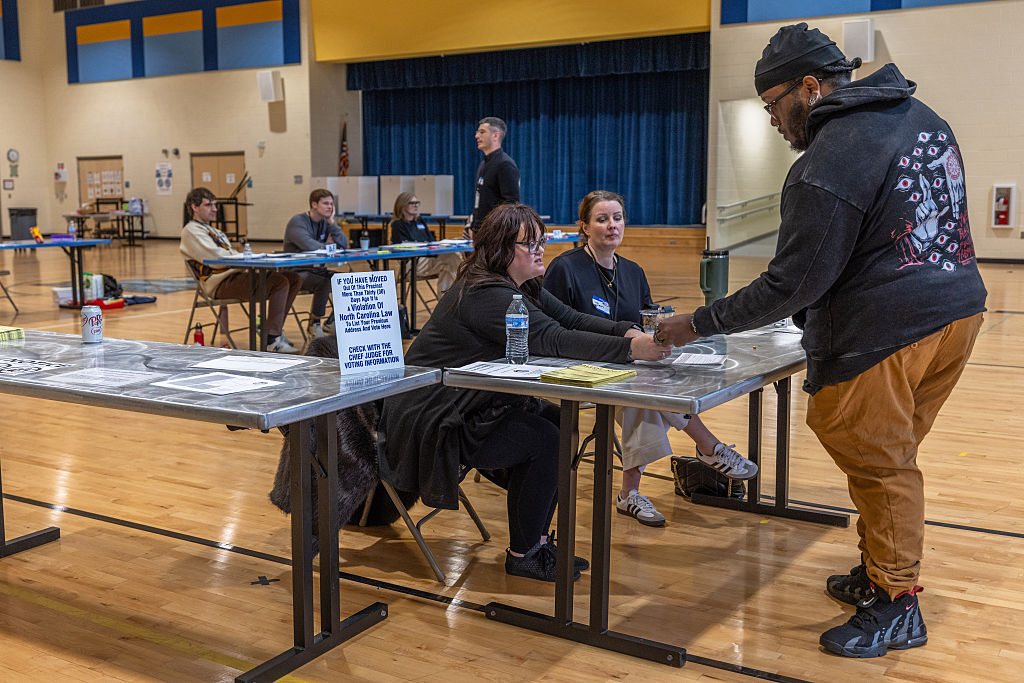
Tuesday’s North Carolina primary, as well as its 2025 local elections, offered a jolt of energy and some hope amid the dumpster fire. High turnout and an engaged electorate seemed to rebut concerns about the health of our democracy.
Yet, that turnout happened despite countless efforts, year after year, aimed at curbing voting rights and political participation—particularly for Black voters. Election administration has always been a tool weaponized against Black voters.
“The high voter turnout speaks to the power of organizing happening on the ground and the determination of the people not to be silenced in the face of these continued attacks on their rights,” said Brittany Cheatham, director of communications at Forward Justice. “Voters turned out in spite of, not because of, the flurry of changes being made to our elections policies and laws.”
Forward Justice serves as a nonpartisan law, policy, and strategy partner to many organizations across the state and region.
North Carolina has been a leader in attacking Black voter power
Georgia, Texas, and Florida have often ranked high on lists of states that serve as warnings to our democracy. But it’s North Carolina that could prove to be the canary in the coal mine in the modern-day fight for voting rights.
Like many states of the former confederacy, North Carolina has displayed a pattern, practice, and pathological obsession with infringing upon Black voting rights. It’s a history that includes a felony disenfranchisement law passed in 1875 as part of efforts to diminish the impact of newly enfranchised Black people. In 1900, the state would amend its constitution to disenfranchise Black voters in clear violation of the 14th and 15th Amendments.
Literacy tests, poll taxes, strict voter ID laws, demands for documentary proof of citizenship, and lots of gerrymandering would follow Post-Reconstruction-era efforts.
“Our state often serves as a testing ground for conservative policies, from voter suppression tactics to gerrymandering, which have later been mirrored across the country,” Cheatham said. “When participation goes up and the balance of power shifts in our state, officials enact more barriers in an attempt to silence voters. We see this mirrored in other states and at the federal level.”
In addition to Shelby County, Cheatham said Supreme Court rulings like Moore v. Harper illustrate the high stakes every year. The case arose from the Republican-controlled legislature’s frustration with courts striking down gerrymandered maps.
Even though SCOTUS rejected the concept of state legislatures being above the law and review was rejected, North Carolina Republicans continued to gerrymander the state map within an inch of its life. In “Anatomy of a North Carolina Gerrymander,” the Brennan Center called the map “one of the two most extreme congressional maps,” ahead of the 2024 election.
The other state was Texas. Think about how different Congress might be right now but for North Carolina and the states that followed suit.
“Democrats could win a solid majority of the ballots cast for Congress, but their candidates would win less than 30 percent of seats thanks to Republicans’ carefully engineered gerrymander,” read the report.
It would be a serious understatement to say North Carolina Republicans were mad at losing not only a veto-proof majority but major statewide races in 2024. In an effort to control election outcomes in their favor, they quickly ushered in a major power grab, transferring oversight of the State Board of Elections to the State Auditor’s office.
Guess which Party’s candidate won that race in 2024?
The other lesson we definitely should take from North Carolina is that persistence pays off. As the State Court Report outlined, North Carolina Republicans have been trying to strip the governor of the power to appoint election officials since at least 2016.
They’ve tried via a constitutional amendment that voters rejected. And an unconstitutional law in 2023.
“We have seen additional attacks on the right to vote since the Board of Elections was moved under the control of the State Auditor in a partisan power grab,” said Kat Roblez, Forward Justice’s Senior Voting Rights Counsel and Litigation Manager. “For example, in January, the State Board of Elections rejected early voting sites on the campus of NC A&T University as well as three other colleges.”
North Carolina A&T, the country’s largest public HBCU, was one of four college campuses that lost its early-voting site. But students made sure their voices were heard, staging a march and other organizing efforts in the lead-up to the 2026 primary.
There’s even a mini-doc highlighting the brilliant student-led effort following in the footsteps of democracy defenders before them. A quote from student organizer Olu Rouse reads, “With us voting, it’s almost a form of justice. It’s a form of movement against oppression and suppression and progress.”
As NC Newsline reported, the state’s Republican controlled board of elections announced it will only provide printed forms to individuals, county boards of elections, and other government agencies. At the same time, it may seem like a reasonable move in light of alleged cost-savings, but limiting printed forms could affect civic engagement orgs that reach voters less likely to access official sources.
North Carolina offers lessons on the necessity of non-partisan election protection
The 2026 North Carolina primary offered a glimpse into the infrastructure and organizing necessary to overcome voter suppression disguised as simple administrative changes. Over the last 10 years, a statewide coalition of organizers, lawyers, and voting rights advocates has done more than keep a watchful eye on the ever-changing trends.
Forward Justice is one of several organizations that lead Protect Our Vote NC, a vital non-partisan resource for voter education, legal support, rapid response, and post-election analysis. Other Coalition partners include the North Carolina NAACP, Democracy North Carolina, NC Black Alliance, and the Union of Southern Service Workers.
Following the 2026 primary, Democracy North Carolina released preliminary data highlighting the need for continued engagement and support for ballot access and for navigating administrative shifts.
According to the group, 5,249 voters utilized same-day registration during the early voting period. Voters using same-day registration were more likely to be younger than early voters overall. Also, “Black and brown voters were more than twice as likely to use same-day registration as white voters.”
These groups helped address issues and delays and also ensured that every vote counts, including those cast by provisional ballot, which often get lost in the election aftermath. Despite high turnout, there were still reports of voters being incorrectly turned away in at least one County and of delays in DMV processing voter registrations.
Days before early voting began, more than 241,000 North Carolina voters received confusing letters about potential data mismatches in their voter registration records following a state database review. According to Democracy Docket, some of these voters are among those targeted by the Republican refusal to accept the outcome of the 2024 state Supreme Court election.
“With increased challenges facing voters, this is about readiness on day one of voting,” Marcus Bass, Executive Director at North Carolina Black Alliance, said in response. “Voters deserve accurate information, accessible polling places, and confidence that if an issue arises, there is a coordinated, nonpartisan team ready to respond.”
North Carolina is also critical to unlocking the vote
Felony disenfranchisement and efforts to block rights restoration remain a barrier to full political participation. People can personally disagree, but there is no reason to deny people access to vote, to have a say in how they are governed. It’s a hallmark of freedom.
North Carolina has the potential to be a leader in this area, restoring rights to thousands of formerly incarcerated voters. But in recent years, we’ve seen targeted attacks on formerly incarcerated people who mistakenly vote in an effort to criminalize voting and make unfounded fraud claims a reality.
“Allegations of voter fraud, non-citizen voting, and other widely unsubstantiated claims distract from the real issues being faced by voters,” Roblez explained. “Things like polling place closures, language access, voter intimidation, and changes to absentee and early voting disproportionately impact the same group of vulnerable voters often targeted by these types of allegations.”
And while there hasn’t been any major action in North Carolina yet, that doesn’t mean a new era isn’t on the horizon. The fixation on proving the presence of virtually non-existent fraud can lead to aggressive prosecution and criminalization of vulnerable would-be voters and others who make simple mistakes.
There’s only one reason why those in power would keep changing and tinkering with rules, and it ain’t simply a matter of saving some money. Also, there is no mass wave of non-citizens or other unauthorized people voting.
As the Bipartisan Policy Center acknowledged in a recent analysis, states have accountable and transparent elections. And there are existing laws governing fraud and intimidation, resulting often in swift prosecution.
States owe our communities a duty of care, not a mandate of harm, in protecting rights like voting.
“When our system is focused on investigating, criminalizing, and barring certain groups of voters from our democracy, instead of strengthening voter protections and increasing access, it begs the question of who will be targeted next,” Roblez said. “We must remember that when this country was founded, only wealthy, land-owning white men were afforded the opportunity to vote. Over centuries of tireless advocacy, our democracy has been strengthened by extending that access to first Black men, then women, and finally all Black people in 1965.”
SEE ALSO:
Jesse Jackson’s Campaigns Offer Blueprint For Defeating US Extremism
Texas Universities Go All In On Censorship, Anti-DEI Policies
Share
What's Your Reaction?
 Like
0
Like
0
 Dislike
0
Dislike
0
 Love
0
Love
0
 Funny
0
Funny
0
 Angry
0
Angry
0
 Sad
0
Sad
0
 Wow
0
Wow
0