Here’s how a Black woman engineer turned a childhood Double Dutch dream into a real invention
A Penn State professor is blending nostalgia, culture, and STEM with what’s believed to be the world’s first automated Double

A Penn State professor is blending nostalgia, culture, and STEM with what’s believed to be the world’s first automated Double Dutch machine.
Certain sounds instantly transport Black folks back to childhood. The slap of beaded ropes against pavement, the chants echoing through neighborhood parks, somebody yelling “ready?” before another jumps into the middle transports you to a specific time and place, doesn’t it?
For many Black girls, Double Dutch wasn’t just a game. It was the foundation of rhythm, coordination, community, competition, creativity, and culture, all wrapped into one.
Now, one Black woman engineer is making sure that tradition evolves.
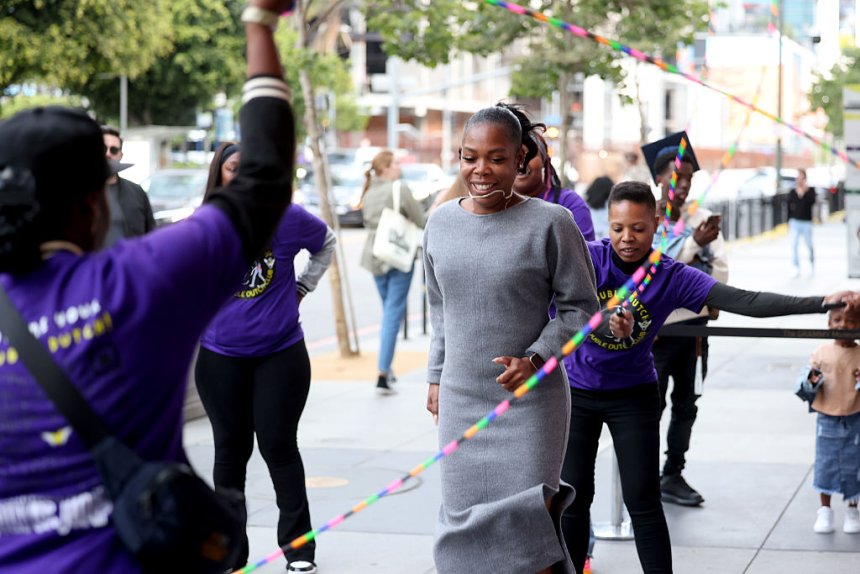
Penn State mechanical engineering professor and inventor Dr. Tahira Reid Smith recently unveiled what’s believed to be the world’s first automated Double Dutch machine during Philly Girls Jump’s Double Dutch Day celebration in Philadelphia.
The invention, called “Jump Dreams,” has been decades in the making, according to the Philadelphia Inquirer.
Long before she became a professor, researcher, and Smithsonian-featured inventor, Reid Smith was an only child growing up in the Bronx with a big imagination and a love for jumping rope. At just 8 years old, she sketched out an idea for a machine that could keep the ropes turning endlessly, allowing someone to jump whenever they wanted without needing human turners.
That childhood drawing eventually became reality.
“Jumping double Dutch is like being a part of a club,” Reid Smith told the outlet. “It’s culture. It’s a part of our history. It’s part of our heritage.”
That sentiment is likely familiar to generations of Black women who grew up treating sidewalks, schoolyards, and parking lots like training grounds. Double Dutch has long occupied a unique space within Black culture, especially in urban communities, where the activity has become both a recreational pastime and a highly skilled sport. From hand claps and chants to competitive tournaments and viral social media clips, the tradition continues to connect generations of Black girls and women across the country.
Reid Smith’s invention blends that cultural nostalgia with engineering innovation.
The app-controlled prototype uses mechanized arms to swing the ropes while participants jump in the center. During the Philly event, attendees of different ages lined up to test the machine for themselves, including visitors who traveled from as far as Atlanta.
Some participants noted that jumping with the machine required an adjustment period because, unlike human turners, the automated system can’t instinctively adapt to a jumper’s rhythm in real time. Still, many saw enormous potential in the concept.
And Reid Smith agrees there’s still room for growth.
The inventor said the current prototype is part of a larger development process and that future versions will be designed better to support beginners and jumpers with varying skill levels. She hopes to officially launch an updated design through her company, Jump Dreams Inc., in 2027.
Her long-term vision extends beyond nostalgia.
Reid Smith reportedly hopes the machine can eventually be used in schools, youth programs, and recreation centers, potentially introducing a new generation of kids to a tradition many Black communities have cherished for decades.
In many ways, the invention represents something bigger than technology itself.
It’s a reminder that Black innovation doesn’t exist only in laboratories or Silicon Valley startups. Sometimes it starts with a little Black girl in the Bronx imagining a way to keep the ropes turning forever.
Share
What's Your Reaction?
 Like
0
Like
0
 Dislike
0
Dislike
0
 Love
0
Love
0
 Funny
0
Funny
0
 Angry
0
Angry
0
 Sad
0
Sad
0
 Wow
0
Wow
0












![RataTataTa! Dolly Babe Teams with Megan Thee Stallion for the Official Remix to Her Viral Hit ‘Pink Blush’ [Listen]](https://thatgrapejuice.net/wp-content/uploads/2026/09/megan-thee-stallion-2026-thatgrapejuice-dolly-babe-pink-blush-remix.jpg)