From ‘Lanterns’ to ‘The Gilded Age’: How Black stories are taking up more space on TV
Aaron Pierre and Salli Richardson-Whitfield discuss Black stories, representation, and authenticity in HBO’s “Lanterns” and “The Gilded Age” at CultureCon.

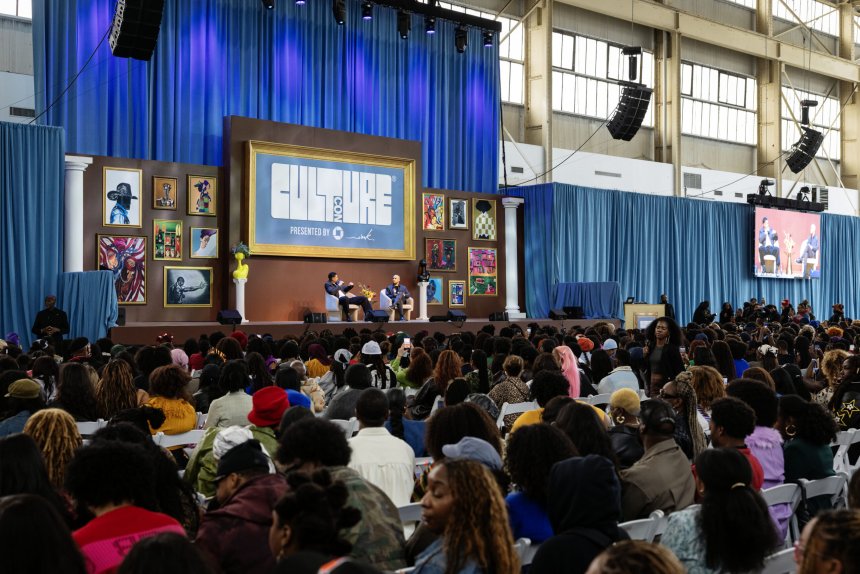

Aaron Pierre and Salli Richardson-Whitfield discuss Black stories, representation, and authenticity in HBO’s “Lanterns” and “The Gilded Age” at CultureCon.
Black stories on television are as diverse as the people they represent. Plots unfold across different worlds, from a superhero who became one of DC Comics’ most prominent Black characters to a historical drama exploring New York’s old and new elite in the 1880s.
At CultureCon, actor Aaron Pierre discussed his role as John Stewart on “Lanterns,” while producer and director Salli Richardson-Whitfield spoke about her work on “The Gilded Age,” highlighting two different forms of Black storytelling on television. Their panels offered two different perspectives of Black storytelling, from superhero mythology and Black heroism to wealth, class, and the complexities of Black life in 19th-century America.
“Lanterns,” which premiered in August, is a drama based on the DC comic characters from Green Lantern. It follows new recruit John Stewart (Pierre) and Green Lantern legend Hal Jordan (Kyle Chandler), two intergalactic cops drawn into a dark Earth-based mystery, according to the show’s synopsis.
Pierre said he wanted audiences to see a different side of Stewart, a character often understood as stoic, measured, and precise. He described Stewart as having an “extreme dichotomy,” with a calm exterior that coexists alongside the range of emotions he carries internally.
“None of us here are one-dimensional,” Pierre said. “We’re multi-dimensional and multifaceted. And that’s what John Stewart is.” 
The 32-year-old also explained that the first season establishes Stewart’s journey, beginning with his character’s origins before assuming the role of a Green Lantern.
“I had to work out who John Stewart was before he became John Stewart,” Pierre said. “That’s what episodes one to four is. Who is the young man before he becomes the man? So that’s what I would say.”
The conversation also touched on the expectations placed on Stewart as a Black man, including the idea that he would have to be twice as good to avoid being overlooked.
“I think it’s such a gift. I think to be who I am, to be who we are is such a gift,” Pierre said, calling it a “superpower.”
He later reflected on limitations others placed on him throughout his career, including being told he was too tall, that his physique was too much, and that he could not play emotionally intelligent characters.
“Watch this,” Pierre said. “Because all we’ve ever been is emotionally intelligent. All we’ve ever been is intelligent, insightful, empathetic, and powerful.”
While Pierre spoke about embracing the fullness of who we are, Richardson-Whitfield offered a similar perspective through “The Gilded Age,” highlighting a side of Black life in 19th-century America that she said is often overlooked: wealth, beauty, family, and community.
Richardson-Whitfield said one thing she loves about”The Gilded Age” is that it introduces audiences to a thriving Black community in the 1880s, where Black wealth was growing.
“We were beautiful, and we had family, and we were building businesses, and that’s what I was excited about bringing to the screen in an authentic way,” she said during her panel.
For Richardson-Whitfield, that meant showing Black life beyond racism and struggle. While she acknowledged those realities, she said the series also makes room for joy, romance, family and ambition. 
When asked why it was important to show the fullness of Black life during that period, Richardson-Whitfield said she wanted to show how the Black community could still live full lives despite the tragedies.
“We try to keep it real,” she said. “We’re not gonna pretend that there’s not racism and struggle during that time, but we don’t have to see the bad stuff all the time. “We can see us growing; we can see the beauty of it.”
Richardson-Whitfield said that approach also extends to Peggy Scott (Denée Benton), who has grown from a supporting character into someone with her own ambitions, voice, and personal life.
“She’s a writer. She’s growing. She is speaking up for her community. And she’s really been able to separate herself. She’s not just a sidekick. She is a full person with a family. With a man, romance, and something that’s outside of just the white storyline, and again, I think that is why our community loves that show,” she said.
As the show continues to expand its portrayal of Black life, Richardson-Whitfield also discussed the importance of having Black representation behind the scenes to ensure authenticity in the characters, their stories, and the historical period.
“I think that’s why it’s important to [have] us in the room,” she said. “One thing with Gilded, we have a black historian who works on the show with us; we have a black writer on the show, because it can’t just be me; my perspective may be different.”
She said having different Black voices involved helps the show tell these stories in a way that feels honest to the people and communities being portrayed.
“That’s why it’s so important to have us in these rooms when these stories are being created about us because we need people to be honest and to tell the truth,” she said.
Share
What's Your Reaction?
 Like
0
Like
0
 Dislike
0
Dislike
0
 Love
0
Love
0
 Funny
0
Funny
0
 Angry
0
Angry
0
 Sad
0
Sad
0
 Wow
0
Wow
0