
Dystany Spurlock just made NASCAR history; Black women are finally getting their moment on the track
The Virginia racer became the first Black woman to compete in NASCAR’s national series this week, adding another historic chapter

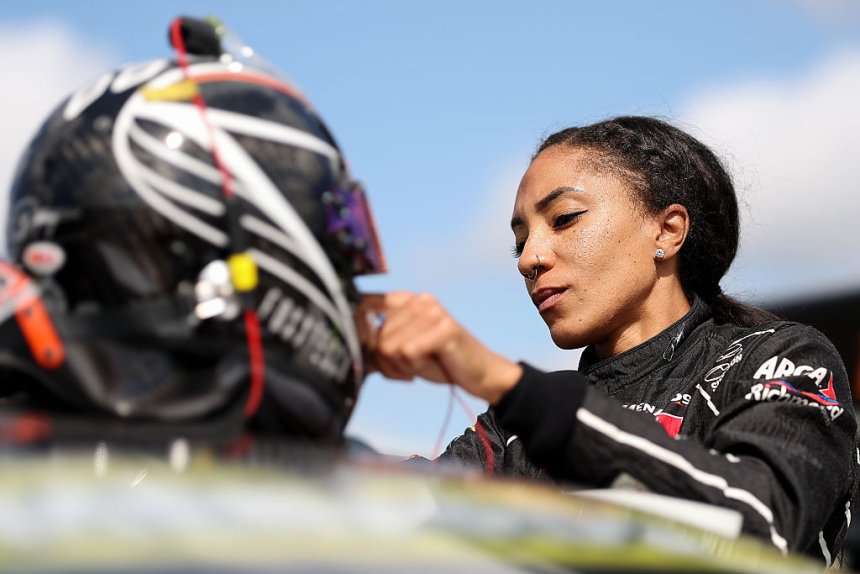
The Virginia racer became the first Black woman to compete in NASCAR’s national series this week, adding another historic chapter to the growing legacy of Black women breaking barriers in motorsports.
When Dystany Spurlock climbed behind the wheel at Watkins Glen this week, she wasn’t just racing for herself. She was driving straight into history.
The 34-year-old Richmond, Virginia native officially became the first Black woman to compete in one of NASCAR’s top three national series after making her NASCAR Craftsman Truck Series debut on May 8 at Watkins Glen International. For longtime racing fans, especially Black women who have spent decades watching motorsports from the sidelines with little representation, the moment landed bigger than a single race weekend.
Spurlock’s path to NASCAR wasn’t traditional, EURweb reported. Before stock cars, she built her name on two wheels.
The professional motorcycle drag racer started racing at 17 and quickly earned respect for her speed and technical precision. She later competed in NHRA Pro Stock Motorcycle competition, a space where Black women have historically been almost nonexistent. In 2024, she set a Real Street Bike world record with a blistering 7.32 elapsed time at 178 mph, while also becoming the first woman to win the DME Racing Real Street class in the XDA Series.
Now, she’s taking that same fearlessness into stock car racing.
According to reporting from the Black sports outlet “Andscape,” Spurlock’s historic NASCAR debut came after an already groundbreaking 2026 season that included becoming the first Black woman to compete in both the ARCA Menards Series East and a national ARCA Menards Series race.
And she didn’t just show up.
At Kansas Speedway earlier this year, Spurlock finished 10th in ARCA competition after pulling off a dramatic late-race save that quickly circulated online among racing fans. The moment introduced many people to a driver who clearly wasn’t interested in becoming a symbolic figurehead. She came to compete.
That distinction matters.
For years, conversations around diversity in NASCAR have often centered around access and visibility, not necessarily sustained opportunity. Black fans have long supported racing culture, from street racing communities to drag racing circuits to HBCU partnerships and NASCAR’s Drive for Diversity program. But seeing Black women in visible competitive roles at the national level has remained rare.
Spurlock’s arrival changes that conversation in a very public way.
And she’s not entering the sport quietly either. Between the signature pink racing suits, modeling work, entrepreneurship, social media following and her upcoming docuseries “Driven by Dystany: The Road to NASCAR,” Spurlock understands modern visibility. She’s racing, but she’s also telling a story about Black women existing unapologetically in spaces that historically excluded them.
Still, history doesn’t happen in isolation.
Spurlock’s moment builds on the work of other Black women who helped crack open NASCAR’s doors long before this week. Tia Norfleet became the first African American woman to earn a NASCAR driver’s license in the early 2010s. In 2017, Brehanna Daniels made history as the first Black woman to work over the wall on a NASCAR pit crew, including at the Daytona 500.
Those breakthroughs mattered because representation in motorsports has always extended beyond the driver’s seat. Ownership, pit crews, sponsorships and licensing have all presented barriers.
Now Spurlock is pushing through one of the sport’s biggest barriers of all: national competition itself.
And for many Black viewers watching this weekend, especially young girls who may never have imagined themselves inside racing culture, that image carries weight.
Because sometimes history isn’t loud at first. Sometimes it sounds like engines roaring around a track while a Black woman calmly does something people once said couldn’t be done.
Share
What's Your Reaction?
 Like
0
Like
0
 Dislike
0
Dislike
0
 Love
0
Love
0
 Funny
0
Funny
0
 Angry
0
Angry
0
 Sad
0
Sad
0
 Wow
0
Wow
0




![2026 MTV Video Music Awards: Red Carpet Arrivals [Photos]](https://thatgrapejuice.net/wp-content/uploads/2026/09/vmas-2026-red-carpet-tgj-scaled.jpg)