
Dr. Erica Schwartz has made history at the CDC. But what comes next?
We unpack Dr. Erica Schwartz’s complex job ahead as the new director of the Centers for Disease Control and Prevention.

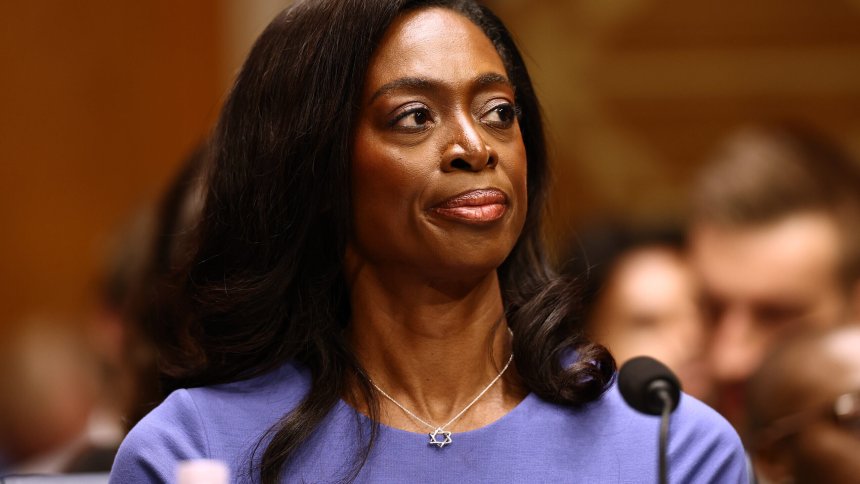

We unpack Dr. Erica Schwartz’s complex job ahead as the new director of the Centers for Disease Control and Prevention.
Few people would envy Dr. Erica Schwartz right now.
The new director of the Centers for Disease Control and Prevention has inherited an agency plagued by mass layoffs, resignations, understaffed programs, slipping morale, nearly a year of leadership instability, and an ongoing cultural battle over vaccines and scientific independence — all while the country contends with its worst measles resurgence in 35 years.
Schwartz got a firsthand look at the job ahead on Wednesday, Aug. 19, during her first agency-wide meeting since taking over the CDC last week. Employees raised concerns about burnout and programs that remain funded by Congress but have little or no staff left to actually run them following the Trump administration’s cuts.
“The good news is, I’m here,” Schwartz told employees, adding that after a “leadership vacuum,” she can now advocate for the agency, ABC News reported. She also said she would be willing to disagree with Health and Human Services Secretary Robert F. Kennedy Jr. when necessary, though she would do so privately rather than in front of the media.
It is quite the dumpster fire for anyone to inherit, much less for the first Black woman ever to lead the nation’s top public health agency. Plus, at a time when the CDC itself is undergoing dramatic change, Schwartz’s arrival raises concerns far beyond the historic nature of her appointment. Who exactly is the woman now tasked with steering the agency through this moment? Where does she stand on some of the most contentious issues in public health, and what could her leadership mean for Black Americans?
So, who is Erica Schwartz?
Hailing from Boston and the daughter of a career Naval officer, Schwartz followed her father into military service, eventually becoming a physician, attorney, and rear admiral in the U.S. Public Health Service. She is married to Dr. Daniel Schwartz, whom she met while studying medicine at Brown University.
Schwartz earned her bachelor’s degree from Brown in 1994 and her medical degree there in 1998, later earning a law degree from the University of Maryland. Her career has included responding to the H1N1 pandemic and the Ebola outbreak, and serving as deputy U.S. surgeon general during Trump’s first administration, before retiring from uniformed service in 2021.
So, unlike some of the more controversial figures in Trump’s current health orbit, Schwartz comes to the job with extensive traditional public health credentials.
A historic — and very complicated — appointment
Her confirmation earlier this month was legitimately historic. The Senate approved Schwartz 51-44, making her the first Black woman ever to lead the CDC and its first permanent director in nearly a year.
Her nomination has also come as something of a relief to some public health experts after months of upheaval and turmoil surrounding the agency, and not to mention Kennedy’s changes to federal vaccine policy. The American College of Preventive Medicine welcomed her nomination, per People magazine, while other experts praised the administration for selecting an experienced public health physician rather than a vaccine skeptic.
Others have been considerably less convinced. Some public health experts came away from Schwartz’s July confirmation hearing concerned about whether she would actually stand up to Kennedy or Trump if any political directives conflict with scientific evidence. Schwartz repeatedly vowed to “follow the science,” according to the Washington Post, but also declined to say unequivocally whether or not she would defy Kennedy in such a situation.
And then things got a little weird when abortion came up. During questioning from Republican Sen. Josh Hawley of Missouri, Schwartz called abortion surveillance a “critical component” of the CDC’s work and discussed ensuring states were not “conflating emergency services and hiding abortions” so the agency could identify “true abortions.” The remarks have alarmed reproductive rights advocates amid an already fraught post-Roe landscape and created some concern for Black women, who already face stark disparities in maternal health and reproductive care.
There is, however, one important aspect of Schwartz’s background that sets her apart from several prominent figures in the current federal health establishment — she is not an anti-vaxxer.
During her confirmation hearing, Schwartz said vaccines are safe and effective and have saved lives. She also said she accepts the scientific evidence that vaccines do not cause autism and defended vaccine requirements in certain military settings based on her own experience with disease outbreaks in the Coast Guard.
We know that’s an extraordinarily low bar for someone running the CDC, but here we are.
Whatever Schwartz ends up proving to be as CDC director certainly remains to be seen, but she does have quite the complicated plate in front of her. More than 3,000 employees have left the agency through layoffs and resignations, some congressionally funded public health programs are barely functioning, and the agency is trying to regain both its workforce and the public’s trust. Feels as though making history was the easy part.
Share
What's Your Reaction?
 Like
0
Like
0
 Dislike
0
Dislike
0
 Love
0
Love
0
 Funny
0
Funny
0
 Angry
0
Angry
0
 Sad
0
Sad
0
 Wow
0
Wow
0











![Chart Check [Billboard 200]: Victoria Monet’s ‘Frequency of Love’ Debuts with Her BIGGEST First-Week Sales Yet](https://thatgrapejuice.net/wp-content/uploads/2026/10/victoria-monet-frequency-of-love-promo-tgj-2.jpg)