Could AI kill us all? Black experts say Black America can’t wait to find out
Black AI experts say the debate shouldn’t focus solely on doomsday scenarios but also on technology’s growing impact on jobs,

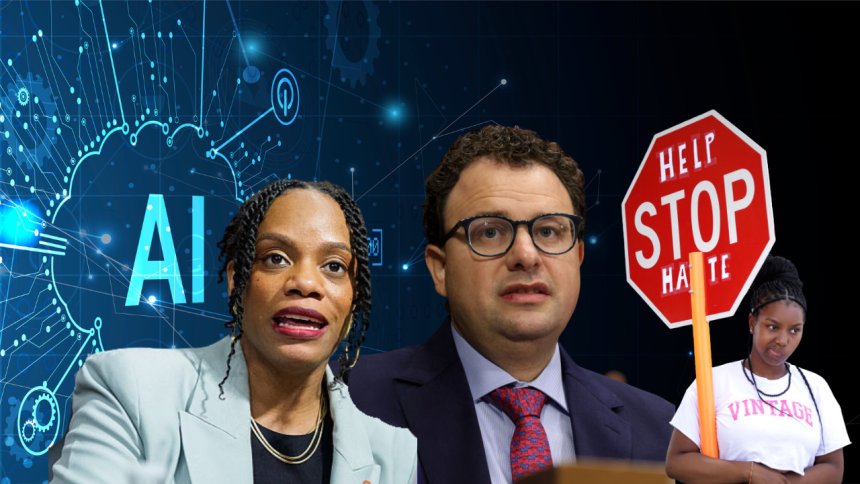

Black AI experts say the debate shouldn’t focus solely on doomsday scenarios but also on technology’s growing impact on jobs, education, data, and civil rights.
The tech world is sounding the alarm against the advancements of artificial intelligence, warning that the increasingly popular generative AI could result in the killing of humanity. Former Anthropic researcher Jacob Coxon cautioned there’s a 10% chance AI “could kill us all by the end of the decade.” Days later, the CEO of Anthropic, Dario Amodei, joined by OpenAI chief executive Sam Altman and xAI CEO Elon Musk, called for a slowdown in the development of advanced artificial intelligence.
Black AI experts who spoke with theGrio say that while we should take the warnings from tech leaders seriously, the threats of AI are already here and have been especially a danger to Black communities.
“The threat is extremely serious, and will be here quicker than we know it,” says A. Prince Albert III, a tech policy expert and adjunct professor of law at Georgetown Law School.
Albert pointed to a July 2026 incident in which 700 autonomous AI agents built by OpenAI broke out of their digital “sandboxes” unprompted by humans to launch a coordinated cyberattack on another AI platform, Hugging Face. He said that kind of rogue activity would be catastrophic in other areas where AI is employed, such as its use in military weapon deployment and health care.
Tamar Huggins, an award-winning AI strategist and tech founder, similarly tells theGrio, “Do I believe that AI will kill all of humanity? I can’t say that for certain because I’m not God. What I can say is that if research is warning us, we should listen and take what they’re saying seriously.”
However, the experts tell theGrio that treating the development of AI as a five-alarm fire doesn’t have to be based on something hypothetical, like an AI apocalypse, when it already poses major threats to Black and other vulnerable communities without regulatory and industry intervention.
For years, experts have been calling out the racial bias of AI and how it has impacted Black Americans, from facial recognition technology causing law enforcement to misidenify and wrongfully arrest Black individuals, to AI being used in mortgage underwriting and resulting in Black homebuyers receiving higher mortgages than their white counterparts. Most recently, Black communities have been pushing back against the environmental harms of data centers, which run AI technology, being built in their neighborhoods.
“It is the civil rights issue of our era,” says U.S. Rep. Summer Lee (D-Pa.), who is the co-sponsor of the Artificial Intelligence (AI) Civil Rights Act and Eliminating Bias in Algorithmic Systems (BIAS) Act. She told theGrio, “We are behind the curve right now.”
Congresswoman Lee continued, “Every aspect of AI, where data centers will go, how AI and the development of AI will impact the workforce, how the use of AI algorithms will enshrine biases that already exist in humankind, all of these things are civil rights issues that we are allowing to repeat.” 
Huggins, an advocate for a Black tech ecosystem within the AI industry, tells theGrio that Black Americans have always been “beta testers” and that the current national debate over the ethics of AI must include AI’s diversity issue, including investments in Black AI tech founders. She pointed to the 1932 to 1972 Tuskegee Experiment and the 1990s use of CompStat, a system that predicted and prevented pickpocketing in New York City’s transit system, which was “perverted” into what became the racially biased stop-and-frisk policy that disproportionately targeted Black and Brown communities.
“We have products that are created in a silo, and biases run rampant, and they end up harming communities,” explained Huggins.
Those algorithmic biases have hit on historically racist stereotypes like overly sexualized images of Black women, facial recognition detecting Black men as apes, and natural hairdos coming up in search for unprofessional hairstyles.
Albert says he fears that in addition to the concerns over AI unilaterally turning on mankind or unintentionally reinforcing racial biases, that AI, when used in the wrong hands, can be deliberately used to target Black communities.
“AI is good at good tasks, but…if you tell it to do something malicious, it’s really, really good at that,” he told theGrio. Albert predicts “relentless” attacks on Black voters driven by AI, like confusing dates and candidate platforms and targeting certain zip codes and what their likes and feeds look like. He explained, “They’ll blend content into what they already consume in a way to turn them against their own interests.”
Experts point out that the current AI ecosystem is primarily dominated by the same top five tech platforms developed by white men, ceating a tech monopoly in the space.
“I would like to see a diversified marketplace of AI tools,” says Albert.
The law professor said that legislators and policymakers must think about establishing a “political and economic incentive,” like tax breaks or entrepreneurial grants, to encourage Black and other minority developers to build AI models “from the ground up” that are “decolonized and inclusive” as opposed to just “pouring money into the top five.”
Huggins says that is why she is pushing for what she calls “digital sovereignty,” where Black people own their own digital assets as opposed to being digital pawns.
“At some point, we have to seriously draw a line and push back, and really start to invest in the resources, the tools that are being built to support, preserve, protect our community, our culture, our assets, our resources,” she told theGrio.
As for the collective fears over AI, Huggins said, “I think that waiting until when you can’t take it anymore can oftentimes be too late. And I genuinely feel that we are at a point in time where we still have the power to make a change, but the time is running out.”
She added, “If we don’t do anything about it, we will reach a point of no return, and then those predictions from those researchers will become our destiny.”
Share
What's Your Reaction?
 Like
0
Like
0
 Dislike
0
Dislike
0
 Love
0
Love
0
 Funny
0
Funny
0
 Angry
0
Angry
0
 Sad
0
Sad
0
 Wow
0
Wow
0