‘Cornell is just one in a million’: Cornell students rally for change and for a Title IX reckoning beyond their campus
Graduate student Ryan Bates opens up about attending the student protest after Cornell was sued for its handling of a

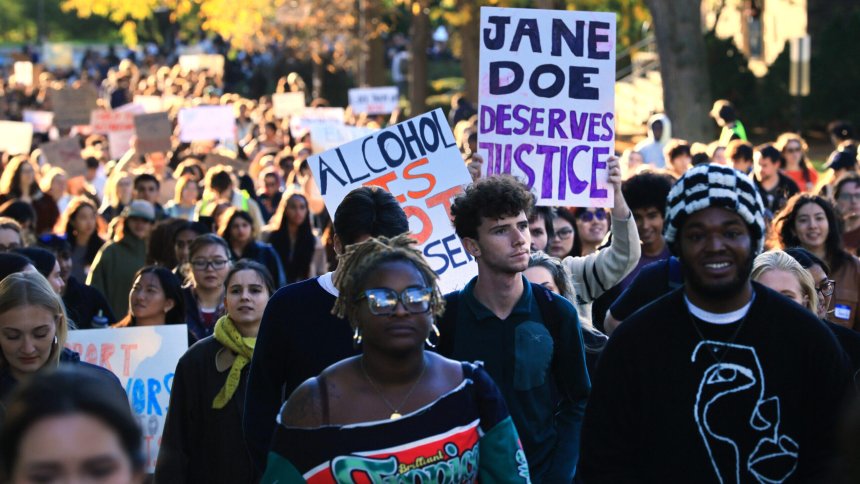

Graduate student Ryan Bates opens up about attending the student protest after Cornell was sued for its handling of a sexual assault case.
After Cornell University was sued by a former student for what she alleges was its failure to properly address and protect her following a sexual assault complaint stemming from a fraternity party in 2024, on Monday, thousands of students, faculty members, and others gathered for a protest against the school’s handling of the situation.
They carried signs emblazoned with messages such as “Where am I safe?” and “I am Jane Doe,” and wore purple ribbons as they filled Ho Plaza and spilled into surrounding walkways.
Among them was Ryan Bates, a graduate student studying public administration who said that, despite having attended several protests in her life, she had never seen a demonstration where attendees were so united.
“It was amazing,” she said, before giving a shout-out to the student organizers who arranged it in such a short amount of time.
“They did an excellent job getting their message across,” she explained, noting the enormous media presence the demonstration attracted. “It was very professional, and it definitely left a message to the campus. Because I can tell you, after yesterday, it was a different campus. It was like unified.”
Students, faculty, and members of the greater Ithaca community turned out across races, genders, and backgrounds, united by calls for accountability and changes to how Cornell handles sexual violence. As footage from the demonstration began to spread online and across national media, Bates said the same message reverberated throughout the crowd.
“Everybody that you could possibly think of,” Bates recalled of the turnout. “We were all there for the same message.”
Students want survivors to feel supported, and they want their university to do more. For the New Jersey native, who recently graduated from Spelman College and began her first semester at Cornell this fall, that message was personal.
While at Spelman, Bates was trained in Title IX and learned how to help students navigate reporting, understand the process, and support survivors. Then, she found herself on the other side of that training.
“I myself went from becoming a helper to becoming a victim, and I had to report a Title IX myself,” she recalled.
“So [Monday’s demonstration] was very intriguing to me because I know the law of the land, I understand what’s going on, and I understand that so many policies need to be changed, and that it’s bigger than just us protesting,” she continued. “It has to be a federal issue, a constitutional issue, because there aren’t enough rules and regulations around this issue.”
That experience made Monday’s demonstration all the more poignant for Bates, who said she was particularly proud of the students who managed to organize such a large response in a matter of days.
“I’m very proud of what they accomplished,” she said.
Among those who addressed the crowd was student organizer Athena Holloway, who challenged the university to offer survivors more than procedures and statements.
“Too often, we are met with silence, we are met with statements, we are met with procedures, but not enough support,” Holloway told the crowd, per footage circulating across social media. “How much does it take for our university to stand with survivors?”
Bates said she actually left the protest early for a meeting of Cornell’s graduate student government, where Cornell President Michael Kotlikoff was scheduled to answer questions from students. She didn’t want to miss the opportunity to address him directly.
“I wanted to be there to ask him a question directly from my mouth to his ears,” she explained.
Bates said she appreciated hearing Kotlikoff respond to students without a prepared script and acknowledge areas where he believed he could have handled matters differently. But for her, accountability from Cornell also has to extend to protecting the students who remain on campus as the case draws national scrutiny.
“I think they owe their students an apology because, regardless of what they think is going on in the media, these students are being targeted,” she revealed. “I mean, I had someone comment on my post today, ‘Why don’t you just transfer?’”
For Bates, who has been speaking out on her own platforms, including TikTok, transferring isn’t that simple. For starters, attending Cornell was a tremendous honor, she explained, and the university offered her a generous scholarship. Many students don’t have the privilege of simply leaving a university amid turmoil for myriad reasons, including financial constraints.
“I think accountability would be showing Americans, people who see the story, anyone who’s looking at this story, to stop attacking the students,” she continued. “Because it’s not their fault. A lot of students are taking a stand against their own university that they wanted to go to, and that they were proud to be accepted into, an Ivy League school. People have to stop going after the students.”
That plea extends to the intense media attention now focused on Cornell. Bates said students have been approached and followed by reporters while simply trying to walk to class, adding another layer of unease to a campus already grappling with questions about safety.
“We all want a story,” she acknowledged, but said students should not be “hounded down walking to class by three reporters and a tripod.”
As national attention remains fixed on Cornell, however, Bates hopes the conversation continues to grow beyond her school. For the policy student, the allegations and the response to them have illuminated a much larger conversation about Title IX, how colleges respond to sexual violence, and what needs to change to better protect students.
“I want this to be a bigger issue. Let’s talk about policy changes. Let’s talk about decision-making. Let’s talk about advocacy,” the grad student said.
“Yes, it’s unfortunate what happened at Cornell,” she continued. “But Cornell is just one in a million right now. Because imagine all the schools that know there’s bad stuff going on in their schools and they’re not saying anything.”
Share
What's Your Reaction?
 Like
0
Like
0
 Dislike
0
Dislike
0
 Love
0
Love
0
 Funny
0
Funny
0
 Angry
0
Angry
0
 Sad
0
Sad
0
 Wow
0
Wow
0