Black influencer speaks out after a white influencer steals her content and uses AI to edit her face in
Influencer and skincare founder Tatiana Elizabeth speaks out after a white influencer uses AI to steal her work. Some of

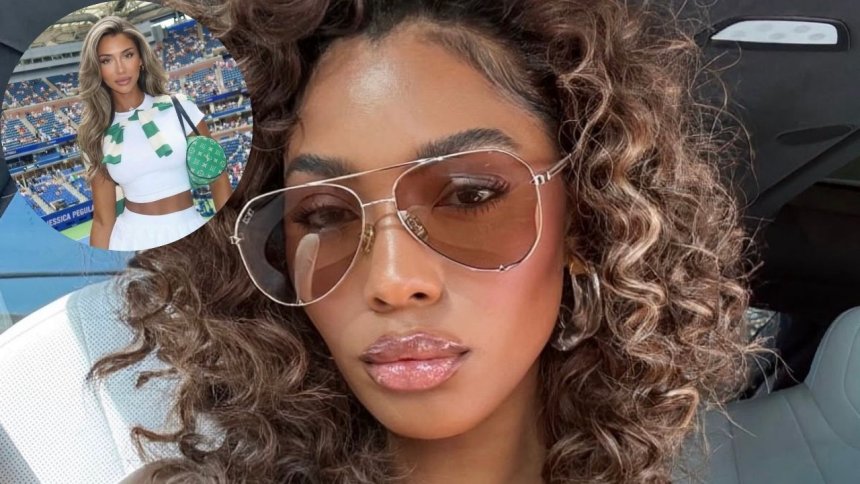
Influencer and skincare founder Tatiana Elizabeth speaks out after a white influencer uses AI to steal her work.
Some of Black creatives’ worst fears about the rise of artificial intelligence may have just become a reality.
On Monday, March 30, influencer and beauty entrepreneur Tatiana Elizabeth called out fellow influencer Lauren Blake Boultier for superimposing her face over her content and attempting to pass it off as her own.
“Well this is….. peculiar,” Elizabeth began in a post on Threads that initially linked to Boultier’s near identical version. “I was here too!! in this same exact outfit and the same watch, same bag, picture was taken at the same angle even.”
View on Threads
In another post on the same platform that included a side-by-side of her original post next to Boultier’s, Elizabeth wrote, “Bar for bar. The weirdest part about this is that it’s not even an AI influencer. This is a real person who used AI to put her head on my body. She geotagged MIAMI as if she’s at the Miami Open. When my photo was taken at the US Open two years ago.”
View on Threads
After Elizabeth posted and commented, Boutlier removed the post and eventually sent her a DM apologizing and attempting to take accountability. She explained her team was using an AI tool to assist in her workflow and that the image was generated during that process. She claimed she hadn’t seen the original and would not have matched it so closely if she had.
Elizabeth did not immediately respond to theGrio’s request for comment.
Beyond whatever legal or moral line this may cross, stealing the work and aesthetic of a Black woman in 2026 and attempting to pass it off as your own raises a bigger question. At what point do we stop calling this a mistake and start calling it what it is, the latest evolution of a very old pattern?
White people have been stealing from, profiting off of, and overconsuming Black culture for so long that it seems they no longer even recognize when they are doing it. From music to fashion to beauty to the very slang now circulating among Gen Alpha as if it were derived from the internet itself, Black creativity continues to drive culture while Black creators themselves continue to fight for proper credit and compensation.
Now, in an influencer economy where authenticity is already fragile, and performance often matters more than originality, artificial intelligence threatens to supercharge that dynamic, making it easier than ever to replicate the aesthetic, culture, vibe, and even the lived experience of Black women without ever living it. As those lines blur even further, the very creators who built much of today’s internet culture—Black women—risk being pushed further out.
In a video reacting to Boultier’s apology (which arrived after she posted another reacting to the saga), Elizabeth explained how what may look like a careless mistake can have very real implications for Black content creators. The skincare brand founder, who spent more than a decade building her career in content creation, explained how hard she and other Black creatives have to work twice as hard. She paid her dues, navigated being the only Black woman in certain spaces, and grew her platform to the point where she was invited to the US Open by Serena Williams.
View on Threads
“This is not new to me,” she continued. “I think that it’s completely and utterly disrespectful to take the work from someone else who has a smaller following than you and act like they don’t exist. Minimize their work, minimize their experience.”
The controversy also raises questions about what this moment says about influencer culture as a whole. What was once a space driven by originality, authenticity, and everyday inspiration has grown into a full-scale marketing industry where authenticity itself is now a commodity. As AI tools become more common, it is becoming harder for followers and users online to distinguish between who is real and who isn’t even actually going to places or trying the things they are attempting to influence us to.
“You are on the internet trying to seem like you are doing something and being somewhere that you are not, when you know that you have people looking up to you,” Elizabeth said. “I think that that is so disrespectful to everyone that’s following you, to not be transparent about these things.”
Toward the end of her video, Elizabeth noted that this is a reminder to be careful about comparisons in an era when some of what we are measuring ourselves against is not even real.
“This is just a lesson for all of us to not believe everything that we see on the internet,” she advised. “Do not create insecurities within yourself based on things that you see online, because some people are living a very, very fake life.”
Share
What's Your Reaction?
 Like
0
Like
0
 Dislike
0
Dislike
0
 Love
0
Love
0
 Funny
0
Funny
0
 Angry
0
Angry
0
 Sad
0
Sad
0
 Wow
0
Wow
0