Ashlee Jenae and the ways in which Black women continue to be vulnerable to violence
The discourse around Ashlee Jenae speaks to something much deeper about how prevalent violence is against Black women. As more

The discourse around Ashlee Jenae speaks to something much deeper about how prevalent violence is against Black women.
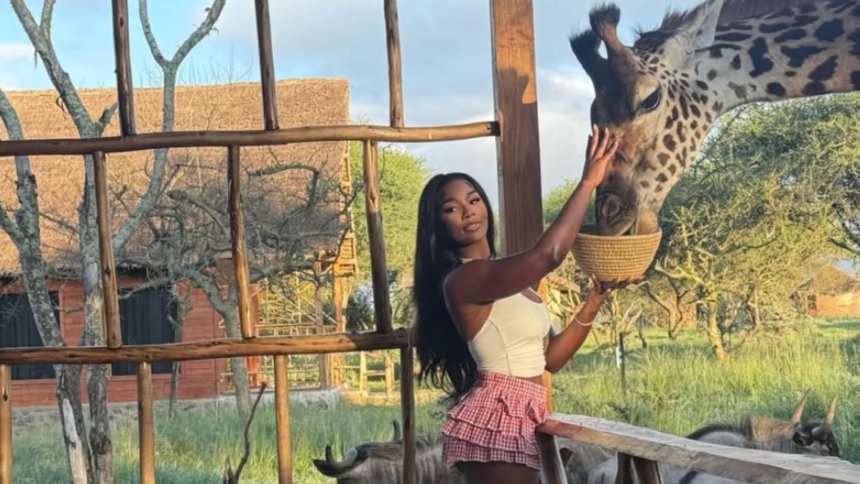
As more details emerge surrounding the mysterious death of Ashlee Jenae, including the update that her fiancé has been brought in for questioning, it is becoming increasingly clear how her case underscores some rather unsettling truths about how vulnerable Black women remain in the pursuit of love.
On Tuesday, April 14, five days after the 31-year-old influencer, born Ashely Robinson, was found dead while traveling in Zanzibar with her fiancé, Joe McCann, police confirmed in a statement that his travel documents had been withheld and that he continues to be questioned by authorities.
Earlier this month, the Portland-based influencer was updating her social media as usual, sharing glimpses of what appeared to be a whirlwind destination birthday trip that turned into an engagement. On April 3, she posted video footage of the proposal on Instagram. By April 9, she was found unconscious in her hotel room and rushed to the hospital, where she was pronounced dead. Authorities initially suggested the death was a suicide. In a statement announcing her death on April 12, her family described the confusion and heartbreak surrounding the situation.
“The suddenness, the unanswered questions, and the distance from home have made this tragedy even more overwhelming for our family. At this time, there is an active investigation into the circumstances surrounding Ashly’s suspicious passing,” they wrote. “Although we have many questions, we are placing our trust in the officials in Zanzibar and are working closely with them as we seek clarity and answers.”
Even with this latest development, much remains unknown. What has been reported is that Robinson traveled to celebrate her birthday, was surprised with a proposal during a photoshoot with lions, and may have had an argument with her fiancé that led hotel staff to place them in separate rooms. The lack of confirmed details has not stopped speculation online. Even Cardi B weighed in, writing, “That girl did not off herself,” in apparent reference to the case.
Beyond the speculation, a complex discourse has begun to take shape. Some are calling out patterns of violence involving non-Black partners and Black women, raising questions about power in interracial relationships. Others have taken a more reactionary stance, suggesting Black women should avoid certain types of partners altogether. At the same time, many are pushing back, noting that Black women face significant risk from partners across the board, including within their own communities.
In many ways, the conversation is circling around a much deeper truth. It has been this easy for people to draw conclusions because, as suicide rates among Black women have risen over the past two decades, intimate partner violence continues to stand as one of the most pressing health crises affecting Black women in the United States today.
More than 40% of Black women will experience intimate partner violence in their lifetime, compared to 31% of white women, according to the Institute for Women’s Policy Research. Meanwhile, the National Center for Victims of Crime reports that 53.8% of Black women experience psychological or emotional abuse.
“Black women are at an especially high risk of homicide by men compared with all women,” authors of an Institute for Women’s Policy Research report wrote.
Research from Columbia University Irving Medical Center and Columbia Mailman School of Public Health found that between 1999 and 2020, Black women in the U.S. were, on average, six times more likely to be murdered than their white counterparts. In roughly nine out of ten cases, the victim knew her killer. Black women are also more likely to be killed at younger ages and in more violent ways, including by gunfire.
“As a scholar whose research examines intimate partner violence, I have long known that there were disparities in homicide rates between Black and white women,” said Bernadine Waller, PhD, lead author of the study and a postdoctoral research fellow in psychiatry at Columbia.
“To uncover the fact that Black women are murdered at rates as high as 20 to 1 is heartbreaking and underscores the urgent need to make substantive structural shifts,” she added.
Some of those shifts have come through awareness campaigns, advocacy networks, and survivor support systems specifically built for Black women. In 2023, Minnesota established the nation’s first Office for Missing and Murdered Black Women and Girls. Two years later, Missouri signed a new law into place aimed at tackling the crisis of missing Black women and girls. Organizations like Ujima work to address violence through culturally specific approaches, while policy efforts such as the Violence Against Women Act have attempted to provide broader protections, though some critics argue it still falls short in addressing racial disparities. Despite all of this, the cases unfortunately keep arriving.
As the investigation continues, Robinson’s family remains focused on finding answers. They have also launched a GoFundMe to support efforts to bring her home and cover related expenses.
“Ashly was deeply loved. She was vibrant, full of life, and had so much ahead of her. Our family is completely devastated, and we appreciate the prayers and compassion we have received as we navigate this unimaginable loss. We respectfully ask that any information not directly provided by our family be treated as unverified and not considered factual at this time,” they shared.
Share
What's Your Reaction?
 Like
0
Like
0
 Dislike
0
Dislike
0
 Love
0
Love
0
 Funny
0
Funny
0
 Angry
0
Angry
0
 Sad
0
Sad
0
 Wow
0
Wow
0