‘You have options’: What Dr. Pierre Johnson hopes Black women know after 27-lbs fibroid surgery
In this exclusive interview, Dr. Pierre Johnson, a board-certified OB-GYN, opens up about his life-saving procedure. By the time Brionna

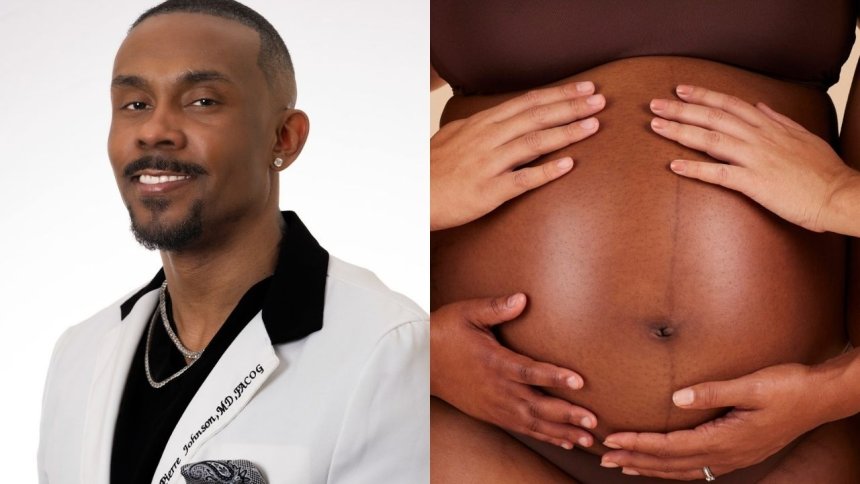
In this exclusive interview, Dr. Pierre Johnson, a board-certified OB-GYN, opens up about his life-saving procedure.
By the time Brionna Johnson, an expectant mother in Chicago, understood what was happening inside her body, the intervention plan was clear.
A 27-pound cluster of fibroids had grown alongside her pregnancy, and doctor after doctor told her that at 17 weeks pregnant, there was no safe path forward but to remove the fibroids, end the pregnancy, and prepare to have a hysterectomy. Then she found Chicago-based fibroid specialist Dr. Pierre Johnson.
The board-certified OB-GYN at Loretto Hospital took on her case, which even some of the most seasoned surgeons turned down, and a month ago successfully removed the 27-pound cluster, preserving both her pregnancy and her uterus. She’s expected to deliver her baby sometime in August.
Despite the rarity of her case involving a removal of fibroids—non-cancerous muscular tumors that grow in or on the uterus wall—during an active pregnancy, Johnson, who never says no to a case and treats women from all over the world, told theGrio during a recent interview, “I knew that I could do it for her.”
“When I heard [about her case] I knew what it was. I knew that 99 times out of 100 that this was more of a pedunculated fibroid, meaning it was stalked off the uterus,” he explained, adding, “The trick was just to really get to the stalk and control that. And once I was able to transect the fibroid off of the uterus, then everything else was just getting it out. And so I’ve done that countless times.”
He admitted the active pregnancy, presented its complexities, but what also stood out to him was the social aspect of the case, the fact that she was a Black woman experiencing a complication during pregnancy and being pushed towards the most extreme treatment option.
“There’s so much bias and discrimination in medicine, I can’t even tell you,” the physician said. “For her case, there were strong attempts to cancel it, to not let me do it, like, without even talking to me like, they tried to not even let me do her case, so it’s even bigger than the options.”
This success story arriving during Black Maternal Health Week, which ran from April 11 through April 17, and at a time when Black women are navigating a Black Maternal Health Crisis and higher rates of complications like fibroids, Brionna’s story is both encouraging and also very telling about how often Black women are pushed into more extreme alternatives for complications when a closer, more careful look is all that’s required.
Presently, while 80% of people with a uterus in general will develop fibroids during their reproductive years, by age 50, up to 90% of Black people who have a uterus will experience uterine fibroids. They are also presently two to three times more likely to get a hysterectomy to treat fibroid growths than other demographics, according to data published by the National Library of Medicine. Looking at the numbers closer, while the research shows Black women and white women have hysterectomies at roughly similar rates, the primary reason being fibroids was twice as high for Black women as it was for white women specifically (61% compared to 29%).
Johnson, who has been handling cases like Brionna’s for 13 years, has his thoughts about why the stats are the way they are. Much about fibroids, including why some develop them at such advanced stages, remains unknown. But he said, “We do know that they’re coded by genes.”
“It’s just not like they just come and just arbitrarily attack people,” he continued. “There’s a very prevalent gene amongst all women, not just Black women, that code for these fibroids.”
There are also other factors that many who develop them at such advanced sizes have in common, including chronic stress.
“Women of color, you know, experience chronic stress and microaggressions, something more than anybody,” he noted. “That also plays a role in how these genes that code for fibroids are regulated and dysregulated.”
Another reason the doctor suspects could also stem from a lack of access to adequate healthcare, another factor that people of color experience disproportionately. And for the ones who maybe have had access to care, Johnson said, for women of color, there’s a legacy of distrust of the medical field.
“The medical system has been disproportionately used to weaponize women of color throughout centuries in this country,” he said, adding that after centuries of that, what you are left with is daughters, granddaughters, and nieces with the horror stories of their mothers, aunts, and grandmothers of how they were pushed to the extreme, like “sterilizing them and performing hysterectomies unnecessarily.”
Johnson also added how more and more women of color are starting families in their 30s and 40s after grinding in their careers and building their wealth in their 20s.
“So now you have late 30s, early 40s, movers that are trying to now start families and have more advanced cases of fibroid issues,” he said.
With so many potential future cases out there, or even current ones, Johnson hopes people know that, while limited, they do have options. Many people are often inclined to trust the word of the first person in a white coat they encounter. They have a medical degree, but we have gut feelings and are living in our bodies. Johnson encourages anyone who may not be fully comfortable with the first approach to seek as many different opinions as possible until they find a physician more aligned with their goals.
When it came to Brionna, who did just that, he said, “It just showed me just how vital it is to really advocate for women in these circumstances.”
Discussing what he described on social media as the most “amazing” surgery of his career, which occurred during Black Maternal Health Week, he said he hopes to be a “beacon of light for women of color.”
“You have options, you have people that care,” he said.
Share
What's Your Reaction?
 Like
0
Like
0
 Dislike
0
Dislike
0
 Love
0
Love
0
 Funny
0
Funny
0
 Angry
0
Angry
0
 Sad
0
Sad
0
 Wow
0
Wow
0