When The World Ends, Will You Be Able To Afford To Live In ‘California Forever’?
The current American hellscape is a bubbling cauldron of a war that nobody wants with Iran, gas prices on the verge of five dollars a gallon, unemployment through the roof, food prices higher than a giraffe on stilts, and a president who can’t stop stealing Americans’ tax money. And now billionaires are building high-priced bunkers [...]


The current American hellscape is a bubbling cauldron of a war that nobody wants with Iran, gas prices on the verge of five dollars a gallon, unemployment through the roof, food prices higher than a giraffe on stilts, and a president who can’t stop stealing Americans’ tax money.
And now billionaires are building high-priced bunkers for the day when it all falls apart.
We’ve now reached the part of the movie where billionaires are buying up land to create utopian housing they claim will be affordable, but is increasingly feeling like a rich-people-only death bubble that will become the only sustainable living space for those who can afford $1 million apartments. They’re calling it “California Forever.” California residents are calling it what it is: a rich people project in exclusion, seclusion, and decadence that leaves out those who can’t afford to pay. And all of it feels a lot like Paradise.
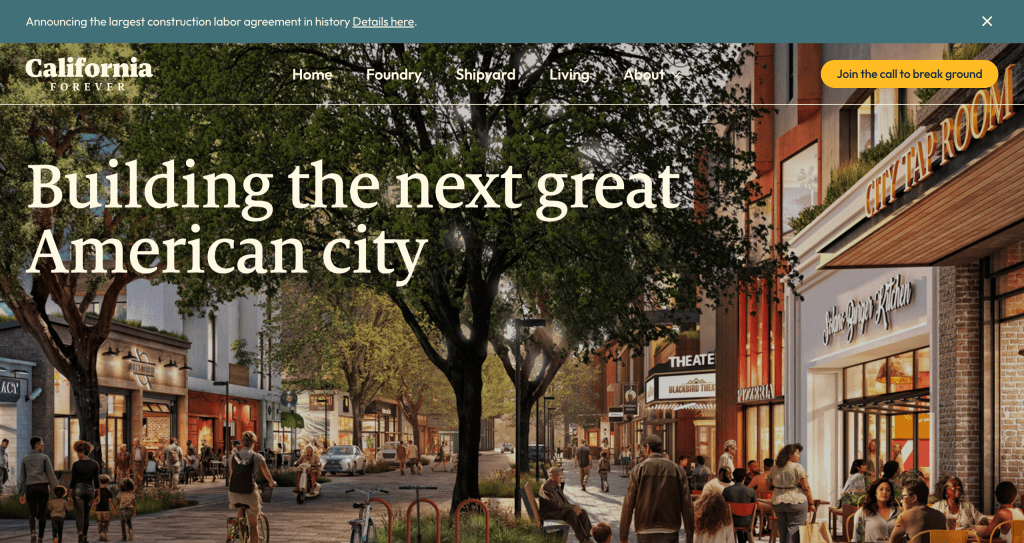
The sales pitch doesn’t quite sell it as such, but the brochure for a place called “California Forever” sounds like something out of a glossy TED Talk: a master-planned, walkable city built from scratch in the rolling fields of Solano County, California, just northeast of San Francisco. Think compact neighborhoods. Tree-lined streets. And, Mediterranean-style plazas where children play while adults sip ethically sourced coffee. The marketing language reads like someone took all the urban-planning buzzwords of the last decade—density, sustainability, transit-oriented development—and turned them into a sales pitch.
But the deeper you look at California Forever, the less it resembles a utopian city for the masses and the more it feels like something else entirely: a billionaire panic room with bike lanes.
California residents couldn’t even find out who was quietly buying up the more than 50,000 acres of farmland in Solano County, spending some $900 million. The company was called Flannery Associates, and their buying began as early as 2017, but where did they get all the capital to create such a utopian love nest?
The list of investors behind it reads like a Forbes list of really rich white people: Marc Andreessen, Laurene Powell Jobs, Reid Hoffman, and Michael Moritz among them. For his part, Hoffman has openly talked about billionaires buying “apocalypse insurance” bunkers where they can hide in case things get really bad.
After the secret land purchases were finally revealed, the billionaires framed the project as a solution to California’s housing crisis. Which is technically true in the same way buying a yacht technically solves the problem of not owning a yacht. California absolutely needs housing. The state has been in a shortage for decades. But philanthropic billionaires are about as common as Centaurs (with the exception of Laurene Powell Jobs; her giving has been monumental; she is a unicorn.)
But this idea that a privately financed, master-planned city backed by venture capitalists is primarily about helping teachers, service workers, and nurses afford homes requires a level of optimism usually reserved for people who still believe the billionaire class wakes up every morning wondering how to make life cheaper for everyone else. Billionaires don’t become billionaires because they are giving. By definition, billionaires are usually some of the most heartless capitalists; it’s a requirement of becoming a billionaire.
So let’s look at the reality of it: California Forever is a place designed for the people who already saw the apocalypse coming—and have been quietly preparing for it.
People with more money than god have always been fascinated with preserving their existence. It’s why they spend ungodly amounts of money on stem cell injections, gene therapy, and anti-aging drugs. And the ultra-rich have been equally obsessed with doomsday planning. Back in 2014, Mark Zuckerberg was said to have begun working on Koolau Ranch, a 1,400-acre compound in Hawaii that costs $100 million and includes a bunker.
A few years ago, tech executives in New Zealand were buying bunkers in a minor cottage. Venture capitalists openly discuss “exit plans” for when civilization becomes inconvenient. Some buy land. Some buy islands. Some invest in fortified compounds with renewable energy and private security.
California Forever feels like the logical next step: why hide in a bunker when you can build your own city?
Not just any city, either. A city designed by the same people who believe everything can be optimized—transportation, governance, community, even democracy itself. In Silicon Valley thinking, if cities are messy and dysfunctional, the solution is not to improve the existing ones but to start over with a fresh operating system.
It’s SimCity, except the people playing the game have billions of dollars and an alarming confidence in their own brilliance. The pitch materials emphasize walkability, green infrastructure, and a return to “traditional town design.” But the subtext is harder to ignore. A brand-new city built on private land, financed by endless money, governed through a carefully designed system, and located just far enough away from existing urban chaos to remain insulated from it.
The plan envisions a city that could eventually house as many as 400,000 people, transforming rural agricultural land into dense neighborhoods, industry, and infrastructure. If climate change worsens, if economic inequality grows, if political instability becomes the norm—well, there will conveniently be a thoughtfully planned community waiting behind the curtain.
This is not a conspiracy theory. It’s simply reading the room.
We are living in an era where billionaires increasingly act like a different species of human—one that experiences global problems primarily as logistical challenges rather than existential ones. They aren’t looking to end climate change; they are just buying bigger boats. They aren’t trying to quell social inequalities; they are just hiring more security. California Forever fits neatly into that worldview. It is a hedge against the chaos that the same tech economy helped accelerate.
The irony is that the project is wrapped in the language of civic virtue. The promotional videos talk about solving the housing shortage. About creating community. About designing a model for the cities of the future.
But if you listen closely, you can almost hear the quiet subheading underneath all that optimism:
Just in case everything else falls apart.
And perhaps that’s the real story here. California Forever isn’t just a housing development. It’s a psychological artifact of the billionaire mindset in 2026. A place where the ultra-rich can convince themselves that they are not retreating from society but improving it.
That they are not building a fortress but a community.
That the gates, if they exist at all, are purely decorative.
Of course, history suggests that privately controlled cities rarely stay utopian for long. They become enclaves. They become exclusionary. They become places where access—whether to housing, opportunity, or safety—depends heavily on who you are and what you can afford.
Which raises a simple question about California Forever.
If the world really does start falling apart—economically, politically, environmentally—who exactly gets to live in the beautifully designed walkable paradise?
Because if the answer is “everyone,” then California Forever might actually be the visionary project its backers claim it is.
But if the answer is “the people who can afford the door code,” then what Silicon Valley is building in the hills of Solano County isn’t the city of the future.
It’s the suburbs at the end of the world.
SEE ALSO:
Share
What's Your Reaction?
 Like
0
Like
0
 Dislike
0
Dislike
0
 Love
0
Love
0
 Funny
0
Funny
0
 Angry
0
Angry
0
 Sad
0
Sad
0
 Wow
0
Wow
0