What, To The Black American, Is The 250th Anniversary?
Source: kali9 / Getty Every July 4th, my social media feed fills up with a predictable wash of red, white, and blue. Last year, one image had me pause a little longer than all of the others. It was a photograph of a white friend’s daughter, smiling brightly and proudly gripping a small American flag. [...]


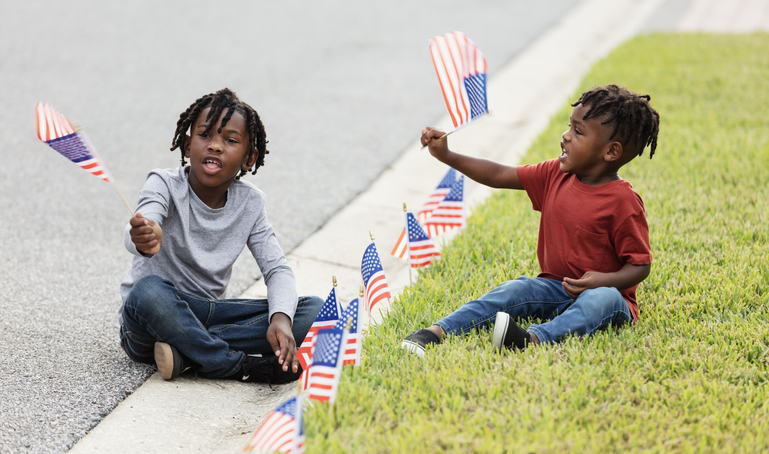
Every July 4th, my social media feed fills up with a predictable wash of red, white, and blue. Last year, one image had me pause a little longer than all of the others. It was a photograph of a white friend’s daughter, smiling brightly and proudly gripping a small American flag. She looked innocent, joyful, and completely at home.
That image made me revisit one of my favorite photographs, which I purchased at a photo auction years ago. It was captured by a photojournalist and features a young Black girl, probably no more than six or seven years old. She is standing tall, firmly grasping the wooden staff of an American flag with both hands. The stick extends diagonally from her shoulder to her hip, while the flag hangs naturally from the top.
The context of where or when that photo was taken doesn’t matter. What matters is her firm grip. In her grip and the expression on her face, we see a deep desire we all feel to hope for a brighter future, mixed with a guarded caution. Looking at her, I am reminded that this country continues to delay delivering the foundational promises of freedom and protection to the Black community, rendering the flag she holds an unfulfilled promise.
In so many ways, we as Black people are all that little girl. After all, this is our country, too. So many of us were born here and grew up here, and we want to celebrate our country wholeheartedly, but our relationship with it is far too complicated.
The contrast between the young Black girl photographed holding a flag and my friend’s daughter celebrating with one brings to mind Frederick Douglass’ 1852 address “What to the Slave Is the Fourth of July?”
He delivered it to an audience at the Rochester Ladies’ Anti-Slavery Society, one day after America’s 76th birthday. It was an audience filled in part with white people who celebrated the nation’s independence while millions of Black people remained enslaved. Douglass made clear where that juxtaposition left him as he declared, “This Fourth of July is yours, not mine. You may rejoice, I must mourn.”
He spoke directly to his audience about the “sad sense of the disparity between us,” proclaiming with heartache, “I am not included within the pale of this glorious anniversary! Your high independence only reveals the immeasurable distance between us.” He pointed out that the “sunlight that brought life and healing to you has brought stripes and death to me.”
The parts of Douglass’ speech that reflect a deep social chasm mirror what so many of us navigate in our daily lives. We see it in the unspoken difference in how we must move through space, how we are policed, and how our humanity and worthiness are measured by the color of our skin.
We feel these disparities on a random Tuesday just as much as we do on the 4th of July. The only difference is that on the Fourth of July, the very act of national celebration feels like part of what’s being celebrated is that chasm. The collective expectation is that we are just supposed to put it aside and forget, leaving us saddled with the complex puzzle of how to fit our truth into their joy.
Douglass labeled this expectation as an “inhuman mockery and sacrilegious irony,” asking the crowd if it was their intention to mock him. He noted that “to drag a man in fetters into the grand illuminated temple of liberty and call upon him to join you in joyous anthems” was itself a profound injustice.
Douglass’s speech wasn’t wholly anti-patriotic. He took the time to praise the framers as statesmen and patriots. He reminded the crowd that America was still in its infancy and that a nation’s lifespan can last thousands of years. For Douglass, the young age of the republic offered hope that a nation in its early stages could still course-correct. He said, “Were the nation older, the patriot’s heart might be sadder, and the reformer’s brow heavier.”
But he also delivered a definitive, timeless verdict. He asked the crowd, “What, to the American slave, is your 4th of July?” and answered that it is “a day that reveals to him, more than all other days in the year, the gross injustice and cruelty to which he is the constant victim.”
Now, as we approach two and a half centuries, that window of hope has narrowed. This country is no longer in its infancy, which means the endurance of these disparities can no longer be considered a temporary phase we are likely to grow out of in time. Sadly, these systemic injustices and disparities have become a permanent stain, defining who we are and who we seem committed to being.
This alienation feels especially acute right now. We are standing on the precipice of America’s 250th birthday, and the corporate machinery is in overdrive. Walk into any major retailer, and you are bombarded with a sea of red, white, and blue marketing.
There are commemorative 1776 t-shirts, limited-edition Star-Spangled Banner packaging, and endless rows of merchandise. The messaging is aggressive and seems intent on packaging a sanitized, unified version of history, bottling up a very tumultuous 250-year history into cheap trinkets that will likely be retired by their owners by the year’s end.
Douglass’s words remind us that under structural scrutiny, these celebratory displays risk becoming what he termed a “thin veil to cover up crimes,” rendering the national shouts of liberty and equality little more than a “hollow mockery.”
This persistent mockery continues and stands in stark contrast to the early hope Douglass held. In 1852, he hoped that “high lessons of wisdom, of justice and of truth” would give new direction to America’s destiny.
Yet, now in 2026, the climb toward that ideal is infinitely harder. Instead of turning toward justice, we have allowed deep and entrenched systemic injustice to become pervasive. As Black Americans, we confront this reality everywhere, from corporate boardrooms to the streets we walk, making it impossible to forget how uneven the ground truly is. This is the version of the country that continues to frame the two girls in my head this Fourth of July.
Until the day this country finally dismantles the chasms it continues to cheer for, the contrast between the two young girls, one Black and one white, is unavoidable. Both are deserving of the best this country, with all of its resources, has to offer.
On this Fourth of July, I will think of my friend’s daughter, experiencing a joy that is simple and unquestioned. Her joy and uncomplicated relationship with this country are the epitome of what all Black folks deserve. And I will look across the room at the photograph hanging on my wall of the little Black girl, standing tall and gripping that wooden staff with the American flag draping down it using both her hands, waiting for a reality she cannot see and one her elders cannot promise her.
She is the reminder that we do not have the luxury of blind celebration. Until this country decides to finally dismantle the chasms it actively cheers for, we as Black Americans are left holding our truth against their joy, forcing us all to contemplate for ourselves the question that needs answering.
What, to the Black American, is the 250th?
SEE ALSO:
America’s 250th Birthday: What Are We Really Celebrating?
Frederick Douglass Said ‘This Fourth Of July Is Yours, Not Mine’
Share
What's Your Reaction?
 Like
0
Like
0
 Dislike
0
Dislike
0
 Love
0
Love
0
 Funny
0
Funny
0
 Angry
0
Angry
0
 Sad
0
Sad
0
 Wow
0
Wow
0


![The WNBA’s Uneven Whistle Continues To Put Black Women In Danger [Op-Ed]](https://i1.wp.com/newsone.com/wp-content/uploads/sites/22/2026/08/17863865807191.jpg?w=1024&strip=all&quality=80&ssl=1#)