The Rise, The Sacrifices, And The Victory Of Jalen Brunson
Source: Gregory Shamus / Getty In order to understand Jalen Brunson’s sacrifice – the financial, emotional, and physical toll the lead guard made for the New York “championship” Knicks – you need look no further than his mom and Game 5 of the NBA Finals. Brunson’s mom, Sandra, didn’t want to take the team flight [...]


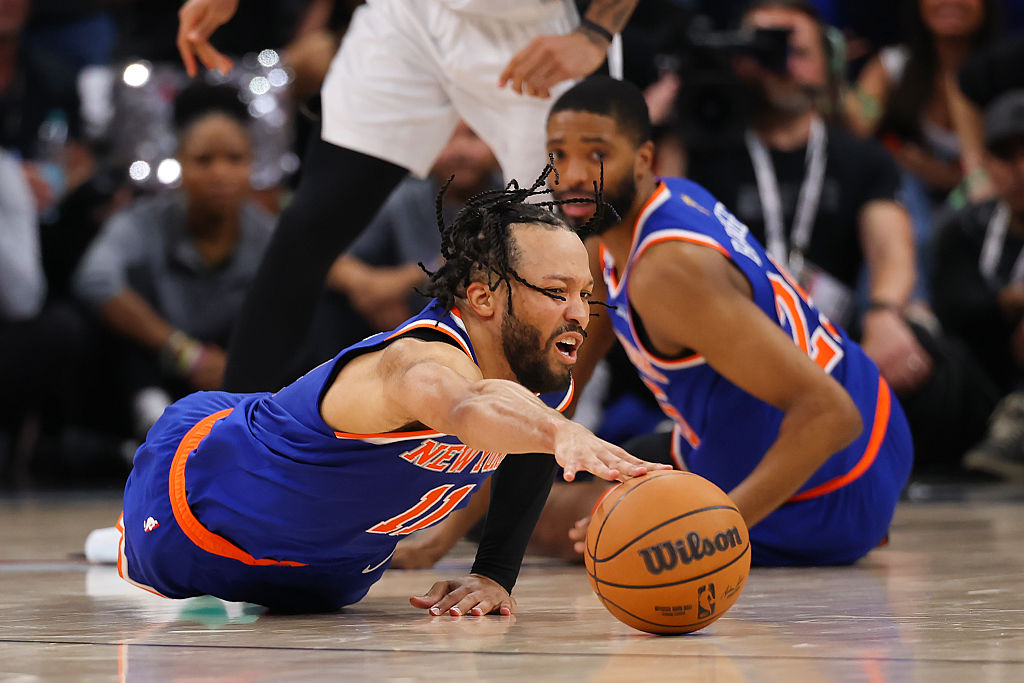
In order to understand Jalen Brunson’s sacrifice – the financial, emotional, and physical toll the lead guard made for the New York “championship” Knicks – you need look no further than his mom and Game 5 of the NBA Finals.
Brunson’s mom, Sandra, didn’t want to take the team flight to Game 5 in San Antonio because she had a prior obligation to a charity she refused to miss. She knew what was at risk, but she wanted to be there for the kids in her and Jalen’s Second Round Foundation that empowers children to determine their own success by understanding that their background doesn’t determine their future.
Sandra missed her connecting flight the night before the game, so she flew to Austin instead, rented a car, and drove an hour and a half to make it to the game
Because that’s what commitment looks like. It’s the work you do when no one is watching. It’s the sacrifice you make when there is no audience to cheer you on. It’s the willingness to make the drive when you could’ve just forgotten the kids and taken the flight.
Brunson could have forgotten his teammates, the city of New York, and the people and taken the bag. He could’ve dropped the top on the whip and pressed play on Southern epistemologist, Young Dolph’s “Get paid, young n–ga, get paid” as he left Madison Square Garden.
Players leave. Teams trade franchise icons. Owners cry poor while printing money. Every contract negotiation becomes a public debate about maximizing value, securing the bag, and making sure nobody leaves a dollar on the table.
And generally speaking? That’s good advice.
Get your money.
Because if sports have taught us anything, it’s that organizations don’t care about feelings or facts. They care about money. That’s it.
Currently, the New York Knicks are the NBA champs from a division often overlooked, in a conference that doesn’t get respect, in a city that hasn’t won a championship in 53 years. To fully understand how long 53 years ago actually was, just know that the number one song in 1973 was “Tie a Yellow Ribbon Round The Old Oak Tree” by some old people named Tony Orlando and Dawn.
Respectfully.
Because if sports history has taught us anything, it’s that organizations rarely reward loyalty. They reward production. The moment that production slips, loyalty suddenly becomes a very flexible concept.
Which is what makes Jalen Brunson’s championship feel so significant.
Because this isn’t just a story about the New York Knicks winning their first NBA title in generations. It’s a story about a star who chose to believe in something bigger than his next paycheck—and was proven right. Brunson could’ve waited and signed a projected five-year, $269 million max contract; instead, he signed a four-year, $156.5 million extension to help bring in better players. It led to the Knicks signing OG Anunoby, Mikal Bridges, and Karl-Anthony Towns. It led to a championship. Leaving $113 million on the table with inflation higher than Willie Nelson standing on top of a giraffe, which is standing on top of the peak of Mount Everest, is insane.
People called it foolish. People called it risky. Some treated it like financial malpractice. After all, NBA careers are short. One injury can change everything. Why voluntarily leave millions on the table?
The answer became clear the moment the Knicks raised the Larry O’Brien Trophy.
Brunson wasn’t thinking about what he could get. He was thinking about what the team could become. Every dollar he didn’t demand gave New York more flexibility. More room to keep talent. More room to build depth. More room to chase a championship instead of merely chasing headlines.
And now that championship belongs to him. Not because he was the highest-paid player. Not because he had the flashiest endorsement deals. Not because he was chasing individual accolades. Because he understood something that gets lost in today’s sports culture.
The point isn’t to win the negotiation. The point is to win the damn championship. That’s what makes Brunson’s story resonate beyond basketball.
We live in a culture obsessed with individual accumulation. More money. More followers. More status. More attention. More everything. Brunson chose a different path. He chose investment. He bet on teammates. He bet on organizational stability.
Most importantly, he bet on himself.
And let’s be honest: betting on himself is something Brunson has been doing his entire life. The Dallas Mavericks certainly weren’t doing it. Before he became the face of New York basketball, Brunson was sitting in Dallas, practically begging the Mavericks to recognize what was right in front of them.
Instead, they hesitated. Again and again. Dallas treated Brunson like a complementary piece when he was already becoming a cornerstone. They saw a solid player. New York saw a franchise leader. The Mavericks looked at him and saw someone who benefited from playing alongside Luka Dončić. The Knicks looked at him and saw somebody capable of carrying a franchise on his back.
Only one organization got it right.
Now one franchise is celebrating a championship while the other is still living with one of the most expensive miscalculations in modern NBA history. The beauty of Brunson’s rise is that it feels familiar to anyone who has ever been underestimated.
Too small.
Not athletic enough.
Not flashy enough.
Not marketable enough.
Not enough.
For years, Brunson heard some version of that message. Now he’s a champion. Not because he transformed into somebody else. Because everybody else finally caught up to who he already was. And that’s why this title matters so much.
And in order to understand this, you have to understand how Brunson was raised.
The Knicks didn’t just win because Brunson took less money. Basketball is more complicated than that. But his sacrifice helped create the conditions that made winning possible. It set a tone. It established trust. It sent a message to the rest of the roster that the franchise star was willing to prioritize the collective over the individual. Championship cultures don’t magically appear. They’re built through a thousand decisions that prioritize winning over ego. Brunson made one of those decisions. The ring is the reward.
And perhaps the sweetest part of all this is how completely it rewrites the narrative. For months, people talked about the money Brunson supposedly lost. Today, nobody is talking about the money. They’re talking about the parade. They’re talking about the banner. They’re talking about the championship. Years from now, nobody will remember the salary-cap calculations. Nobody will care about the spreadsheets. Nobody will debate the exact dollar figure he left on the table. They’ll remember that Jalen Brunson became the face of the franchise that brought a championship back to New York.
They’ll remember that he helped resurrect the Knicks.
They’ll remember that he won.
And somewhere in Dallas, they’ll probably remember him too.
Just not for the reasons they hoped.
SEE ALSO:
New York Knicks Win 1st NBA Championship In 53 Years
After A Long Journey, Mike Brown Finally Wins An NBA Championship
Share
What's Your Reaction?
 Like
0
Like
0
 Dislike
0
Dislike
0
 Love
0
Love
0
 Funny
0
Funny
0
 Angry
0
Angry
0
 Sad
0
Sad
0
 Wow
0
Wow
0