The Phone Call That Changed Everything: 1 Woman’s Breast Cancer Fight in Albany, Georgia
Source: Paris Holsey / Bison ONE Newsroom Kelly Washington was standing at the counter at work when the phone call came. Just moments earlier, she had been juggling the usual demands of the day and the quiet rhythm of ordinary life. But as the doctor spoke on the other end of the line, everything around [...]


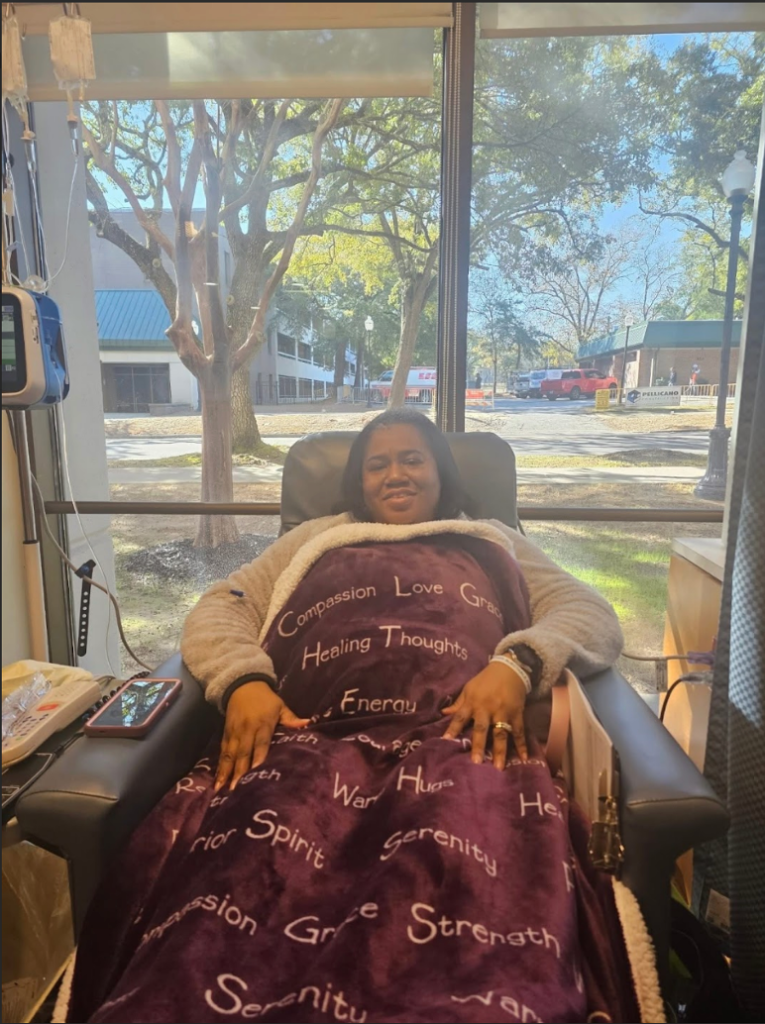
Kelly Washington was standing at the counter at work when the phone call came.
Just moments earlier, she had been juggling the usual demands of the day and the quiet rhythm of ordinary life. But as the doctor spoke on the other end of the line, everything around her seemed to slow.
Stage 2 breast cancer.
“I was floored,” Washington recalled. “I basically had to lean against the counter. I was somewhat prepared, but you never really expect to hear the word cancer about yourself.”
In the days that followed, life moved quickly. There were appointments to schedule, biopsies to review, and chemotherapy treatments to plan. Fatigue set in almost immediately, forcing Washington to rest more often than she ever had before. The routines she once took for granted, like late nights, long workdays, and uninterrupted schedules, suddenly felt distant.
But amid the fear and uncertainty, Washington found herself surrounded by a network of support. Her husband began driving her to medical appointments and treatments. Her eldest son stepped in to help care for her youngest child. Friends and extended family members checked in constantly.
“Everybody has rallied around me,” she said. “The love and support have been incredible.”
Washington knows that in many ways she has been fortunate. After noticing a lump last summer, she was able to schedule a mammogram quickly and follow up with specialists without long delays. But she also knows that many people in her community do not have that same experience.
“Not everyone can get in that fast,” she said. “Some people have to wait months to see a doctor, then get referred to a surgeon or a breast center. By that time, the cancer could be growing.”
Washington’s story reflects a broader reality in Albany, Georgia, where access to timely cancer care can depend heavily on insurance coverage, hospital capacity, and the limited healthcare infrastructure serving much of Southwest Georgia. In smaller Southern cities like Albany, patients often face long waits for screenings, referrals, and specialist appointments.
To understand why Washington’s diagnosis raises deeper concerns about access to care, it helps to understand Albany’s recent history with healthcare crises.
The city of roughly 70,000 residents in Southwest Georgia became an early national symbol of how vulnerable Black communities can be during public health emergencies. In the spring of 2020, Albany emerged as one of the first major COVID-19 hotspots in the United States. Within weeks, hospitals were overwhelmed, and the city’s predominantly Black population experienced some of the highest infection and death rates in the country.
Much of the outbreak was traced to funerals and church gatherings that occurred before the scale of the virus was fully understood. As the virus spread rapidly through families and neighborhoods, Phoebe Putney Memorial Hospital, the region’s largest medical center, struggled to keep up with the surge of critically ill patients.
The crisis exposed long-standing weaknesses in the region’s healthcare infrastructure. Many residents lacked consistent access to primary care, preventative screenings, and insurance coverage. For patients living in rural areas surrounding Albany, traveling long distances to see specialists was already routine when seeking care.
Public health experts say those structural challenges did not disappear when the pandemic subsided.
“Albany’s healthcare system has been under strain for years,” said Monder Ponder, an assistant professor of Health Communication and Culture at Howard University who studies healthcare access in Southwest Georgia. “The pandemic simply made those disparities visible to the rest of the country.”
Those same structural pressures now shape how residents experience other serious illnesses, including cancer.
For diseases like breast cancer, early detection and quick referrals to specialists can significantly improve survival rates. But in communities where access to screenings, insurance coverage, and specialty care is limited, delays can mean the difference between catching cancer early and confronting it at a more advanced stage.
That reality weighs heavily on Washington as she continues her own treatment.
Her diagnosis was triple-negative breast cancer, an aggressive form of the disease that is more likely to affect Black women and tends to grow and spread faster than other types of breast cancer. According to the American Cancer Society, Black women are about 40 percent more likely to die from breast cancer than white women, even though their overall incidence rate is slightly lower.
In Albany, those disparities unfold within a community already facing significant health challenges. Albany sits in Dougherty County, where public health data show breast cancer incidence rates of roughly 53 cases per 100,000 women in recent reporting periods. The region also relies heavily on a single major hospital system to serve much of Southwest Georgia, meaning patients often travel long distances for screenings, oncology care, and specialist referrals. Health researchers say that in communities like Albany, where poverty rates are high, and access to preventative care can be uneven, delays in screening and diagnosis can make aggressive cancers like triple-negative breast cancer even more dangerous.
Doctors say early detection is critical, particularly for aggressive cancers like Washington’s.
Ponder says Albany reflects a broader pattern across rural America.
“Rural communities often have fewer screening facilities, fewer specialists, and longer travel distances for care,” Ponder said. “Those barriers may not seem dramatic on paper, but when you combine them with poverty, insurance gaps, and transportation issues, they can delay diagnosis and treatment in ways that significantly affect outcomes.”
Public health data from the Georgia Department of Public Health shows that breast cancer mortality rates in several counties in Southwest Georgia exceed national averages, with Black women experiencing the highest death rates.
Those disparities are not simply about individual health decisions but about the structure of healthcare access itself.
“Cancer outcomes are often shaped by where someone lives,” Ponder said. “If you live in a place where screenings are difficult to schedule, or specialists are far away, you’re starting from a different position than someone in a major metropolitan area.”
For Washington, the speed of her diagnosis may have made a critical difference. After noticing a lump last summer, she was able to schedule a mammogram and quickly move through the next steps of testing and treatment.
Still, the physical toll of chemotherapy has forced her to slow down in ways she never anticipated. Some days are harder than others. Fatigue lingers. Simple routines now require more energy. Yet Washington says her family’s support continues to keep her grounded.
Her husband drives her to appointments and treatments. Her eldest son helps with childcare responsibilities at home. Friends and relatives regularly check in.
“Everybody has rallied around me,” she said. “It reminds you that you’re not fighting this by yourself.”
As she moves through treatment, Washington has become increasingly vocal about encouraging other women to take early warning signs seriously.
“Listen to your body,” she said. “If something feels off, don’t ignore it.”
For many women in Southwest Georgia, however, listening to their bodies is only the first step. Finding timely medical care can still be the greater challenge. Those concerns have taken on new urgency as national debates over healthcare coverage intensify.
Policy changes affecting Medicaid eligibility, insurance coverage, and federal healthcare funding could disproportionately affect rural hospitals and low-income patients in states like Georgia, where Medicaid expansion has remained limited compared to many other states.
For communities like Albany, where poverty rates are high and healthcare infrastructure is already stretched thin, advocates worry that any additional barriers to coverage could further delay screening and treatment for diseases like cancer.
For Washington, the policy debates feel distant compared to the daily work of recovery. But she knows how differently her story might have unfolded if she had not been able to move quickly through the healthcare system.
“Some people don’t get that chance,” she said. “And by the time they finally see a doctor, the cancer has already progressed.”
As she continues chemotherapy, Washington remains focused on the things she can control: her faith, her family, and her determination to keep fighting.
“This is a fight you take on for yourself,” she said. “But faith, family, and community make all the difference.”
SEE ALSO:
Howard Students Are Rethinking Their Future In Journalism
DCHA: Budget Limits Its Ability To Address Resident Safety Complaints
Share
What's Your Reaction?
 Like
0
Like
0
 Dislike
0
Dislike
0
 Love
0
Love
0
 Funny
0
Funny
0
 Angry
0
Angry
0
 Sad
0
Sad
0
 Wow
0
Wow
0
![The WNBA’s Uneven Whistle Continues To Put Black Women In Danger [Op-Ed]](https://i1.wp.com/newsone.com/wp-content/uploads/sites/22/2026/08/17863865807191.jpg?w=1024&strip=all&quality=80&ssl=1#)