‘The Next Little Black Book of Success’ returns with new lessons on loss, leadership and resilience
“This book is a roadmap to the future,” Rhonda Joy McLean said. “We really try to anticipate changes in the

“This book is a roadmap to the future,” Rhonda Joy McLean said. “We really try to anticipate changes in the workplace, changes in the workforce.
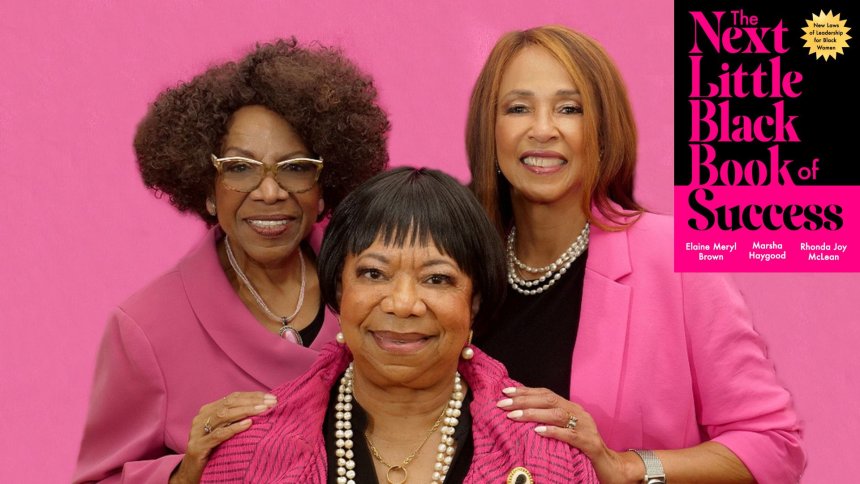
Six hundred thousand Black women have been laid off, fired or pushed out of the workforce since early 2025, and the number is still climbing. DEI initiatives that took decades to build have been gutted through executive orders. In the midst of it all, three veteran executives decided it was the right moment to update a leadership book written specifically for Black women, one beloved enough to earn a second edition.
Elaine Meryl Brown, a Daytime Emmy Award-winning writer and executive producer, and Rhonda Joy McLean, president and CEO of RJMLEADS LLC, aren’t newcomers to this fight. The co-authors of the newly republished “The Next Little Black Book of Success,” part of a leadership series they built alongside the late Marsha Haygood, who passed away earlier this year, have spent decades navigating spaces that were never built for them, and buried the people they loved most while still showing up to lead.
The book, originally published in 2010 and selling more than 600,000 copies, has been updated for this specific moment: mass layoffs, AI reshaping entire industries and a political climate openly hostile to Black women in professional spaces.
“This book is a roadmap to the future,” McLean said. “We really try to anticipate changes in the workplace, changes in the workforce — we talk about AI. We talk about trying to be an authentic black woman in the workplace.”
At the center of that roadmap is an argument the authors have been making for nearly two decades: the skills that actually determine whether you survive and advance in the workplace are rarely the ones anyone teaches you. And according to Brown, those skills don’t belong to any one generation — they apply to every Black woman, wherever she is in her career.
The “Little Black Book” career guide has always focused on soft skills — the ones that rarely show up in job descriptions but determine almost everything about whether you stay, advance or burn out.
“It’s the hard skills that really get us in the door, but it’s the soft skills that really sustain us,” Brown said. “And our mantra for this book — the first person you lead is yourself.”
Those skills, they argue, look different depending on who’s in the room,and today’s workplace has more generations in it than ever.
“Our book also addresses how each generation may work differently or approach problems. You know, millennials are different than the Gen Xers, and different than the Gen Yers, and different than the boomers. And we all have to figure out how to listen to each other and how to work together,” Brown added.
Learning to work across those differences requires something deeper than surface-level professionalism; it requires knowing the difference between being liked and being respected. For McLean, that lesson began long before she ever set foot in a boardroom.
In August 1965, a 13-year-old McLean integrated a previously all-white high school in North Carolina with a sheriff’s gun at her back and two other Black girls beside her. They were met with hostile signs, and the principal was unkind to them, but McLean and the two other girls, whom she says she is still friends with 50 years later, said community is what got them through.
“We learned to stand alone because they separated us. We could not sit together. Only at lunch could we sit together. And we also learned that sometimes you just have to stand on your own in the face of ignorance and fear,” McLean said.
Decades later, McLean, an attorney, found herself in a different kind of hostile room: New York law firms in the 1980s. The assumptions about who she was and what she was there to do followed her through every door. As one of the few Black women in those spaces, she was often mistaken for support staff rather than counsel. She learned quickly that waiting for others to define her role was not an option.
“If food came in, they would look at me, for me to go and get it and serve it. And being from the South, there was a part of me that, you know, just being nice, but I learned to keep my butt in that chair, let those men get their little heinies up and serve themselves. And I learned, but it was hard and it was painful and not nice,” McLean recalled.
It’s the same situations she addresses in one of the book’s most talked-about chapters, “Don’t Be the Office Mammy,” which draws on her own experiences while speaking to other Black women whose innate response is to take care of everyone else’s needs while putting themselves last. However, the workplace often demands something very different.
“It’s just in you to just take it over, take care of it, and not promote yourself, not take credit, not even put your name on it. Well, in corporate America, you can’t do that. You’ll disappear.” McLean said, noting that a woman can also do things outside of her primary job description, but “don’t let that be all you’re known for.”
The book doesn’t let readers stay in the professional without acknowledging the personal. No section makes that clearer than the chapter on leading after loss, which McLean wrote while dealing with her own grief after losing her stepdaughter to cancer and, three months later, her husband. Then came the loss that reshaped the book itself.
During that time, McLean said she relied on her friends and family, as well as Brown and Haygood, to help her through it. “I stopped writing. I couldn’t write at all for months, and they just held me up. So they wrote some of the things I was supposed to write.”
The two authors ultimately returned the favor when their beloved friend and co-author faced her own battles. “When Marsha became ill, because she was sick for a year before she passed, we held her up, and Elaine and I split up the chapter she was working on. So what we learned is, once again, going all the way back, start with your fundamental relationships, friends, family, faith. We’re all believers and in different ways,” McLean said.
Haygood passed away in January after a yearlong illness. Her chapters remain in the book, and according to both McLean and Brown, her voice is on every page.
“Marsha is still with us. We’re continuing her legacy. I still feel Marsha’s presence whenever we have conversations about the book,” Brown said.
The chapter also expands the definition of grief beyond the personal, which the authors speak about women who may be mourning professional losses.
“There are all kinds of loss. Big loss is like a loss of a job, a loss of a position. Maybe a lot of us are also being demoted. So it’s not like you lose your [actual] job, but you lose some of the things that really made you feel special, that really hurts, and that’s a loss that you need to grieve,” McLean said.
Which brings it back to where so many Black women find themselves today: displaced by DEI rollbacks and trying to figure out what comes next. For both authors, the answer starts with something simpler than a strategy: establishing relationships before the crisis hit.
“I would call it relationship building,” McLean said. “You need to not have waited until you were laid off to have a network of people who can help you. You need to know people from your high school, from college, your church, your sorority, your Girl Scout troop.”
Brown also adds a note about expanding that circle beyond familiar groups. “At one point I had all black women and maybe one black man in my network. I realized I don’t have any white people, no Asian, or different religions. Just kind of expand your group of people.”
Despite the challenges along the way, McLean returns to what she has always believed about Black women. “Black women are the most creative people I know. We can take something and turn it into enough for everyone. We’re like Jesus and the five loaves and two fish. And they said 5,000 people. We do that all the time. And I don’t think we even see that as a skill.”
The conversation feels especially timely as McLean and Brown brought their decades of experience from the pages to an in-person discussion. On April 27, Alpha Kappa Alpha Sorority, Incorporated® – Rho Gamma Omega Chapter, serving the Oranges and Maplewood community in New Jersey, hosted a conversation with the two authors alongside TheGrio’s Natasha S. Alford serving as moderator. 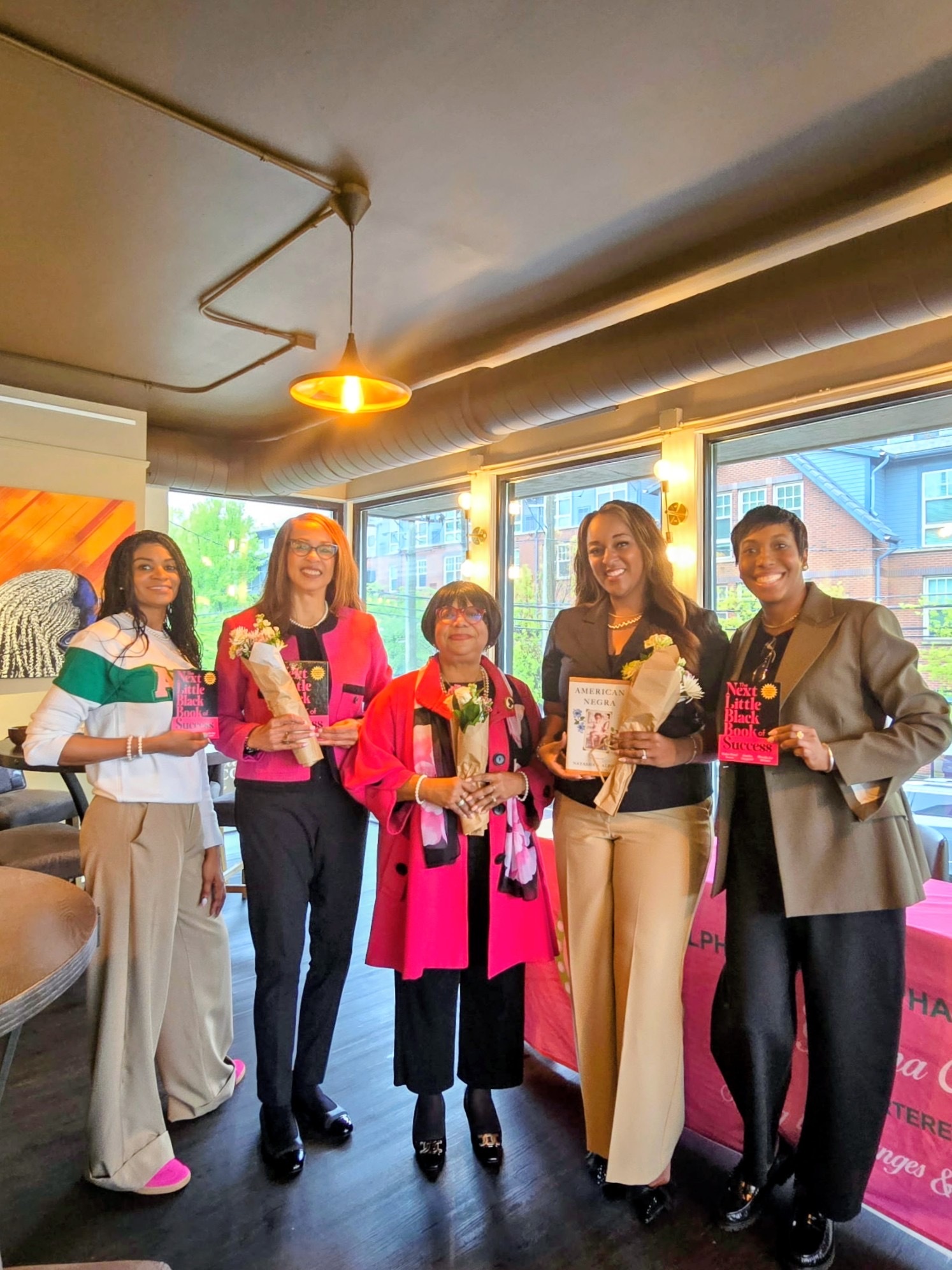
The event was organized by the chapter’s Advocate for Social Justice Committee, which focuses on equipping communities with tools, knowledge and support to activate their voices and foster self-empowerment. It brought both McLean and Brown together at a time when conversations around leadership and advancement feel especially urgent.
Share
What's Your Reaction?
 Like
0
Like
0
 Dislike
0
Dislike
0
 Love
0
Love
0
 Funny
0
Funny
0
 Angry
0
Angry
0
 Sad
0
Sad
0
 Wow
0
Wow
0