‘The Hunger Games’ cast on why the fight against the system never gets old
Ben Wang, Maya Hawke, Lili Taylor and Kelvin Harrison Jr. discuss the timeless themes of “Sunrise on the Reaping,” from

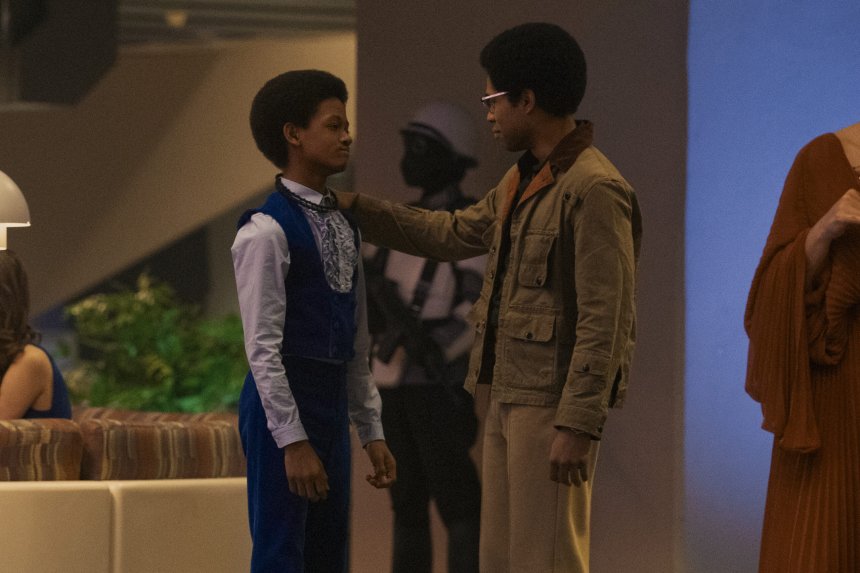

Ben Wang, Maya Hawke, Lili Taylor and Kelvin Harrison Jr. discuss the timeless themes of “Sunrise on the Reaping,” from society’s appetite for spectacle to the personal cost of resistance.
Nearly two decades after Suzanne Collins introduced readers to a dystopian society where children are forced to fight to the death for the entertainment of the ruling class, “The Hunger Games” remains as relevant as ever. In fact, some aspects of the fictional world of Panem are beginning to feel a little too familiar.
Consider the growing popularty of online betting platforms, where people can wager on everything from elections to political crises and criminal proceedings. It’s not quite the Capitol, where the suffering of children is packaged as entertainment, but the parallels are difficult to ignore.
In “The Hunger Games: Sunrise on the Reaping,” Ben Wang plays Wyatt Callow, a young oddsmaker whose ability to calculate the likelihood of his fellow tributes surviving the Games makes him particularly suited to a society that treats human lives as entertainment.
Asked by theGrio’s Janeé Bolden about the parallels between Panem and today’s increasingly casual relationship with betting on real-world events, Wang pointed to the historical influences behind Collins’ writing. 
“I think that’s what is so brilliant about Suzanne Collins’ writing,” Wang said. “She set this world of Panem in a future, so it’s a possible future, but it’s not a distant future. It’s a future that we can recognize.”
Wang noted that Collins draws from centuries of history, including ancient Rome, whose influence is evident in the names of many of the Capitol’s most prominent figures.
“I think what she created is a story that’s not just relevant to our times now,” he explained. “If these books and these stories came out in the early 2000s or in the ’90s and the ’80s, I think people would still find them to be relevant to their times. I think it speaks to a human truth.”
That observation helps explain why the franchise continues to resonate with audiences more than a decade after the first film arrived in theaters.
Set 24 years before the original, “The Hunger Games: Sunrise on the Reaping” follows a teenage Haymitch Abernathy (Joseph Zada) as he’s selected to compete in the 50th Hunger Games. The competition, also known as the Second Quarter Quell, doubles the number of tributes forced into the arena, making an already brutal spectacle even more deadly.
While Haymitch’s journey is central to the film, the story also explores the different ways people respond to a system designed to keep them powerless. 
Maya Hawke, who plays Wiress, a former victor who now serves as a mentor, believes one of the most important messages of the franchise is that even the most powerful institutions are vulnerable.
“I think we all participate in larger systems, both consciously and unconsciously,” Hawke told theGrio when asked what the film’s call to “break the machine” means to her.
“I think there are so many forces that make you feel like the machine is unbreakable, or impenetrable, or perfect,” she continued.
Hawke also questioned the tendency to attribute too much control to the people maintaining those systems, suggesting that the appearance of invincibility can be misleading.
“I think that it’s a good reminder that these systems are breakable and rebuildable, and we’re in a long timeline of history where there have been many, many different systems that seem impenetrable that then collapsed.”
For Hawke, the more enduring lesson is humanity’s capacity to survive and adapt.
“The one consistent thing is that humanity continues and continues to rebuild itself and reinvent itself,” she said. “I think that that is a deep message of these movies.”
Of course, challenging the system in Panem can come at an extraordinary price, even for those who have already survived the Games. 
Kelvin Harrison Jr. portrays a younger version of Beetee, the technologically gifted former victor previously played by Jeffrey Wright. After Beetee attempts to sabotage the Capitol’s communications during his own Games, President Snow retaliates by arranging for his son, Ampert (Percy Daggs IV), to be selected as a tribute.
For Beetee, surviving the arena was supposed to mean he’d fulfilled his obligation to the Capitol. Instead, the government he’s already risked his life to satisfy is now threatening his child.
“I think he’s fed up,” Harrison told theGrio. “He’s just like, listen, I’ve had enough. This doesn’t even make any sense. I’ve literally won the game. You set up the Games a certain kind of way. I’ve done the required thing that you want to see, and I did it. So why are you sitting there including my child?”
Harrison sees Snow’s retaliation as an escalation of a conflict that was already deeply frustrating for Beetee.
“It feels personal at a certain point,” he said. “He’s already frustrated with how it works. I think now it’s just another element of, it’s pathetic. I don’t know what else to say.”
Beetee’s predicament illustrates the cruelty of a system that doesn’t simply demand obedience but continues punishing those who dare to challenge its authority, even after they’ve played by its rules.
For Lili Taylor, who portrays fellow mentor Mags, the answer to confronting such overwhelming power begins with recognizing what individuals can do.
“Just what can I do? What can I do today?” Taylor said, encouraging people to recognize their strengths and keep searching for “the breaks, the cracks in the system.”
And perhaps most importantly, she emphasized the patience required to make lasting change.
“Know that it’s a long game.”
“The Hunger Games: Sunrise on the Reaping” is in theaters now.
Share
What's Your Reaction?
 Like
0
 Dislike
0
 Love
0
 Funny
0
 Angry
0
 Sad
0
 Wow
0