Jaylen Brown the face of an NBA divide
Brad Stevens’ eyes told the entire story. The anguish on the face of the Boston Celtics’ president of basketball operations seemed authentic. He was speaking to the media for the first time since the franchise traded star forward and 2024 Finals MVP Jaylen Brown to its generational division rival, the Philadelphia 76ers, for Paul George [...]


Brad Stevens’ eyes told the entire story. The anguish on the face of the Boston Celtics’ president of basketball operations seemed authentic. He was speaking to the media for the first time since the franchise traded star forward and 2024 Finals MVP Jaylen Brown to its generational division rival, the Philadelphia 76ers, for Paul George and a swath of draft picks.
In the days following the blockbuster offseason move, Brown became an avatar for multiple conversations: race, basketball aesthetics, intellect and his contract. For Stevens, the move reflected what many Americans feel at the moment — albeit from the vantage point of a historic, multibillion-dollar franchise.
For Stevens, it came down to the money and how excruciatingly difficult it has become to manage it in the current NBA. Whether he made the right decision, Stevens admitted, only time will tell.
“When I looked at our team and where the league was heading…the path looked a little bit more challenging to me,” Stevens said, seated alongside Celtics owner Bill Chisholm on Monday. “I might be wrong. I’m not going to stand up here and be defensive about that, but the path looked a little bit more challenging, with 70 percent of our cap and such a high percent of our usage tied into two players [Brown and Jayson Tatum].”
Stevens continued, “The reality in this day and age at the NBA, and you could see it obviously with the last couple of champions…you have to do a great job of building out depth that can hopefully replace the irreplaceable individual. And that’s not an easy thing to do. And that’s absolutely nothing against Jaylen. If you have Jaylen Brown on your team, you should feature him, you should use all those possessions, and you should approach things that way. But I think the importance of depth and, then obviously, we have to continue to work on ways to diversify our attack overall.”
Stevens’ explanation didn’t include the critiques around Brown’s actual on-court game, from his ball-handling to his usage rate. It wasn’t about whether Brown could be the lead act on a championship team because he’d already won only the franchise’s second Finals MVP since the Larry Bird era. It was about the now-infamous NBA’s second apron and roster construction.
It was a fascinatingly practical answer for a debate that had previously been enveloped in anything but practicality. Were there tensions between the team and the player that bubbled slightly below the surface? Of course, there were. But in the moment, Stevens spoke from the perspective of a front-office executive at one of the most powerful brands in American sports. Everyone else spoke as critics, economists, media analysts, historians, sociologists and cultural commentators. The truth, perhaps, lives in a hazy, humid gray area in the middle that few venture into.
Stevens, perhaps inadvertently, revealed how many talking points had become layered into Brown and the Celtics. He didn’t erase or deny any of them. Ultimately, Stevens made it clear that Brown, the franchise’s top pick in the 2016 NBA draft, had become a pathway for all.
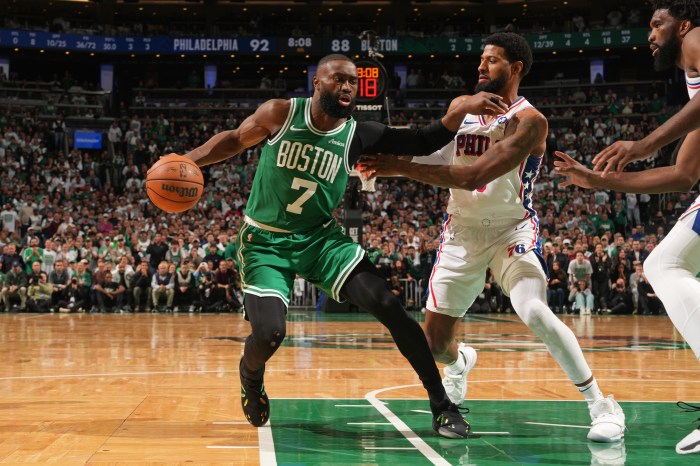
Following Boston’s heartbreaking, seven-game, opening-round loss to the 76ers — in which Boston blew a 3-1 lead — the signs were undeniable: Changes would be coming.
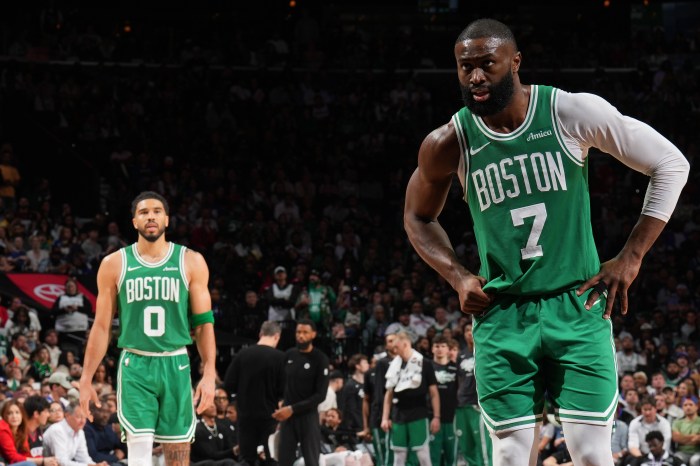
Brown, on a live stream, admitted this season was his favorite. Averaging nearly 29 points, 7 rebounds and 6 assists per game, it was clearly his most dominant season. It was also largely spent without Tatum, his star partner for nearly a decade. Whatever the validity of reports saying the working relationship between Brown and Tatum — both top 10 in franchise history in points scored — had dissolved isn’t nearly as important as everything else surrounding the larger discussion.
The critiques against Brown have been consistent despite Brown improving his game each season. His handles are slightly above average, at best. The advanced metrics suggest other players are far better. But then there’s the other side of the coin: Brown is one of the league’s great transition and rim attackers. His two-way prowess puts him near the top, or the very top, of the league in that category. He’s been named an All-Star five of the past six seasons, including a sixth-place finish in MVP voting in 2026.
Deciding which side is right is harder than acknowledging the obvious. Brown is the face of a much deeper philosophical divide.
The debate has been passionate and public for years. But more than any other sport in the world, and certainly in America, what fans see and what prognosticators can measure represents the NBA’s civil war. Brown, at least for right now, sits squarely in the middle, the type of player who has proven he can win championships while also being the type who becomes maddening on an Excel spreadsheet.
Listen to any discussion about the business of basketball nowadays, and the phrase “second-apron” will likely come up. It’s undeniably changed how basketball operates and how fans navigate its uncharted waters. Three years ago this month, Brown signed, at the time, the richest contract in NBA history, resulting in $303.7 million over five years. The immediate return on investment proved fruitful with Brown winning Finals MVP 11 months later as the Celtics defeated the Dallas Mavericks.
As time passed, conversations around Brown shifted. The current collective bargaining agreement (CBA) was enacted. Could teams build around such massive individual salaries? Would these billionaire owners be willing to foot exorbitant tax bills all in the name of winning? And how in the hell could teams move massive contracts when the rubber met the road?
Fast-forward to the present day, and the truth remains. Brown didn’t become more expensive. The team and the player reached an agreement, so the numbers came as no shock to anyone. What changed was the cost of building around the world’s best players.
Somewhere along the way, actual basketball became secondary.
The language around players has remarkably altered, too. They’re still stars. The rarest of them are still viewed as superstars. But it’s impossible these days to discuss basketball without terms like positive or negative assets, matching salaries, or expiring contracts. The terminology has, in one way or another, always existed. That’s Wall Street happy hour chatter. That’s icebreaker conversation at investment banking conferences. Over the last several generations of basketball, not just the NBA, the focus and discourse have gone away from the game and now seemingly split time with the business of the game.
Since when did basketball become more of an earnings call than a question of who can hoop and who can’t? And what happens when basketball grows but becomes less intimate at the same time? Player empowerment became a necessary and welcome reality before turning convoluted as players wielded power in more complex ways. It leveled a playing field that was never meant to be even, but these conversations became far more transactional than holistic.
In 2023, the late Rev. Jesse Jackson praised the NBA’s report card in its racial and gender hiring processes.
“[The NBA] has been very intentional about improving conditions,” Jackson said after reviewing the NBA’s report card. “As [Dr. Richard Lapchick’s] report confirms, the NBA has led the way, set the standard, and they continue to do a stellar job, which is to be commended. I look forward to continuing to be both a fan and partner with the league moving forward.”
Two truths exist here. The NBA can be commended for those practices. Existing in tandem, however, are the crucial conversations around race that its players experience, Jaylen Brown included.
Brown, by any conceivable metric, is an intelligent young man. Being an intelligent young Black man is where the conversations get murky. But why is his confidence perceived as aloofness? He’s a young man who has spoken intently about education, Black history, community investment and economics. Is his intellectual curiosity worthy of being weaponized? Even more, is Brown’s individuality a “disease” of unnamed sources railing against him for thinking he’s “the smartest guy in the room?”
Why are, namely, Black athletes railroaded with critiques from critics they can’t address directly, all in the name of “journalistic integrity?” Sources should be protected in many cases, but shouldn’t athletes have the same discretion to protect their names and reputations?
Brown is private and often frustratingly cryptic. He isn’t always keen to make himself easy to understand, nor is he the poster child for easy public consumption. All truths have to be acknowledged, though.
From basketball, identity, race, analytics and economics, few athletes are evaluated through all five entry points. Brown is now. In most cases, being the best player on an NBA championship team and winning Finals MVP should be the proverbial Wild Draw Four, Uno Out card. For Brown, it’s not. It’s only part of the argument.
What Brown, and really the discussion around him, has revealed more than anything is the true meaning of value. The NBA should focus on the business it produces. It’s a business model that, proverbially, prints its own money in ways most businesses could never fathom. But just like any of those businesses, it’s only as valuable as the people who work in it.
Brown lives in a space where aesthetics and analytics may clash until the end of his career. He’s no longer just a Finals MVP or multi-time All-Star, presumably with more to come now that he has a ridiculously talented 76ers roster. He’s a contract. He’s an argument about what our eyes tell us versus what math tells us. He’s no longer just about basketball because the journey never made it so.
Stevens’ comments Monday aren’t the end of the swirling conversation around Boston’s former star. The basketball debate has never been simply about basketball. A mercurial superstar who just wants to be heard? That’s nothing new. This is now the reality surrounding basketball. Championships and mathematical equations have never been more inseparable. Whether Boston made the right decision may ultimately be the calling card of Stevens’ life in Boston.
The trade itself, though, answered a key question: Debates over the best players are no longer the NBA’s most impactful arguments. Debates over who the NBA deems critical are so much more.
Brown, whether he wanted to be or not, is now the face of that discussion.
The post Jaylen Brown the face of an NBA divide appeared first on Andscape.
Share
What's Your Reaction?
 Like
0
Like
0
 Dislike
0
Dislike
0
 Love
0
Love
0
 Funny
0
Funny
0
 Angry
0
Angry
0
 Sad
0
Sad
0
 Wow
0
Wow
0