‘It has never left me’: Morgan Freeman announces blues album rooted in Black music history
The Oscar winner released “Death Letter Blues” with Taj Mahal on Juneteenth ahead of his upcoming project, “Morgan Freeman’s Symphonic

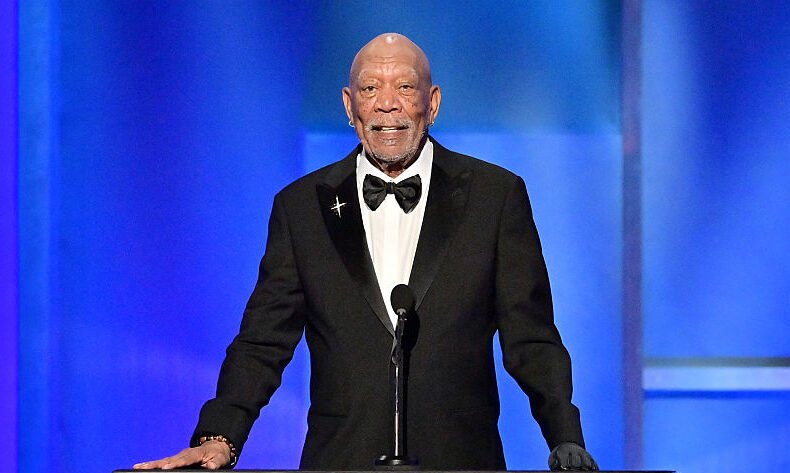
The Oscar winner released “Death Letter Blues” with Taj Mahal on Juneteenth ahead of his upcoming project, “Morgan Freeman’s Symphonic Blues Experience.”
Morgan Freeman has one of the most recognizable voices in Hollywood. Now, he is using it to help tell the story of one of America’s most foundational sounds.
The 89-year-old Oscar-winning actor has announced “Morgan Freeman’s Symphonic Blues Experience,” a 12-track album set for release on Aug. 7 via Decca Records. The project, which Freeman serves on as both producer and narrator, is described as a journey through 100 years of blues music, blending Delta blues, orchestral arrangements, and cinematic storytelling.
And yes, the timing matters.
According to People, Freeman introduced the project on Juneteenth with the release of its first single, “Death Letter Blues,” a reimagining of Delta blues legend Son House’s 1965 recording, featuring five-time Grammy winner Taj Mahal on lead vocals and guitar.
For Freeman, the blues is not some late-career hobby or celebrity passion project. It is personal.
“I heard the blues for the first time on my grandmother’s porch in the Mississippi Delta, and it has never left me,” Freeman said in a release.
That sentence alone says a lot.
Before Freeman was the voice of God in “Bruce Almighty, became the wise principal in “Lean on Me,” Red in “The Shawshank Redemption,” or the steady narrator generations have come to associate with wisdom and gravitas, he was a child of Mississippi. The blues was not just music floating in the background. It was a language. A memory. A spiritual inheritance.
That is part of what makes this project feel bigger than an actor releasing an album. “Morgan Freeman’s Symphonic Blues Experience” arrives at a time when Black music history is constantly being mined, sampled, repackaged, and reintroduced to new audiences. But Freeman’s approach appears to be less about reinvention and more about remembrance.
The album includes contributions from Taj Mahal, Keb’ Mo’, Shemekia Copeland, Lawrence “Boo” Mitchell, Alvin Youngblood Hart, and the Chineke! Orchestra. The tracklist moves through blues classics and related musical touchstones, including “Dark Was the Night, Cold Was the Ground,” “Crossroads,” “Dust My Broom,” “The Thrill Is Gone,” “Cadillac Assembly Line,” and “I’ll Take You There.”
That lineup is not subtle. It places the blues where it belongs: at the center of American music, not in the margins.
For Black audiences especially, the release date of “Death Letter Blues” adds another layer. Juneteenth marks the delayed arrival of freedom for enslaved Black people in Galveston, Texas, on June 19, 1865. The blues, born out of Black survival, grief, humor, faith, labor, and resistance, carry that same complicated history. It is the sound of people making art out of what America tried to bury.
“Releasing this on Juneteenth is not just symbolic — it is the truth of where this music comes from and who made it,” he said. “I hope people listen and remember.”
That line may be the thesis of the whole project.
Blues music has always asked people to remember. Remember the fields. Remember the juke joints. Remember the church pews. Remember the railroads, the porches, the back roads, the kitchens, and the heartbreak. Remember that before rock, soul, R&B, hip-hop, and so much of modern pop music, there was the blues.
Freeman’s project also builds on his longstanding connection to Clarksdale, Miss., where he co-founded Ground Zero Blues Club, a venue dedicated to keeping Delta blues alive in the place that helped give it birth. That matters because preservation is not just about documentaries and museum plaques. Sometimes it is about giving musicians a stage, giving elders their flowers and giving younger listeners a reason to trace the music back to its roots.
The album’s live component will also hit the road, with shows currently set for Aug. 7 in Houston, Sept. 26 in Memphis and Oct. 17 in Gulfport, Miss. Those cities are not random stops on a tour map. They sit along a cultural corridor where Black music history has been shaped, carried and transformed for generations.
Of course, Freeman has not stepped away from acting. He currently stars in the Paramount+ series “Lioness” and recently narrated the Netflix documentary series “The Dinosaurs.” But with “Morgan Freeman’s Symphonic Blues Experience,” he is leaning into another kind of storytelling — one that lets the music speak while his voice helps guide the listener through it.
At 89, Freeman does not need a new lane. His legacy is already cemented. But this album feels like a return to something older than fame.
The blues, as Freeman tells it, never left him.
Now he is asking the rest of us to listen as if it never left us, either.
Share
What's Your Reaction?
 Like
0
Like
0
 Dislike
0
Dislike
0
 Love
0
Love
0
 Funny
0
Funny
0
 Angry
0
Angry
0
 Sad
0
Sad
0
 Wow
0
Wow
0





![Stream: Tank’s ‘Experience’ Album [featuring Kirk Franklin, Remy Ma, Fred Hammond, & More]](https://thatgrapejuice.net/wp-content/uploads/2026/08/Tank-Experience-Album-Cover-thatgrapejuice-2026.jpg)