Gabourey Sidibe reflects on ‘bravery’ interited from her aunt, Dorothy Pitman Hughes, and Gloria Steinem
Hughes, who died in 2022, was affectionately known as Aunt Dot to Sidibe, who said she couldn’t wait to grow


Hughes, who died in 2022, was affectionately known as Aunt Dot to Sidibe, who said she couldn’t wait to grow and feel as brave as Steinem and Hughes did.
Feminist Gloria Steinem might have been the face of the movement, but in totality, some of the biggest lessons that impacted her worldview came from Black women—namely, those of Dorothy Pitman Hughes.
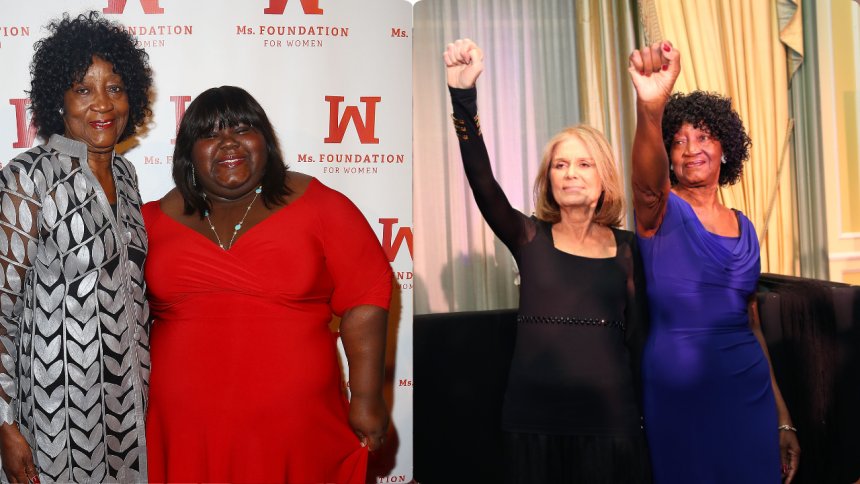
Hughes, who passed away in 2022, co-founded the Women’s Action Alliance and helped inspie Steinem’s Ms. Magazine, the publication that featured the works of a young Alice Walker. In 1971, Hughes and Steinem posed side by side, their fists held aloft in a moment of racial solidarity between women. It is Hughes whom Steinem credited for helping her find her voice in public.
For actress Gabourey Sidibe, Hughes was merely Aunt Dot. Steinem? Aunt Dot’s friend.
In a tribute shared on Threads, Sidibe revealed the kinship she shared with Hughes and reflected on what Steinem meant to her.
“Here is a picture of my Aunt Dot (Dorothy Pitman Hughes) and her good friend Gloria Steinem,” she wrote on Friday. “Gloria’s impact on the world is one thing but her impact on me was smaller but meaningful. We danced at Aunt Dots house when I was little because we both loved the way my dress moved when she spun me around. We giggled and told jokes to each other. I didn’t know that she or my aunt for that matter were a bigger deal than those moments at a family party. I had become a woman myself before I realized.”
She added, “Even in my ignorance, my existence and sense of self was partly shaped by these two women and this photo that hung in Aunt Dots living room where I lived for 2 years as a child. I couldn’t wait to grow up and feel as brave as they looked standing there together with their fists held high. We lost Aunt Dot 4 years ago, my mom and another aunt last year and now Gloria. As the family and friends who helped raise me continue to disappear, I lean more and more on the bravery I inherited from them.”
View on Threads
Steinem, who passed away Thursday at the age of 92, was widely on the record in her later years finding intersectionality in regards to the impact Black women had on the feminist movement. In a 2017 interview with theGrio, Steinem made it clear that without Black feminists, there would be no movement.
“People talk to me about white feminism, and I say, ‘Are you kidding me?’ If it’s white it can’t be feminism. I mean, hello? It either includes all women or it’s not feminism,” Steinem said at the time.
In 2010, she explained to Black Enterprise how Black women helped shape her viewpoints by being at the forefront.
“I thought they invented the feminist movement. I’ve learned feminism disproportionately from Black women,” Steinem said at the time. “I realize that things being what they are, the White middle-class part of the movement got reported more, but if you look at the numbers and the very first poll of women responding to feminist issues, African American women were twice as likely to support feminism and feminist issues than White women.”
Despite being hailed as a hero by some for her work in bringing the feminist movement to the forefront of culture and emboldening women in the workforce, Steinem left behind a complicated legacy.
During the 2008 election cycle, Steinem placed “sexism as a bigger barrier than racism” during Hilary Clinton’s initial run for the White House agains then Senator Barack Obama. In a 2008 essay for The New York Times Steinem wrote, “So why is the sex barrier not taken as seriously as the racial one? The reasons are as pervasive as the air we breathe: because sexism is still confused with nature as racism once was; because anything that affects males is seen as more serious than anything that affects “only” the female half of the human race.”
She continued, “Because children are still raised mostly by women (to put it mildly) so men especially tend to feel they are regressing to childhood when dealing with a powerful woman; because racism stereotyped black men as more “masculine” for so long that some white men find their presence to be masculinity-affirming (as long as there aren’t too many of them); and because there is still no “right” way to be a woman in public power without being considered a you-know-what.”
In her assessment of Steinem, Abiola Agoro referenced her 2008 essay and also refrenced Steinem’s work as a CIA operative before changing tide. Agoro urged those remembering Steinem to look at the entire picture, not the mere idea of them.
“There are so many stories that remain untold and with them organizers and activists that likely were pushed to the side with methods that we need now,” Agoro wrote. “Every time we refuse to sit with it all, something in us dies at a moment where we need more. This is a time for discomfort, and only through that will we find the growth we need to save us all.”
Share
What's Your Reaction?
 Like
0
Like
0
 Dislike
0
Dislike
0
 Love
0
Love
0
 Funny
0
Funny
0
 Angry
0
Angry
0
 Sad
0
Sad
0
 Wow
0
Wow
0