Freedom Fighting 101: We Protested. We Voted. Now What?
Source: UCG / Getty Nationally, we’re in the grip of compounding crises – especially for Black and brown communities. Just when we think we’ve caught our breath after the last newscycle, another wave forces us to ask: How do we fight while treading water at the same time? The answer: Find hope, then turn that [...]


Nationally, we’re in the grip of compounding crises – especially for Black and brown communities. Just when we think we’ve caught our breath after the last newscycle, another wave forces us to ask: How do we fight while treading water at the same time?
The answer: Find hope, then turn that hope into action. So what’s our call-to-action right now?
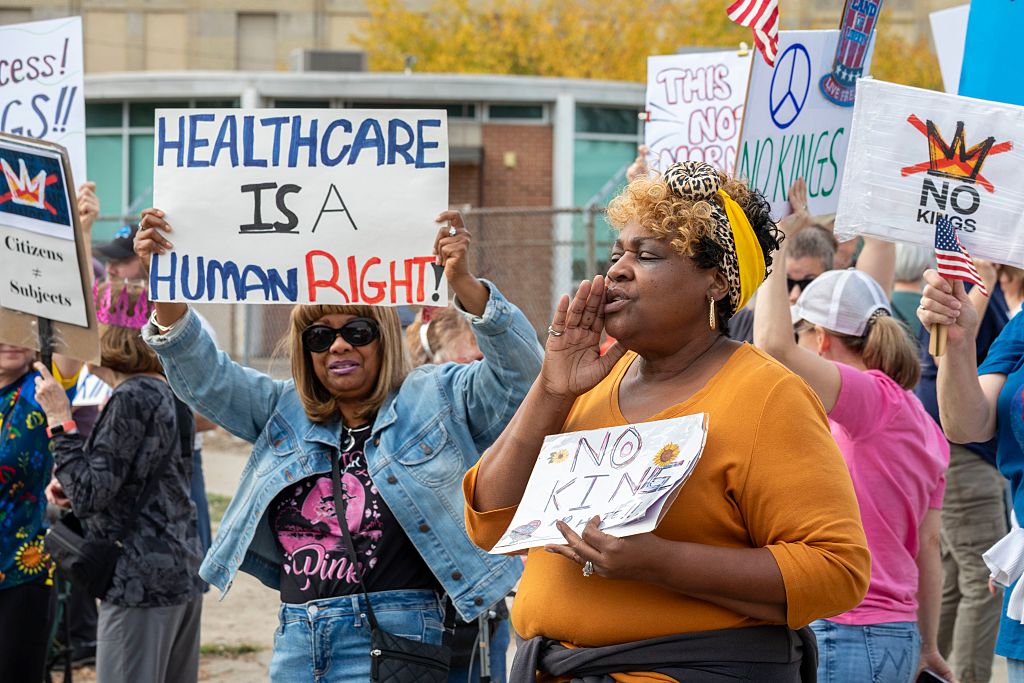
The organizers of the No Kings protests in October 2025 estimate that 7 million Americans attended the nationwide rallies, potentially the largest demonstrations in U.S. history. Attendees left the events in their cities feeling hopeful and connected, as these mobilizations energize communities and remind us that we’re not alone in our discontent with the current political system.
But, seriously, what comes next after the chants fade? How do we convert the momentum gained from successful campaigns, such as Zohran Mamdani’s win in the New York City mayoral election and a wave of Democratic victories on ballots?
Take notes.
Reject individualism and move together
Crises can make us want to hunker down or isolate ourselves for safety. In this moment, the opposite is true. Safety comes from stretching our arms wide to the people around us. Individually, we’re drops; together, we are a tide. Making connections empowers us for the most impactful phases of resistance to tyranny while also ensuring that we have each other’s backs. What are some of the ways we can move together?
Don’t build alone; find a political home
Our communities are under constant attack. One of the best defenses against that is joining a political formation that supports you mentally, spiritually, and physically with people-power and resources. These can be:
- Monthly neighbor circles
- Church-led local actions
- City-wide or state-wide organizations
There are even political formations working at the national level, building infrastructure to involve people from around the country in campaigns that serve as a compass, guiding Black communities to create change at the local level. Finding a political home can feel like discovering a secret language that everyone around you speaks fluently, and then using that language to articulate, embody, and fight for a shared vision of the future.
Challenge Tyranny; prepare for a General Strike
Hundreds of thousands of Italian workers recently shut down their country with a General Strike for Palestine, blocking ports, railways, and highways. The strike grabbed global headlines, pressured the Italian government, and forced officials to notice their demands.
A general strike lets people hit corporations’ bottom lines (and sometimes even billionaires), opening a long‑term front for social and political resistance.
The U.S. has never had a general strike at the national level, but there are two historic city-wide examples: Seattle in 1919 and Connecticut in 1946, both of which were worker-led battles against exploitative employers. There are currently credible calls for a national general strike in the U.S., and with the right combination of environmental and political factors, we could be on the brink of the largest general strike in American history!
Know your neighbors. Build Safety Networks
If you don’t know your neighbors by name, there’s no time like the present to introduce yourself to them and consider exchanging contact info. During a local outbreak of chaos, familiar faces or a quick Signal message can be invaluable.
Well-connected neighbors can:
- Share food, water, or supplies
- Check on your loved ones and pets
- Vouch for you, bear witness to conflict, and help de-escalate confrontations
We’ve seen the power of having nearby allies in viral videos exposing ICE raids and police brutality. Safety networks are about sharing crucial intel, flagging surveillance, and staying vigilant together.
Know your enemies; explore Power Mapping
What issues hit your community the hardest? That might be things like accessible housing, access to clean water, policing and prison abolition, education and youth, immigration, or war and genocide. Power mapping isolates a key issue or a constellation of connected problems and discovers the levers of authority—people, corporations, and institutions that hold the most sway. Imagine a power map like the roots of a tree: each branch represents a point of influence. Knowing who’s with us and who we’re up against lets us plan actions such as targeted boycotts or pressure campaigns that push candidates to align with community demands.
Invest in Safety Nets; support mutual aid
Institutions won’t save us. The recent and longest U.S. government shutdown laid bare America’s systemic shortcomings in comparison to other Western nations, highlighting food insecurity for the 42 million SNAP recipients amid high inflation, low wages, and a lack of universal health care. There are 42 million recipients of SNAP whose benefits are constantly in jeopardy, and as the infrastructure we‘re familiar with continues to crumble around us in real time, we can support our communities by donating time and/or money to local mutual aid groups that fill the gaps.
Like the Black Panthers free breakfast program, grassroots mutual aid fills in the gaps. They’re not funded by the government. They’re run by people who reject the individualism baked into our culture, and contributions, big or small, matter. You could:
- Call neighbors in need to onboard them
- Make supply drop-offs
- Donate essentials like furniture, baby formula, and winter gear
- Organize block party fundraisers
In this model, everyone contributes what they can, and everyone deserves to receive the help if they need it. Mutual aid is a parachute anyone can pull to soften a long fall. That way, if the government ain’t got us, we got us.
Joude Ellis is a communicator and cultural organizer based in NY whose writing prioritizes radical ideas that challenge mainstream narratives and help platform Black and other marginalized perspectives.
SEE ALSO:
How Inequity Is Coded Into Surveillance Tech
10 Billionaires Actively Harming Black, Marginalized Communities
Where Are The NWAs? A Call For The Return Of Protest Music
Share
What's Your Reaction?
 Like
0
Like
0
 Dislike
0
Dislike
0
 Love
0
Love
0
 Funny
0
Funny
0
 Angry
0
Angry
0
 Sad
0
Sad
0
 Wow
0
Wow
0






![Stream: Quavo’s ‘QRÖMELIFE’ Album [Featuring Offset, Future, Justin Timberlake, Pharrell, & More]](https://thatgrapejuice.net/wp-content/uploads/2026/10/quavo-qromelife-tgj.png)