FaithActs brings Connecticut governor candidates together to hear directly from Bridgeport voters
FaithActs leaders discuss the organization’s mission after Connecticut gubernatorial candidates answer community questions. FaithActs, Connecticut’s only Black-led education advocacy organization,


FaithActs leaders discuss the organization’s mission after Connecticut gubernatorial candidates answer community questions.
FaithActs, Connecticut’s only Black-led education advocacy organization, held a nonpartisan gubernatorial candidate forum on Tuesday in Bridgeport, where candidates addressed school funding issues.
The candidates included Gov. Ned Lamont (D), State Sen. Ryan Fazio (R-36th) and State Rep. Josh Elliott (D-88th), who answered questions from the audience, according to WTNH.
The event was moderated by TheGrio’s Natasha S. Alford, who asked each candidate their position on the state’s obligation to close the school funding gap between communities.
“It is the state’s responsibility to be sending resources back to municipalities that don’t have the taxable base so that everyone, regardless of your skin color, has access to an equitable education and that we are looking at the back end to make sure everyone is getting the same results,” Elliott said.
While Elliott focused on the state’s role in addressing funding disparities, Fazio said that improving schools would require more than increased funding alone.
“Yes, we need to increase the foundation amount. We need to tie ECS to inflation. It is not right that over the last eight years, adjusted for inflation, ECS spending is lower than it was at the beginning,” Fazio said. “Yes, all of that is true, but we also need an ambitious education reform agenda in this state that first and foremost that says we are not going to settle for anything but the best in every single zip code in our state.”
Lamont, meanwhile, defended his administration’s education record and argued Connecticut has already made significant investments in public schools.
“You know, before I got here, for 10 years it was flat-funded. You were really holding kids back. It was raise taxes, raise taxes, deficit upon deficit upon deficit, and flat funding. We’ve done just the opposite,” Lamont said. “We cut taxes for you. We cut taxes for the middle class. We’ve increased funding every year for Bridgeport and every year for all of these schools and we are just getting started because we have a long way to go.”
While the candidates spent the evening outlining their policy priorities, FaithActs leaders said the forum was the result of years of community organizing and advocacy across Connecticut.
In an interview with Alford, FaithActs Chief Executive Officer Jamilah Prince-Stewart and Chief Strategy and Communications Officer Dwanisha Clark said the organization’s work extends far beyond election season, with members advocating for equitable education funding and holding elected officials accountable year-round.
Prince-Stewart said FaithActs began by organizing around local issues in Bridgeport before expanding its efforts statewide as members realized families across Connecticut were facing many of the same challenges.
“We built a broader coalition of folks across the state and started working on state-level policy over the past decade and five years in particular, that has primarily been around equitable school funding,” Prince-Stewart said. “We have a large racial funding gap in this state, and so what a black or brown student gets versus a white student gets for their education is grossly inequitable.”
Clark said FaithActs’ ability to bring candidates from both major parties together stems from years of building trust with communities across Connecticut.
“We do that by telling people not who to vote for, but why it is important to vote, and not doing that in a way that panders to them, right? But actually extracts what this decision means, and that elections are just one small part of the full cycle of electoral accountability,” Clark said. 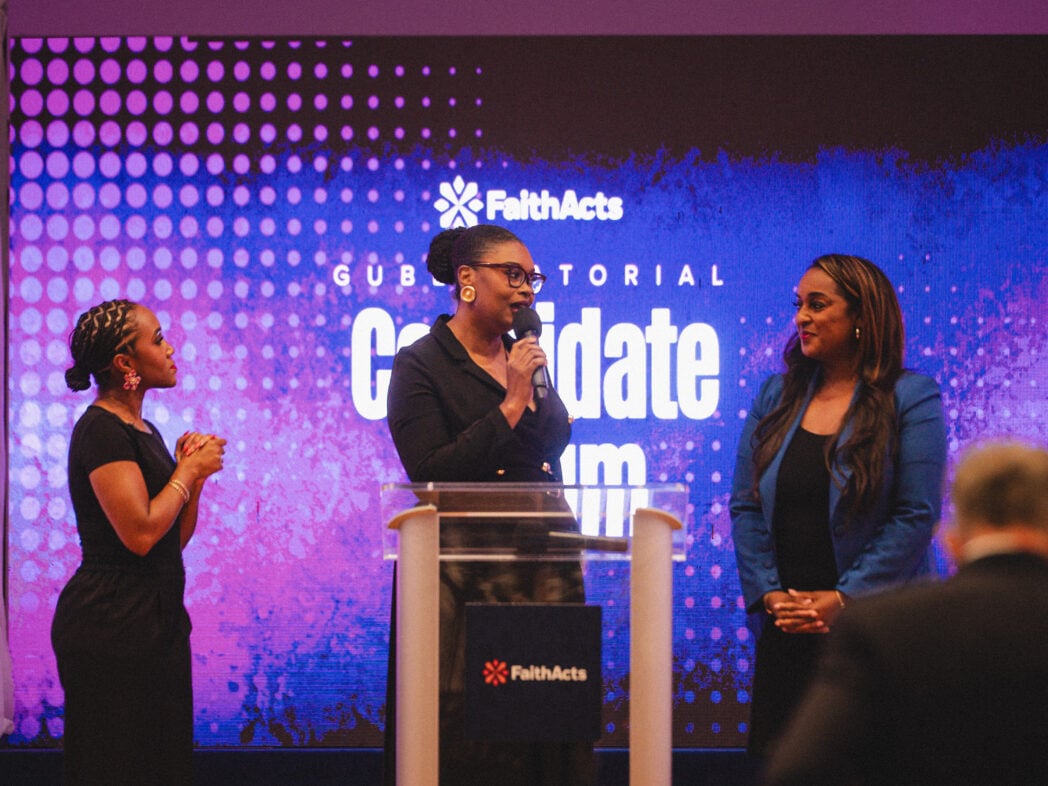
The conversation later shifted to Black women and the challenges many have faced amid ongoing political and social changes. Alford asked the FaithActs leaders for advice on how women can stay engaged in their communities.
“First, I would just say I see you, I love you, thank you. Everyone should say thank you to Black women. How we draw strength, power, rest, reassurance is through our people. So we stay very rooted in people and in community, and I think at a time where people want to isolate and retreat, we have to come back together,” Prince-Stewart said.
For Clark, she encourages Black women to use the tools and resources that they have to make a difference in their communities.
“I would say do what you can with what you have,” she said. “For Jamillah and I, we have built a career individually, almost 20 years apiece, doing what we can with what we have. This is what we can do with what we have, and I imagine for every Black woman, they have their own version of that.”
Looking ahead, Prince-Stewart said she hopes FaithActs can continue expanding its grassroots organizing model while inspiring communities beyond Connecticut.
“I think there will be a FaithActs before today and a FaithActs after,” Prince-Stewart said. “What I hope is that the power that we’re demonstrating and building today, four years from now, the person who is elected in November will finish their term. And what I hope to see is that we have transformational policy happening in this state, that we have strong responses to the attacks on people in our communities at the federal level, and that this is a state and this is a country where people can thrive.”
Share
What's Your Reaction?
 Like
0
Like
0
 Dislike
0
Dislike
0
 Love
0
Love
0
 Funny
0
Funny
0
 Angry
0
Angry
0
 Sad
0
Sad
0
 Wow
0
Wow
0