EXCLUSIVE: How Adam Blackstone became the ‘Editor-in-Chief’ of Black Music
From Jill Scott’s new soulful return to the Super Bowl stage, the Grammy-winning director explains why storytelling is the heartbeat

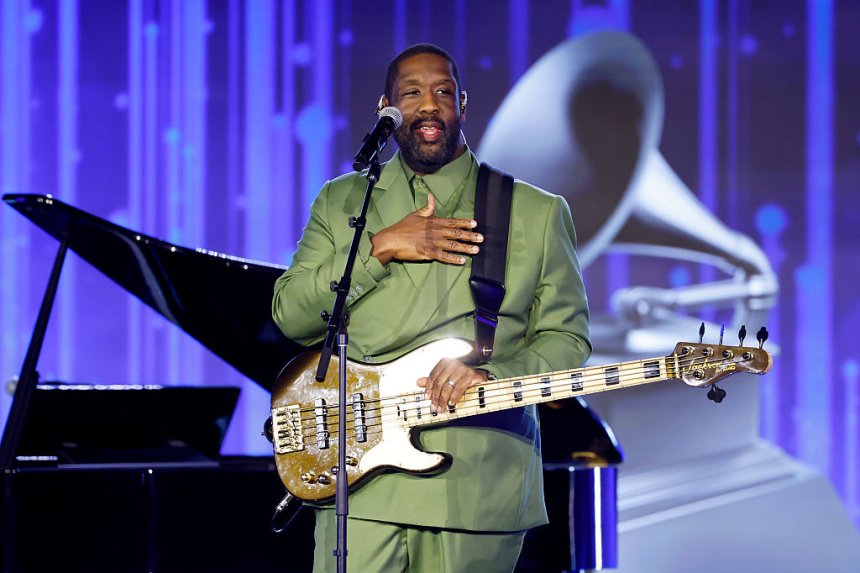
From Jill Scott’s new soulful return to the Super Bowl stage, the Grammy-winning director explains why storytelling is the heartbeat of his arrangements.
Adam Blackstone‘s name consistently serves as the connective tissue between the legends and the leaders of the new school.
A read through his credits often reads like a “who’s who” of Black excellence and musical kinship.
Whether he’s behind the keys for Justin Timberlake, producing tracks for Jill Scott’s latest release, or arranging the national anthems that stop the world in its tracks, Blackstone has moved beyond the role of a traditional music director. In an exclusive conversation with theGrio’s Bobby Pen while leaving rehearsals during NBA All-Star Weekend, the Philly-bred maestro revealed that he views his work through a lens more familiar to a newsroom than a recording studio.
“I’m an expert, I’m an editor,” Blackstone says. “I use the music to provide… the script tells the story, no matter how great the music and the string line is. It’s really about the lyric and the script that allows people to interject their own experiences.”
Lifting as he climbs
Blackstone’s career is a masterclass in the “Philly Way”—a philosophy of communal success he learned coming up in the early 2000s neo-soul scene alongside Questlove and DJ Jazzy Jeff. It’s a spirit of “lifting as you climb” that he carried into this month’s Super Bowl performances with Coco Jones and Charlie Puth.
“For me, it’s always a blessing to represent culture and music on such a grand stage,” Blackstone said. “You’re trying to find that fine line between something familiar to the ear but also making it cool.”
For Blackstone, producing Coco Jones’ rendition of “Lift Every Voice and Sing” wasn’t just about a broadcast; it was about protecting a legacy.
“I went through a couple of different variations to make it classical enough, to make it ‘hood’ enough with the 808s, to make it R&B enough where it represents who she is,” he explains. By blending the Sainted Trap Choir with orchestral arrangements, Blackstone ensured the “Black National Anthem” resonated as a “Black girl joy moment” for a global audience.
“These are national moments,” he said. “You want unity. You pray that what you created brought people together.”
A storyteller behind the sound
Though widely known as a music director, Blackstone views his role differently.
He calls himself an editor.
Working closely with artists, he begins not with instrumentation but with narrative, asking performers what story they want audiences to feel. The approach, he says, was sharpened during his work on Alicia Keys’ Broadway production “Hell’s Kitchen.”
“The script tells the story,” Blackstone said. “No matter how great the chords are, it’s the lyric and emotion that allow people to insert their own experiences.”
That philosophy guides how he approaches timeless songs whose lyrics never change but whose emotional meaning constantly evolves.
“You could be talking to your grandmother, your church, or a football team,” he said. “The emotion behind the lyric changes every time.”
The ‘Church’ in the 808s
Despite his mastery of modern technology, Blackstone’s foundation is rooted in the pews of his youth. “Church and God is in everything that I do,” he says. He credits the improvisational “shout” of the Sunday morning service with giving him the instincts to command a stadium of 60,000 people.
“Church allowed me to get the improvisational skills and to listen to what people react to. If the pastor’s preaching and you hit a certain chord or the spirit is high, now I take that same thing as if I’m at Levi’s Stadium,” he said.
While he acknowledges the technological shifts in R&B, Blackstone believes the “grit” of live musicianship—the feeling of a bass line or the crack of a snare—is what allows people to truly “soak it in.” In a world of phones and social media clips, his arrangements are designed to keep the listener in the moment.
“What church gave us was being present,” he said. “Now we experience concerts through our phones. But that human instinct to feel something from music will never leave.”
As conversations continue about whether modern R&B has drifted away from its church-rooted origins, Blackstone takes a more measured view. While the industry shifts toward AI and laptop production—something his 10-year-old son is already exploring—Blackstone insists the human element of the church experience is irreplaceable.
A Season of ‘Pressure’ and Greatness
Blackstone isn’t resting on his recent Emmy and Grammy wins. He is currently celebrating his contributions to Jill Scott’s new album, “To Whom It May Concern,” including the standout tracks “Pressha” and the anthemic album opener “Be Great.”
“She was one of the first people to really give me the opportunity to shine,” Blackstone recalls of Scott. “She trusted me with her baby, her music. I’m so forever grateful for Jill.”
Long before Super Bowls and Grammys, Blackstone was a young musician absorbing the creative energy of early-2000s Philadelphia during the height of the neo-soul movement.
Artists like Jill Scott, Musiq Soulchild, and The Roots helped define an era that continues to influence contemporary R&B. Blackstone credits that environment with shaping both his sound and his career philosophy.
“It was brotherly love and sisterly affection,” he said. “Everybody wanted each other to win.”
Opportunities often came through community rather than competition. Musicians invited younger artists into studios, passed along gigs, and created space for emerging talent.
“That’s how I got my break,” Blackstone said. “When my number was called, I was ready.”
That spirit still guides his work today, particularly as he collaborates with both established legends and rising artists. Among the artists he hopes to work with next are Usher protégé Jaydon, Philadelphia lyricist Tierra Whack and respected R&B mainstays like Eric Roberson and AverySunshine.
As he looks toward the future, one he hopes includes a Tony and an Oscar to complete his EGOT, Blackstone is focusing his energy on social impact. Next month, he joins the HBCU AwareFest in Atlanta to help raise awareness for student debt, proving that his arrangements aren’t just about making hits, but about making a difference.
As he told theGrio, his message to his younger self and the next generation is simple: “Keep dreaming big. This is not the beginning. God has so much more in store.”
Share
What's Your Reaction?
 Like
0
Like
0
 Dislike
0
Dislike
0
 Love
0
Love
0
 Funny
0
Funny
0
 Angry
0
Angry
0
 Sad
0
Sad
0
 Wow
0
Wow
0