Designer Stella Jean brings culture and style back to the Olympic stage withTeam Haiti’s 2026 Winter Olympic looks
Stella Jean’s Milan-Cortina Winter Olympics designs honor Haiti’s history and global diaspora after Olympic rules forced a creative pivot. After

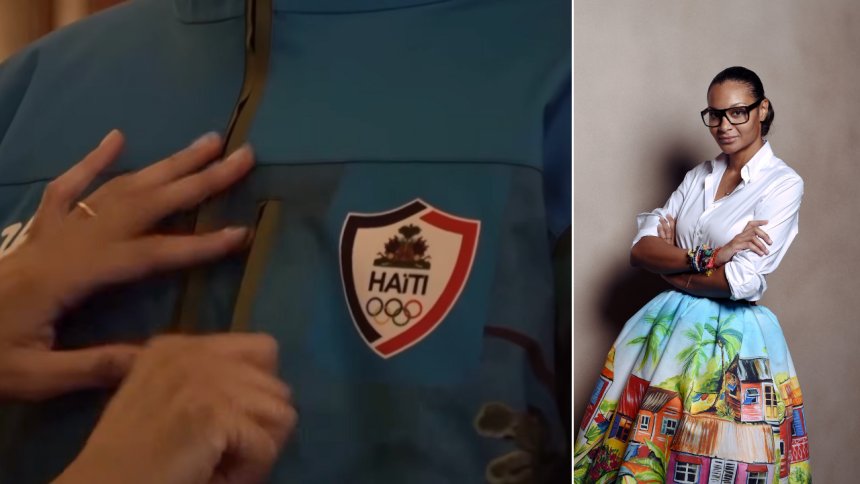
Stella Jean’s Milan-Cortina Winter Olympics designs honor Haiti’s history and global diaspora after Olympic rules forced a creative pivot.
After crafting the viral opening ceremony outfits for Team Haiti during the 2024 Paris Olympics, Haitian-Italian designer Stella Jean is reuniting with the island’s team to create its uniforms for the 2026 Milan-Cortina Winter Olympics.
This year, Team Haiti is comprised of two athletes: Richardson Viano, 23 and Stevenson Savart, 25. Though the team may be small, Jean is ensuring their uniforms reflect the rich culture of the Haitian communities that support them from around the world. In an interview with the Associated Press, the Haitian-Italian designer revealed that the team’s uniforms originally featured an image of Toussaint Louverture, the former slave who led the revolution that established the world’s first Black republic in 1804.
“We have a commitment and a responsibility to convey a message,” Jean told AP News. “There are many messages in this uniform. There is a bit of Haiti’s history, there is a representation of one of the fathers of the nation, Toussaint Louverture, a man feared by the most powerful on earth, such as Napoleon.”
However, after the International Olympic Committee (IOC) flagged the image for violating its rules on the demonstration of political, religious, or racial propaganda at any Olympic site or venue, Jean had to get creative.
“Rules are rules and must be respected, and that is what we have done,’’ she shared, explaining how her team changed the design to remain in compliance.
Inspired by a painting by Haitian artist Edouard Duval-Carrié depicting Louverture riding a red horse, Jean called on Italian artisans to recreate the image without the historical figure. The final kits feature the image of a red riderless horse against a tropical background, with the words “Haiti” across the top. In addition to the men’s uniforms, Jean designed a look for Team Haiti’s women, featuring a Haitian “tignon,” a head turban, which enslaved women were forced to wear to cover their hair.
“For us, it is important that this horse, his horse, the general’s horse, remains. For us, it remains the symbol of Haiti’s presence at the Olympics,” she continued. “We know that in these few meters of cloth, in this uniform, we must concentrate all of history and a message. Therefore, we cannot afford to engage in stylistic exercises.”
“Haiti’s presence at the Winter Olympics is a symbol, is a statement, not a coincidence,’’ Haiti’s ambassador to Italy, Gandy Thomas, added. “We may not be a winter country, but we are a nation that refuses to be confined by expectation. … Absence is the most dangerous form of erasing.’’
Viano, who became Haiti’s first Winter Olympian at the 2022 Beijing Games, echoed Thomas’s sentiments, explaining that their presence in the competition is a way to change the often-negative narratives that surround the Caribbean island. In November 2025, Haiti qualified for the World Cup for the first time in 52 years. And now, Days before Haiti is set to appear in the international winter sports competition, 350,000 Haitian immigrants living in the US celebrated a win in the fight to protect migrants as a judge blocked the Trump administration’s attempt to end their temporary protection status.
Share
What's Your Reaction?
 Like
0
Like
0
 Dislike
0
Dislike
0
 Love
0
Love
0
 Funny
0
Funny
0
 Angry
0
Angry
0
 Sad
0
Sad
0
 Wow
0
Wow
0