David Mills’ poetry excavates American history
The dreams began about 10 years ago. David Mills was giving poetry readings at the African Burial Ground in New York City’s Lower Manhattan neighborhood, where the remains of more than 15,000 free and enslaved people were buried in the 1600s and 1700s. At night, Mills began having vivid dreams in which disembodied voices spoke [...]


The dreams began about 10 years ago.
David Mills was giving poetry readings at the African Burial Ground in New York City’s Lower Manhattan neighborhood, where the remains of more than 15,000 free and enslaved people were buried in the 1600s and 1700s. At night, Mills began having vivid dreams in which disembodied voices spoke to him. He told a friend and mentor, the poet Tim Seibles, who responded:
“Be still and listen. The ancestors want you to tell their story.”
Mills started sleeping with a notebook next to his bed. He wrote down several nocturnal messages that became part of his fourth book, the 2021 poetry collection Boneyarn. That set the stage for his 2025 volume, Unhired Hands, which explores slavery in Massachusetts and New York City’s Queens borough.
Putting dream texts into his books is unusual for Mills; his prodigious output comes primarily through years of research and effort. But the dreams are part of his rare connection to a history that, 250 years after America’s founding, many now in power want to keep buried.
Using extensive study of legal documents, cemetery and ownership records, news accounts, advertisements, and other archival materials, Mills blends archival detail with imagined interior lives, creating a poetry-driven form of historical fiction. Telling the stories in the first person, in verse, invests them with a weight and nobility that our unacknowledged ancestors are usually denied.
On July 4, in Princeton, New Jersey, Mills brings to life another ancestor, Frederick Douglass, with a dramatic reading of his famous 1852 speech “What to a Slave is the Fourth of July?” While not one of Mills’ poems, the reading highlights his skills as a performer, which are in demand on the poetry circuit and urge us to widen our perspective of history.
Luigi Cazzaniga
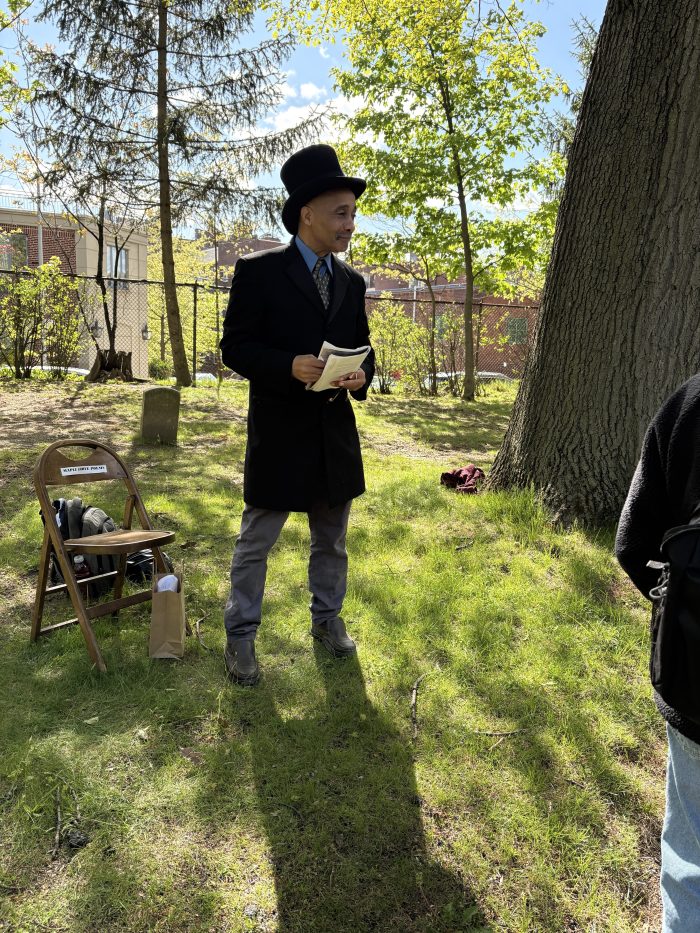
“There’s a whole thing called documentary poetry, and I don’t just want to just live in that,” Mills, a New York City native who grew up in the Bronx, said during a phone interview. “I’m also trying to find something imaginative that makes that individual distinct even beyond the slavery. I have one poem in the voice of a woman who was in the Van Cortlandt slave labor camp, but I imagined that she fell and broke one of her ribs. I didn’t read that anywhere. That became a framing that helped me move through the poem beyond just, ‘Oh, she’s enslaved and she’s harvesting wheat.’”
That approach is central to Unhired Hands, Mills’ most recent book, which explores the lives of three historical figures who are buried in Queens.
One is Martha Peterson, who was born enslaved in Queens a few years before the state of New York outlawed slavery in 1827. In 2011, construction workers accidentally unearthed Peterson’s body, which had been preserved in an iron coffin that was state-of-the-art for its time. Another is Victoria Earle Matthews, born enslaved in Georgia, who became a writer and journalist who founded a mission for Black girls in New York City.
Then there is Millie Tunnell, born into slavery in Virginia, who was emancipated and then purchased the freedom of her six children. She moved to Queens, where she was miraculously reunited with her husband after decades apart. She worked as a domestic for various white families and lived to be about 114 years old. Mills breathes life into Tunnell:
My son John hacked a beer barrel at its
heart, made a washtub where I would go
at some stains with lye soap, pipe clay
to greasy ones, milk to remove
urine and onion juice to bleach, (I
punished ink with sorrel salt) all so
whites could stay white …
“Outside of whatever I try to bring in terms of my imagination, the things I’m very concerned about are the material culture and the diction,” Mills said.
“The diction — like, we say, ‘What’s up?’ They don’t say that. I would look for the phrase that they might use that is equivalent for that time. And then material culture is certain things like the clothes they wore, the food they ate, the alcohol they might drink, what kind of transportation that they use, what kind of paper did they write on?”
Mills is a graduate of Yale University, where I met him in 1987 while pledging Kappa Alpha Psi, which he had joined the previous year.
Over the past four decades, I’ve come to know Mills as an extraordinarily sensitive person, with an artist’s ability to see beyond what most of us discern. He is far from the trope of a poet daydreaming on a riverbank to come up with pretty words; Mills has worked tirelessly to amass the knowledge and skills that he deploys on the page.
He speaks often of history that has been deliberately hidden, and practically bursts with information that he has freed from obscurity — that the first Revolutionary War battle was fought in Brooklyn; Quock Walker’s court case, which helped end slavery in Massachusetts in the late 1700s; how enslaved Africans brought advanced maritime skills to colonial New York City.
“I played sandlot football for the Co-op City Rams, and we played in Van Cortlandt Park in the northwest Bronx. That was one of the largest slave labor camps in the Bronx. Why did I not find this out till like three years ago?” Mills said. “So I have a poem that’s combining, temporally, the innocence and the joy of playing football and winning the game … and that there are actually enslaved bodies literally on that field where we played. You’re just playing football, having fun. You’re Black, you’re Latino; it’s the Bronx. You’re literally walking on this ground where enslaved people both worked and are buried.
“It’s what you know, but you don’t know.”
Toward the end of writing this story, well after interviewing Mills, I asked him what specific lines he brought from dreams to the page. He texted me back:
what we leave the earth
when we leave the earth
is not ours to say
Now that privilege belongs to David Mills.
The post David Mills’ poetry excavates American history appeared first on Andscape.
Share
What's Your Reaction?
 Like
0
Like
0
 Dislike
0
Dislike
0
 Love
0
Love
0
 Funny
0
Funny
0
 Angry
0
Angry
0
 Sad
0
Sad
0
 Wow
0
Wow
0